
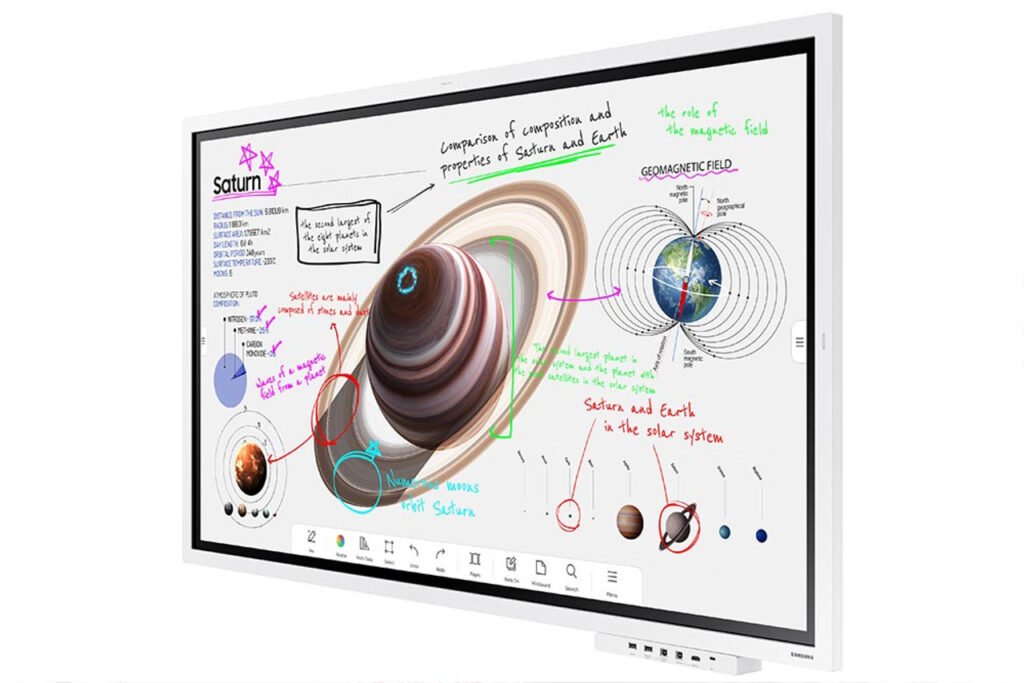
Samsung Flip Pro Interactive Whiteboard: Deployment Guide & Collaboration Ecosystem Overview
Deployment Snapshot — Samsung Flip Pro Interactive Whiteboard
The Samsung Flip Pro is a premium annotation-first collaboration display designed for environments where writing quality, hybrid meeting integration, and daily sustained use are genuine operational requirements — not occasional use cases.
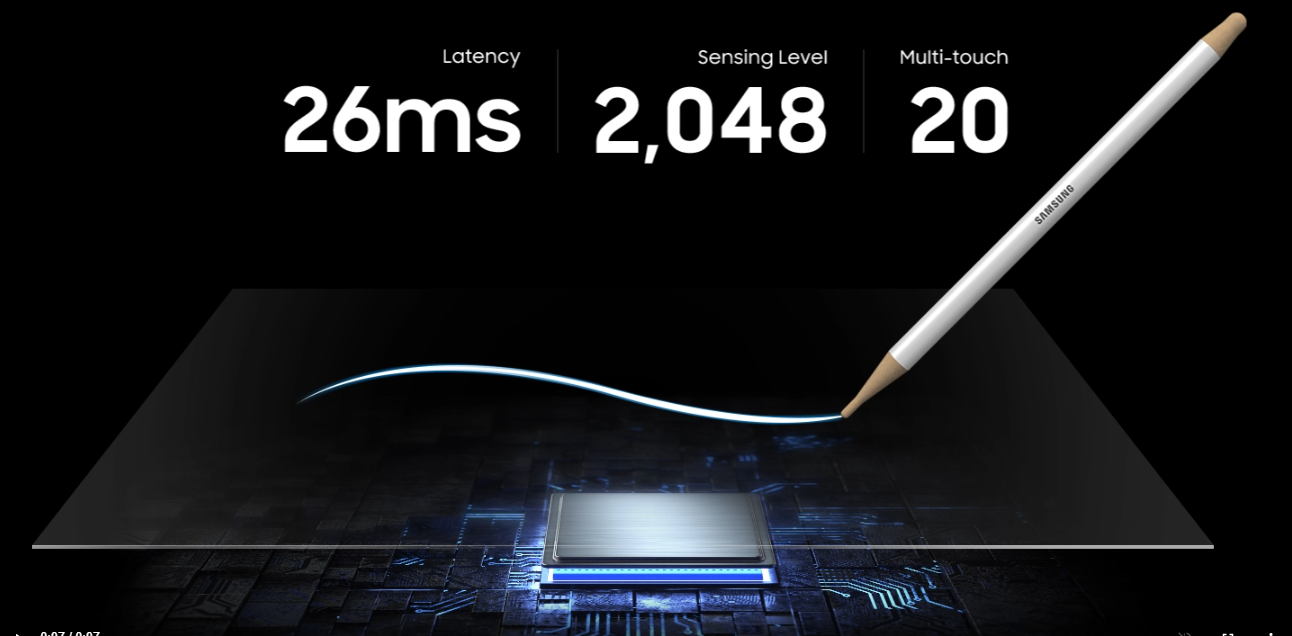
Key differentiators: Optical bonding eliminates parallax for precise pen registration. 26ms touch latency produces a natural writing rhythm. Pressure-sensitive line thickness simulation gives annotation the feel of a real marker rather than a uniform digital stroke. These are not specification talking points — they are the factors that determine whether a display is comfortable to use for forty minutes or two hours of continuous annotation.
Best suited to: Corporate boardrooms, executive meeting suites, university lecture environments, secondary education classrooms with heavy annotation workflows, and any organisation running daily hybrid collaboration via Microsoft Teams, Google Meet, or Zoom.
Samsung WAD E-Board: Serves a different deployment objective — value-conscious rollout across multiple classrooms where broad coverage and cost efficiency outweigh premium writing experience. Not a lesser version of the Flip Pro; a different product for a different brief.
Long-term presenter and teacher fatigue is a real deployment consideration that raw specifications don’t capture. This guide addresses it directly.
Samsung Flip Pro (WMB) Availability Update
Samsung’s WMB Flip Pro generation is now approaching end-of-life status within the Australian channel, with only selected sizes and configurations remaining available through distributors and resellers.
The newer Samsung Flip WMFX generation now represents the current evolution of Samsung’s premium collaboration platform, continuing the WM family lineage:
WM Family: WMA → WMB → WMFX
WA Family: WAD → WAFX
Importantly, Samsung’s newer WMFX and WAFX platforms are not simply different sizes of the same screen. They represent two separate collaboration ecosystems — with the WMFX remaining Samsung’s premium Tizen-based Flip platform, while the WAFX extends Samsung’s Android / EDLA interactive whiteboard ecosystem.
To understand the differences between the older Flip Pro range and the newer WMFX generation, visit our Samsung Flip Pro vs WMFX comparison guide .
You can also explore our broader Samsung Flip Interactive Whiteboards hub for a full breakdown of Samsung’s current interactive display ecosystems, deployment strategies and collaboration platforms.
Evaluating the Samsung Flip Pro Interactive Whiteboard for your classroom, boardroom, or hybrid collaboration environment? This guide covers deployment suitability, writing experience, ecosystem fit, and how the Flip Pro compares within the broader interactive whiteboard landscape.

Ready to purchase? Click the image above to view current pricing and availability.
Quick Deployment Summary
The Samsung Flip Pro is a large-format interactive display built on a commercial Android platform, designed around annotation-heavy collaboration, hybrid meeting integration, and professional presentation workflows. Understanding where it genuinely fits — and where it doesn’t — is more useful than a specification comparison alone.Best suited for: Environments where writing quality, annotation fluidity, and hybrid meeting integration are genuine day-to-day priorities. This includes corporate boardrooms, executive meeting suites, medium-to-large conference rooms, university lecture theatres, and secondary education settings where teachers annotate extensively and expect a display that responds naturally to the pen. It also performs well in any environment already running Microsoft Teams or Google Workspace, where wireless device sharing and session capture are routine workflow expectations rather than occasional extras.How it differs from education-first ecosystems: Platforms like SMART and Promethean have historically been engineered around structured classroom pedagogy — curriculum-aligned lesson tools, school IT management depth, and purpose-built education software. The Samsung Flip Pro takes a different approach, prioritising collaboration fluidity, writing responsiveness, and commercial ecosystem compatibility. For schools that need deep curriculum software integration, dedicated education platforms may still hold advantages. For schools, universities, and businesses that need a display bridging both education and commercial collaboration workflows, the Flip Pro fits more naturally. The Interactive Whiteboard Hub covers Promethean and SMART positioning in more detail for organisations making that comparison directly.Hybrid environment fit: The Flip Pro integrates comfortably with Microsoft Teams, Google Meet, Zoom, and other major conferencing platforms. It supports wireless screen sharing from multiple devices simultaneously and is straightforward to onboard for non-technical users. In environments where hybrid meetings are a daily operational reality rather than an occasional accommodation, the Flip Pro handles the workflow without significant IT overhead.Why writing feel matters more than raw specifications: Touch point counts and latency figures are useful reference points, but they don’t fully capture how a display actually feels to annotate on over an extended session. Optical bonding, parallax reduction, pressure sensitivity simulation, and pen tip response collectively determine whether writing on a large interactive display feels natural or laboured. The Flip Pro has been consistently recognised for prioritising this experience — a distinction that becomes apparent quickly in side-by-side comparisons with lower-tier displays.Samsung WAD vs Flip Pro in brief: Within Samsung’s own display range, the WAD E-Board serves budget-conscious education deployments where core interactivity is required without the premium writing experience. The Flip Pro sits above it for environments where annotation quality, connectivity depth, and hybrid collaboration matter operationally.Samsung’s Role in the Evolution of Collaboration Displays
To understand where the Flip Pro sits today, it helps to understand how the broader market arrived here.For many years, large-format interactive displays in Australian schools and businesses were dominated by specialist education ecosystems — proprietary platforms with purpose-built hardware, dedicated stylus systems, and software suites designed around structured classroom delivery. These platforms were often effective, but they came with significant cost, complexity, and vendor lock-in. Deploying them outside structured education environments was frequently impractical, and the pricing model put them out of reach for most small-to-medium commercial organisations.The gap this created was meaningful: businesses that could genuinely benefit from interactive display collaboration had few accessible options that weren’t either overbuilt for their needs or underpowered for serious daily use. Interactive displays in corporate settings remained a niche adoption, often limited to large enterprises with dedicated AV budgets.Samsung’s entry into this space — most visibly with the original Samsung Flip — helped bridge that gap in a way that mattered commercially. The original Flip was a deliberate departure from the education-first model: a commercially accessible, Android-based collaboration display that focused on making annotation, wireless sharing, and meeting room productivity genuinely straightforward without the specialist integration overhead or ongoing software licensing complexity that characterised the dominant education platforms.Critically, Samsung also prioritised annotation realism earlier than many mainstream commercial display vendors at the time. While some competitors treated touch accuracy and writing feel as secondary to screen size and brightness specifications, Samsung’s development approach for the Flip platform placed writing quality — latency, pen response, and natural interaction feel — as a central product differentiator rather than an afterthought. That emphasis helped establish a different quality expectation for the broader commercial collaboration display category.The result was a meaningful shift in the market. Organisations that had previously found interactive displays either too expensive, too education-specific, or too complex began deploying them across corporate and hybrid environments. The original Flip helped normalise the idea that a large interactive display could be a practical everyday collaboration tool — something a small business, a consultancy, or a training team could adopt without specialist AV infrastructure or dedicated support resources.The Flip Pro built on this foundation with substantially improved writing performance, deeper connectivity, and enterprise-grade management capabilities — moving the platform from an accessible market entry point into a credible premium commercial collaboration solution suited to larger and more demanding deployment environments.Deployment Insight: Understanding this evolution matters for procurement decisions. The Flip Pro isn’t trying to be a SMART Board or a Promethean ActivPanel — it’s solving a different problem. Organisations evaluating it against education-first platforms should assess whether their primary requirement is curriculum-integrated lesson delivery or flexible collaboration across both education and commercial workflows. Those are different briefs, and they point toward different platforms.
Writing Experience and Touch Realism
One of the most operationally significant — and frequently underweighted — factors when evaluating any interactive display is how it actually feels to write on. Specification sheets will report touch latency and touch point counts. They won’t tell you whether annotating for forty-five minutes in a classroom or running a two-hour workshop session feels natural or accumulates fatigue.This distinction matters more than it might initially appear. A display that subtly fights the pen during annotation doesn’t announce the problem — it just slowly makes the experience less comfortable. Teachers and facilitators who use a display as their primary working surface throughout a full day feel this in a way that’s hard to articulate in a procurement meeting but immediately apparent after a week of sustained use.The Flip Pro’s writing performance is underpinned by several technical decisions that, in combination, produce a noticeably different experience from lower-tier interactive displays.Optical bonding eliminates the air gap between the glass surface and the display panel beneath it. The practical effect is that your pen or finger appears to touch precisely where ink appears, rather than registering a few millimetres offset. On displays without optical bonding, this parallax gap is a minor but persistent irritation — particularly noticeable during precise annotation, fine mathematical work, or detailed diagram construction. After extended use it contributes to the subtle frustration that erodes engagement with the display over time. The Flip Pro removes this friction point entirely.Low latency at 26ms means the display registers input quickly enough that ink appears to flow naturally from the pen tip rather than trailing behind it. On higher-latency displays, this lagging effect subtly disrupts writing rhythm. It is one of the primary contributors to presenter fatigue during extended annotation sessions — not because it is dramatically wrong, but because it is slightly wrong, consistently, across every stroke. At 26ms, the Flip Pro sits comfortably within the range where most users describe annotation as feeling natural rather than mechanical.Pressure-sensitive line thickness simulation allows the display to modulate stroke weight based on how firmly the stylus contacts the surface. The result is writing that behaves more like a real pen or marker — lighter strokes produce thinner lines, firmer strokes produce broader ones. This matters most in creative, mathematical, and diagram-heavy workflows where varying line weight communicates meaning. It also makes extended annotation feel less uniform and more intuitive, reducing the cognitive overhead of working with a tool that behaves differently from what the hand expects.Expert Check — Presenter Fatigue: When evaluating interactive displays for annotation-intensive environments, ask to run a live annotation session of at least 20–30 minutes rather than a brief demonstration. The difference between a well-bonded, low-latency display with pressure simulation and a standard display is subtle in a five-minute demo but becomes readily apparent during sustained use. This is the evaluation condition that most closely mirrors real deployment usage.
Core Platform Capabilities
Touch Technology and Responsiveness
The Flip Pro operates with 2,048 points of touch at 26ms latency — figures that position it comfortably within the premium tier of commercial interactive displays. In practical terms, this means the display handles simultaneous multi-user interaction without degrading responsiveness, supports fluid freehand annotation alongside precision tool use, and responds consistently whether you’re working with a fingertip or a fine-tipped stylus.The Miniboard feature — a floating note-taking overlay usable without interrupting the primary canvas — is a small but practically useful addition for environments where participants need to capture asides or secondary annotations during a session. It works reliably and reflects a platform design philosophy oriented around real annotation workflows.Connectivity and Device Integration
The Flip Pro’s connectivity suite is well-considered for modern hybrid environments. USB-C ports support single-cable connection with simultaneous content mirroring, touch passthrough, and 65W device charging — meaning a presenter can connect a laptop, control it via touch, and keep it charged throughout a session without managing a cable cluster. In practical boardroom and classroom deployments, this kind of connection simplicity reduces setup friction and the incidental disruptions that erode session flow.SmartView+ enables wireless content sharing and switching across up to 50 devices simultaneously. For environments running BYOD workflows — increasingly standard in both corporate and education settings — this removes the friction of wired connection management and supports more natural, fluid sharing between participants.Operational Consideration — Hybrid Meeting Setup: The Flip Pro’s wireless sharing capability works well in practice, but hybrid meeting quality depends heavily on camera placement and audio setup, which are separate from the display itself. Budget for a quality USB or Bluetooth conferencing camera and ceiling or tabletop microphone as part of the room deployment cost — the display handles the collaboration surface, but a genuinely functional hybrid room requires the full AV stack.
Display Quality and Environmental Adaptation
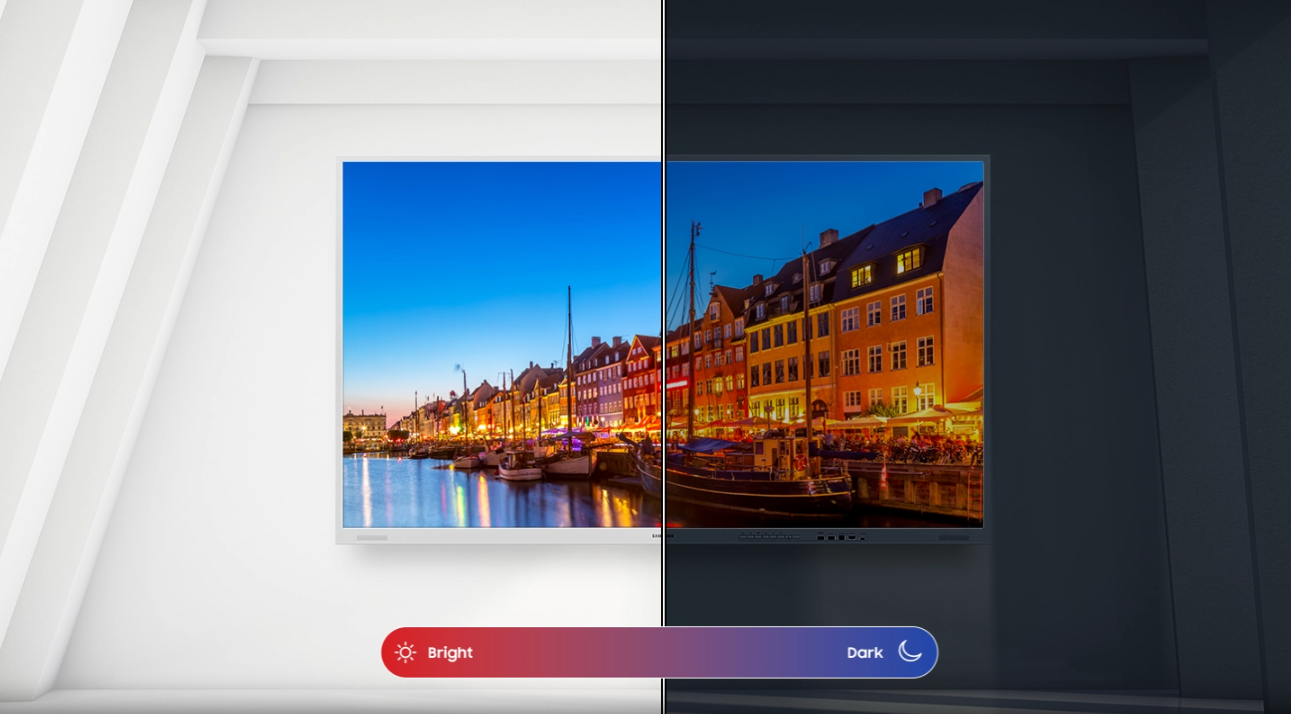
The ambient light sensor automatically adjusts display brightness in response to changing room conditions — straightforward in concept but practically valuable in classrooms and meeting rooms where lighting varies significantly throughout the day. Rooms with natural light variation, or environments where blinds are regularly adjusted, benefit from a display that adapts without manual recalibration.Deployment Insight — Room Brightness: Display brightness and glare management are frequently underweighted in pre-deployment planning. Rooms with windows directly opposite or adjacent to the display — common in school classrooms and open-plan offices — can significantly affect visibility and annotation legibility regardless of display quality. Before finalising screen size and mounting position, assess ambient light conditions at different times of day. The Flip Pro’s auto-adjustment helps, but room layout and blind placement remain important physical deployment variables.
Software Ecosystem and Enterprise Integration
Running on Android, the Flip Pro provides direct access to Microsoft Teams, Google Meet, Zoom, and the broader Android app ecosystem. Microsoft Office 365 integration allows content to be opened, annotated, and saved without requiring a connected PC for standard workflows. Samsung Knox provides enterprise-grade security management — device policy enforcement, remote management capability, and data protection controls that meet most corporate IT governance requirements without additional third-party MDM complexity.For organisations using MagicINFO for broader digital signage and display management, the Flip Pro integrates into the same management infrastructure — a practical advantage for multi-site deployments where centralised device oversight is a genuine operational requirement.Procurement Note — Android SoC vs Windows OPS: The Flip Pro’s native Android platform handles the majority of modern collaboration workflows without a connected PC. For organisations with Windows-specific software dependencies — specialist engineering applications, legacy internal tools, or IT policies mandating Windows device management — an OPS (Open Pluggable Specification) Windows module can be added to the deployment. This changes the cost profile meaningfully and introduces Windows device management overhead alongside the Android platform. It’s worth scoping this requirement explicitly before finalising the deployment configuration rather than adding it as an afterthought post-purchase.
Boxlight MimioConnect
The inclusion of Boxlight MimioConnect provides access to pre-built lesson content and education-focused collaboration tools. For school deployments, this lowers the content preparation burden for teachers transitioning to interactive display-based delivery and adds structured educational utility beyond the core Android platform. For corporate deployments it’s largely peripheral, but for education environments comparing the Flip Pro against dedicated education platforms, it’s a meaningful capability worth acknowledging.Deployment Suitability by Environment
Corporate and Professional Environments
The Flip Pro is well-suited to corporate meeting rooms, boardrooms, and executive collaboration spaces where hybrid meeting capability, wireless sharing, and annotation quality are genuine daily requirements. Organisations running Microsoft Teams as their primary communication platform will find the integration straightforward and the workflow intuitive for non-technical participants. The Samsung Knox security layer satisfies most corporate IT governance requirements without requiring extensive upfront configuration work.For presentation-heavy environments — sales rooms, client-facing spaces, training centres — the display quality and annotation capabilities support dynamic, responsive presentation delivery. The ability to annotate directly over live content, save sessions, and share outputs immediately covers the core workflow requirements of most professional presentation scenarios.Non-technical user adoption tends to be relatively smooth. The Android interface is familiar enough that most participants can connect a device, share a screen, or pick up the stylus and annotate without requiring formal training. This matters operationally — a display that requires IT support for routine daily use creates friction that limits actual adoption regardless of its capability on paper.Expert Check — Corporate Rollout: In multi-room corporate deployments, consistency of user experience across all rooms significantly affects adoption rates. Deploying a mix of display brands or quality tiers in different meeting rooms tends to create user friction as participants adjust to different workflows and interfaces. If the Flip Pro is the right fit for your primary collaboration spaces, extending the same platform to secondary meeting rooms — even at the same tier — typically produces better organisation-wide adoption outcomes than mixing platforms.
Secondary Education and University Settings
In secondary education and university environments, the Flip Pro’s annotation quality is its most operationally significant advantage. Teachers and lecturers who annotate extensively — across mathematics, sciences, design, and engineering disciplines — will notice the difference between a display that supports natural writing and one that works against it. The pressure sensitivity simulation and optical bonding together produce a writing surface that holds up across sustained daily use without the accumulated fatigue that lower-quality displays introduce over time.Teacher comfort over the course of a full teaching day is a practical consideration that rarely appears in procurement discussions but is consistently raised by staff after deployment. A mathematics teacher delivering five annotation-intensive lessons per day experiences the display’s writing quality in a fundamentally different way from someone who uses it for a single weekly presentation. This is the use case the Flip Pro is genuinely built for.Hybrid learning capability is now a standard expectation in most secondary and tertiary environments. The Flip Pro’s support for mainstream conferencing platforms and wireless device sharing means this requirement is met without specialist configuration. For schools that need deeper curriculum software integration beyond what the Android ecosystem and MimioConnect provide, a direct comparison with education-first platforms is worthwhile — the Interactive Whiteboard Hub covers those alternatives in detail.Primary Education
The Flip Pro functions well in primary education settings, particularly where the school is standardising on a consistent display platform across year levels rather than deploying purpose-built primary-specific tools. The intuitive interface reduces onboarding friction for both teachers and younger students. For primary classrooms with strong preferences for curriculum-integrated lesson delivery tools baked into the platform, purpose-built education ecosystems may offer a more structured fit for that specific context.Deployment Insight — Large-Scale School Rollout: For schools deploying interactive displays across many classrooms — particularly primary schools with tight per-room budgets — the Samsung WAD E-Board often represents a more practical deployment logic than the Flip Pro at scale. The Flip Pro’s premium writing capabilities are most valuable in environments with heavy daily annotation use. In classrooms where the display is used primarily for content delivery and occasional interaction, the WAD E-Board’s lower per-unit cost allows broader deployment without meaningful compromise to the core use case.
Healthcare and Specialist Professional Settings
In healthcare review environments, engineering departments, and other settings where high-resolution image display, multi-user simultaneous annotation, and precise interaction are required, the Flip Pro’s display quality and touch performance translate directly. The 75″ and 85″ variants are particularly suited to environments where multiple professionals need to view and annotate content simultaneously.Hybrid Learning and Collaboration Workflows
Hybrid operation — simultaneous in-room and remote participation — is now a standard deployment consideration rather than an edge case. The Flip Pro addresses this through native support for major conferencing platforms and a connectivity suite designed to reduce the practical friction of hybrid session management.Video conferencing via Teams, Google Meet, or Zoom runs directly from the Android platform with a compatible camera mounted to the display. Remote participants can see annotations in real time, view shared content, and participate in collaborative sessions without requiring specialist bridging software. For education environments, this means students participating remotely can follow annotation-based lessons without the content being lost to them. For corporate environments, it means hybrid meetings can use the display as a genuine shared working surface rather than a passive viewing screen for remote participants.Organisations evaluating the Flip Pro specifically for Teams-heavy corporate environments sometimes also consider purpose-built Microsoft Teams Room certified hardware — including the Yealink MeetingBoard — which offers a native Teams Room OS experience as an alternative to Android-based deployment. The operational distinction is worth understanding: the Flip Pro’s Android platform handles Teams alongside Google Meet, Zoom, and general BYOD workflows with strong flexibility; a dedicated Teams Room solution optimises exclusively for the Teams experience with tighter native integration but less versatility outside it. For organisations with mixed conferencing requirements, the Flip Pro’s broader platform coverage is typically the more practical choice.MagicINFO Remote Management allows administrators to push content updates, policy changes, and notifications across all Flip Pro devices within an organisation from a centralised console — a practical operational advantage for multi-room or multi-site deployments where managing devices individually would be prohibitive at scale.Practical Deployment Considerations
A few consistent observations emerge across education and corporate Flip Pro deployments that are worth noting for organisations at the evaluation stage.Onboarding simplicity is a genuine operational strength. The Android interface is familiar enough that basic operation — connecting a device, annotating, sharing a screen — requires minimal training for most users. Staff and teacher adoption tends to happen relatively quickly compared to more complex or proprietary platforms, which matters when deployment return on investment depends on consistent daily use rather than occasional demonstration use. A display that sits unused because staff find it too complex to operate spontaneously is a procurement failure regardless of its technical specification.The writing experience is the differentiator that registers most clearly in hands-on evaluation. Organisations that have compared the Flip Pro against lower-tier displays consistently identify the annotation feel as the most noticeable practical difference. Specifications communicate this imperfectly — the difference between a 26ms low-parallax display with pressure simulation and a standard display is subtle in a five-minute demo but cumulative over a working day. Evaluate it under conditions that resemble actual use.Room sizing matters for model selection. The 55″ WM55B works well in huddle spaces and small meeting rooms but can feel undersized in standard classrooms or larger conference environments. The 75″ WM75B tends to be the most versatile option across mixed education and corporate environments — large enough for standard rooms without the installation constraints of the 85″. The 85″ WM85B is the right choice for large lecture theatres and open-plan boardrooms, but its size and weight make it a fixed-installation decision rather than a portable one. Attempting to move an 85″ display between rooms is not a realistic operational plan.Procurement Note — Multi-Room Deployments: For organisations deploying across multiple rooms, MagicINFO remote management significantly reduces ongoing IT overhead. Device policy updates, software configurations, and content pushes can be managed centrally rather than requiring physical access to each unit. For five or more deployed units, factoring in MagicINFO as part of the deployment architecture from the outset — rather than adding it reactively — avoids the management overhead that accumulates with unmanaged multi-device installations.
Samsung Flip Pro vs Samsung WAD E-Board: Deployment Logic
Within Samsung’s own interactive display range, the Flip Pro and WAD E-Board serve genuinely different deployment contexts. The distinction is operational rather than purely about specifications.The Samsung Flip Pro is the right choice for environments where the quality of the interaction experience is a primary requirement. Annotation-heavy workflows, hybrid collaboration environments, premium meeting rooms, and settings where teachers or presenters use the display as a central working surface throughout the day all justify the Flip Pro’s investment level. The writing experience, connectivity depth, and enterprise integration capabilities are the capabilities you’re paying for.The Samsung WAD E-Board addresses a different brief: budget-conscious education deployments where core interactivity is required at scale without the premium writing experience or connectivity depth of the Flip Pro. For schools rolling out interactive displays across many classrooms on a constrained budget — where the primary requirement is content display and basic annotation rather than advanced collaboration or writing quality — the WAD E-Board delivers functional interactivity at a more accessible per-unit cost. It is not a lesser version of the Flip Pro; it is a different product serving a different deployment logic.It’s also worth acknowledging that some organisations — particularly those balancing premium writing experience against broad rollout affordability — extend their evaluation to value-performance platforms from manufacturers such as ViewSonic and Hisense. These platforms can offer competitive per-unit cost at scale, and in environments where annotation depth and hybrid meeting integration are lower priorities than coverage and cost efficiency, they warrant consideration. The Interactive Whiteboard Hub addresses this tier of the market alongside Samsung, SMART, Promethean, and Yealink for organisations mapping the full landscape.Choosing between them comes down to whether the environment’s primary requirement is premium collaboration and writing quality or cost-effective broad deployment. Both are legitimate objectives. They tend not to be the same objective within the same project.Expert Check — Premium vs Rollout Logic: A common deployment mistake is applying Flip Pro investment logic to rooms where the WAD E-Board would serve equally well, and WAD E-Board logic to rooms where annotation quality genuinely matters. Mapping deployment tier to actual use intensity — rather than buying one tier across the board — typically produces better outcomes and better budget allocation. Flagship rooms with daily heavy annotation use justify the Flip Pro. Rooms used primarily for occasional content display and basic interaction often don’t.
| Feature | Samsung Flip Pro Series | Samsung WAD E-Board |
|---|---|---|
| Primary Deployment Logic | Premium collaboration, annotation-heavy workflows, hybrid environments | Budget-conscious education deployment, value-focused classroom rollout |
| Touch Technology | 2,048 touch points, 26ms latency, pressure simulation | Fewer touch points, higher latency, standard touch response |
| Writing Experience | Optical bonding, low parallax, pressure-sensitive line simulation | Functional annotation, standard touch response |
| Use Case Fit | Corporate boardrooms, hybrid meeting rooms, annotation-intensive education | General classroom display, entry-level business interactivity |
| Software Integration | Microsoft Office 365, Samsung Knox, MimioConnect, MagicINFO | Standard Android app access, simpler management |
| Device Connectivity | USB-C 65W, SmartView+ up to 50 devices | Standard connectivity, fewer simultaneous connections |
| Price Point | Premium investment | Budget-accessible |
| Ideal For | Environments where interaction quality is the primary requirement | Schools and organisations prioritising broad deployment at lower per-unit cost |
Flip Pro Model Comparison
The Flip Pro is available in four screen sizes — 55″, 65″, 75″, and 85″ — covering the range from small huddle spaces to large lecture theatres and training facilities. All models share the same core touch performance and platform capabilities; the differences are primarily about physical scale and the room environments they suit.| Feature | WM55B (55″) | WM65B (65″) | WM75B (75″) | WM85B (85″) |
|---|---|---|---|---|
| Best For | Huddle spaces, small meeting rooms | Standard classrooms, medium conference rooms | Large classrooms, boardrooms, versatile mixed deployments | Lecture theatres, large training centres, auditoriums |
| Screen Size | 55 inches | 65 inches | 75 inches | 85 inches |
| Touch Points | 2,048 | 2,048 | 2,048 | 2,048 |
| Touch Latency | 26ms | 26ms | 26ms | 26ms |
| Portability | Highest — mobile stand optional | High — mobile stand optional | Medium — stand recommended | Limited — fixed installation recommended |
| Optimal Viewing Distance | Up to 5m | Up to 7m | Up to 8m | Up to 10m |
| Power Consumption | Lowest | Moderate | Higher | Highest |
| Price Range | Entry point of the range | Mid-range | Higher investment | Premium investment |
Which Samsung Interactive Display Is Right for Your Deployment?
The Samsung Flip Pro is the right fit when:
- Annotation quality and writing experience are operational priorities, not secondary considerations
- The environment runs hybrid meetings regularly and needs seamless Teams, Meet, or Zoom integration
- Multiple devices need to connect wirelessly and share content simultaneously
- Enterprise security management via Samsung Knox is a governance requirement
- The display will be used as a genuine daily working surface rather than an occasional presentation screen
- The room environment — boardrooms, university settings, annotation-intensive classrooms — justifies the premium investment
The Samsung WAD E-Board is the right fit when:
- The deployment priority is broad classroom rollout at accessible per-unit cost
- Basic annotation and content display are the primary requirements
- Advanced connectivity and premium writing experience are not the central decision criteria
- The organisation is deploying interactivity at scale across many rooms on a constrained budget
- A simpler, lower-management-overhead deployment model is preferred