


In education and corporate collaboration spaces, a display must handle continuous multi-user interaction, deliver reliable touch responsiveness across a classroom or boardroom, and integrate with existing wireless infrastructure. The 86WE3FE addresses these requirements through Android 14 platform maturity, dual WiFi modules for simultaneous network and content-sharing hotspot operation, and infrared touch architecture capable of supporting up to 40 simultaneous touch points.
Key Features
- 40-Point Multi-Touch Input: Support for up to 40 simultaneous touch points means multiple students or meeting participants can annotate, draw, and interact on the display at the same time without input lag or dropped touches. This removes the technical barrier to genuine collaborative work — not just turn-based interaction.
- Android 14 with Google Certification: Google Certification ensures reliable integration with Google Workspace, Classroom, Meet, and other GMS-dependent education and collaboration platforms. Hardware compatibility is validated, reducing deployment friction in schools and enterprises already committed to the Android ecosystem.
- Dual WiFi Modules and Pluggable Architecture: The display can maintain a network connection while simultaneously hosting a content-sharing hotspot, allowing wireless mirroring from student devices or meeting participants without disconnecting from the school network. Independent circuit design and thermal management make the pluggable module more stable and replaceable than integrated alternatives.
- 400 Nits Brightness with Anti-Glare Glass: In brightly lit classrooms or meeting rooms with windows, 400 nits ensures content remains legible without washout. The anti-glare surface reduces reflections and fingerprints while maintaining contrast — critical in high-traffic education and corporate environments.
- 4K Resolution (3840×2160) and 178° Viewing Angle: Classroom-scale deployments require every student to see fine detail and colour accuracy from any position in the room. 4K resolution and wide viewing angles eliminate the need for students to move closer or lose visual clarity from the sides of the room.
- Low Writing Height and Smooth Touch Response: At 1.5mm writing height with 8ms response time, the touch experience approximates writing on paper — critical for maintaining teaching flow during live annotation and reducing the cognitive friction that slows down interactive lessons.
- Built-in Intelligent Whiteboard Software: Formula editor, mind map tools, shape libraries, and handwriting-to-text conversion are included. Four-split screen display capability allows instructors to organize content logically — splitting the screen for side-by-side comparisons, multi-part problems, or collaborative group work.
- Multiple Wireless Content Sharing Standards: Support for AirPlay, Miracast, Chromecast, and webcast means content from teacher laptops, student devices (iOS, Android, Windows), and cloud-based education platforms can be mirrored with low latency. No proprietary app download barriers — standard protocols work out of the box.
- TÜV Rheinland Blue Light Certification: In education environments where students spend 6+ hours daily in front of the display, certified blue light reduction measurably reduces eye strain and headache risk — a genuine operational consideration for all-day classroom deployment.
- Energy Star 8.0 Certification: Significant power consumption reduction compared to competitive displays matters operationally at scale — a school deploying 20–30 displays across multiple campuses realises material facility cost and environmental impact reductions.
Specifications
| Specification | Detail |
|---|---|
| Display Size | 86 inches (diagonal) |
| Resolution | 3840 × 2160 pixels (4K UHD) |
| Brightness | 400 nits (typical) |
| Contrast Ratio | 1200:1 (typical) |
| Colour Gamut | 72% NTSC |
| Display Colours | 1.07 billion (10-bit) |
| Response Time | 8ms (typical) |
| Refresh Rate | 60 Hz |
| Viewing Angle | 178° horizontal / 178° vertical |
| Panel Lifespan | 50,000 hours (typical) |
| Touch Technology | Infrared touch frame, 40-point multi-touch |
| Touch Accuracy | 90% (±1.5mm) |
| Writing Height | 1.5mm |
| Surface Protection | Anti-glare glass panel |
| Operating System | Android 14.0 |
| Processor | Cortex-A73 (4-core), 1.39 GHz maximum |
| GPU | Mali-G52 MC1 |
| RAM | 8 GB |
| Internal Storage | 128 GB |
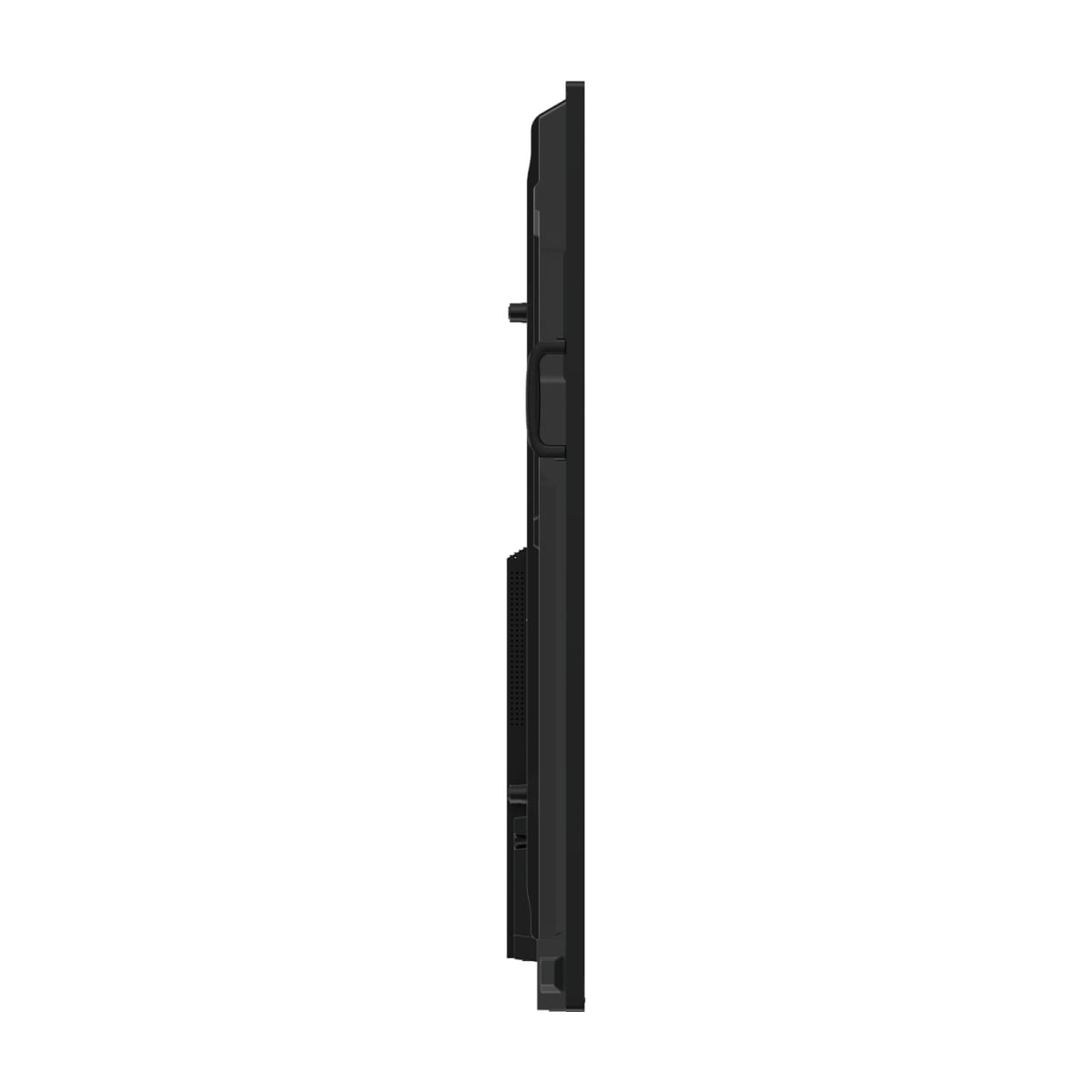
| Dimensions (W × H × D) | 1957 × 1159.9 × 97.1mm (77 × 45.7 × 3.8 inches) |
| Net Weight | 51.0 kg (112.4 lbs) |
| VESA Mount Pattern | 800 × 600mm (4 × M8 screws) |
| Power Consumption (Typical) | 255W |
| Power Consumption (Maximum) | 410W |
| Standby Power | <0.5W |
| Operating Temperature Range | 0–40°C |
| Operating Humidity Range | 20–80% RH |
| Built-in Speakers | 2 × 16W |
| Certifications | Android Google Certified, Energy Star 8.0, TÜV Rheinland Blue Light Certified |
Connectivity
- HDMI 2.1 inputs (×3): Three independent HDMI connections support simultaneous input from multiple source devices — instructor laptop, document camera, and external media player without cable swapping.
- DisplayPort 1.2a input (×1): High-bandwidth alternative input for high-resolution content sources and future-proofing against evolving education technology stacks.
- VGA input (×1): Legacy connection support for older teaching equipment and institutional IT systems still in circulation in schools.
- USB 3.0 (×3) and USB 2.0 (×2): Multiple USB ports support content transfer, peripheral connectivity (wireless keyboards, document cameras), and charging of education devices.
- USB Type-C (×2): Front Type-C port with 65W Power Delivery supports charging and content sharing from modern laptops, tablets, and student devices. Rear Type-C provides additional flexibility.
- WiFi 802.11a/b/g/n/ac/ax (dual-band 2.4G and 5G): Dual-band support with pluggable module architecture ensures stable wireless content sharing, network connectivity, and firmware updates. Simultaneous dual-module operation means network connection persists while hosting a hotspot for device mirroring.
- Bluetooth 5.2: Connects wireless input devices (keyboards, mice, document cameras) and enables audio streaming from mobile devices.
- Ethernet LAN input/output (×2, 1000 BaseT): Wired network option for schools and enterprises requiring hardwired connectivity, centralized management, or settings where WiFi is restricted.
- HDMI output (×1): Pass-through output for daisy-chaining or secondary display applications in hybrid meeting room setups.
- S/PDIF audio output (×1): Digital audio connection for external sound systems in large classrooms or boardrooms requiring distributed audio.
- 3.5mm audio input/output: Analog audio for microphone input, line-level audio sources, and external speaker connections.
- RS-232 serial port (DB9): Legacy control interface for integration with older audiovisual control systems and building management systems still common in institutional deployments.
- TF Card slot (×1): Local media card reader for content import without requiring USB adapter.
- OPS slot (×1, optional): Supports pluggable Windows PC module, allowing the display to function as an all-in-one collaboration system for facilities requiring Windows-based software or legacy application compatibility.
For education facilities and enterprises standardizing on interactive display deployments, review our full range of collaboration and interactive whiteboard solutions to compare form factors, touch technologies, and platform options across different classroom sizes and meeting room requirements in our Interactive Whiteboards collection.