transport-digital-signage
Transport Digital Signage for Airports, Stations & Transit Hubs
Commercial displays for airports, train stations, bus terminals, ferry terminals and transport hubs — high-brightness, continuous-operation panels engineered for the demanding conditions of public transit environments. Samsung and LG transport digital signage displays available with Australia-wide delivery.
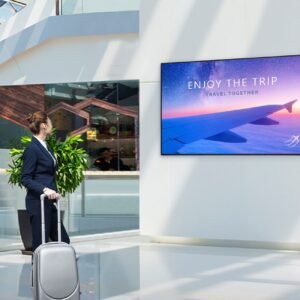
Transport digital signage covers the full range of commercial display applications across public transit infrastructure — departure and arrival boards in airport terminals, platform information displays at train stations, wayfinding screens at bus interchanges, ticketing and service information displays at ferry terminals, and the large-format video walls that anchor major transport hub concourses. What defines this category is the combination of public-facing operation, continuous duty cycles, high ambient light in many locations, and the safety-critical nature of the information being displayed.
The displays in this range are commercial-grade panels rated for 24/7 continuous operation — the standard duty cycle for transport environments that operate around the clock. Airports, major train stations and ferry terminals run signage continuously; even bus terminals and regional stations that close overnight require displays rated for sustained daily operation without the thermal degradation that consumer or standard commercial panels experience under extended duty cycles.
Airports & Terminals
Departure and arrival boards, gate information displays, wayfinding screens, retail and food court signage, and large-format concourse video walls. Mix of indoor controlled and semi-outdoor environments across a single facility.
Train & Metro Stations
Platform information displays, concourse wayfinding, timetable and service alert screens. Often semi-outdoor or exposed to high ambient light — requiring higher brightness ratings than standard indoor commercial panels.
Bus & Ferry Terminals
Service information displays, route and timetable screens, ticketing information and safety messaging. Outdoor or semi-outdoor positions common — requiring IP-rated displays engineered for weather exposure.
Brightness specification in transport environments varies significantly by location within the same facility. An enclosed airport terminal concourse with controlled lighting requires a standard commercial brightness rating — 500 to 700cd/m² is adequate for most indoor airport signage positions. A platform-end display at an open-air train station exposed to direct or indirect natural light steps up to the 700 to 1,000cd/m² high-brightness range. Fully exposed outdoor positions — bus stop displays, forecourt signage and covered but open-sided platforms — require IP-rated outdoor displays rated at 2,500cd/m² or above with full weatherproofing against rain, dust and temperature variation.
Network management and remote monitoring are operational requirements in transport signage that are treated as optional in many other commercial environments. A transport operator managing hundreds of displays across multiple stations or terminal zones cannot physically check each screen for content accuracy or hardware status. Commercial display platforms with network management capabilities — including remote brightness control, content verification, fault alerting and display health monitoring — are the standard specification for transport signage deployments at any meaningful scale.
Transport displays are often viewed from significantly greater distances than retail or corporate signage. A departure board mounted above a concourse may need to remain legible from 20 to 50 metres away — making screen size, font sizing and viewing angle performance just as important as brightness specification. A display that looks sharp at three metres in a showroom can be unreadable at 30 metres in a terminal if the panel size, resolution and content layout haven't been specified with that viewing distance in mind.
Transport industry procurement uses specific terminology that reflects the operational function of each display type. Passenger Information Displays — PIDs — cover the broader category of passenger-facing screens showing service status, timetables and wayfinding. Flight Information Display Systems — FIDS — are the airport-specific equivalent, covering departure and arrival boards in terminal environments. Service Alert Displays handle real-time disruption messaging across a transit network. Understanding which category applies to your installation determines the content management platform, the network architecture and the display hardware specification required.
Large-format display configurations are common in major transport hubs where the concourse scale demands something beyond a single commercial panel. Departure board arrays running multiple tiled screens, video wall installations in terminal concourses and multi-screen information systems at interchange points all draw on the same panel technology as single-screen commercial displays — but require video wall processors, mounting infrastructure and content management platforms capable of handling multi-zone, multi-source output simultaneously.
- Airport departure boards
- Train station platforms
- Bus terminal information
- Ferry terminal displays
- Transit hub wayfinding
- Ticketing information screens
- Concourse video walls
- Service alert displays
- Park & ride signage
- Transport interchange screens
For transport installations in exposed outdoor or semi-outdoor positions — open-air platforms, forecourts, covered interchanges and bus shelters — a fully IP-rated outdoor-rated display is the correct specification rather than a standard commercial indoor panel in an aftermarket enclosure. IP54 or higher ingress protection, wide operating temperature ranges and anti-vandal glass are the baseline requirements for any transport display exposed to weather and unsupervised public contact.
Understanding Transport Digital SignageExposed outdoor and semi-outdoor transport positions — open-air platforms, bus shelters, forecourts and covered interchanges — require fully IP-rated displays engineered for weather, temperature variation and unsupervised public contact. Browse our outdoor-rated display range for those specifications.
Large transport hub concourses, airport terminal departure board arrays and multi-screen interchange installations require video wall configurations — tiled panel arrays with processors capable of handling multi-zone, multi-source content simultaneously.
Transport operators managing control rooms, operations centres and administrative facilities alongside public-facing signage will find that many of the same commercial display specifications apply. Browse our corporate digital signage range for office, operations centre and control room display solutions.
Specifying displays for a transport or transit project?
Call Andrew on 0416 353 501 or send us a message — transport signage projects vary significantly by environment, exposure and duty cycle requirement. Tell us about the installation and we can point you to the right display specification without the guesswork.
Showing 1–16 of 125 results
- Found it cheaper elsewhere? Talk to us first.
 Out of stock
LG 105BM5N – 105″ Stretch Signage
Original price was: $29,166.67.$16,650.00Current price is: $16,650.00. - Found it cheaper elsewhere? Talk to us first.
LG 105BM5P – 105″ Stretch Signage
Original price was: $19,444.44.$15,269.00Current price is: $15,269.00. - Call for Price
- Found it cheaper elsewhere? Talk to us first.
LG 110UM5K 110″ 4K UHD Signage
Original price was: $27,777.78.$14,213.00Current price is: $14,213.00. - Found it cheaper elsewhere? Talk to us first.
LG 22″ 1,500nit FHD Outdoor Digital Signage Display
Original price was: $4,755.88.$3,795.00Current price is: $3,795.00. - Found it cheaper elsewhere? Talk to us first.
LG 37BH7N 37″ Stretch Signage
Original price was: $1,933.33.$1,761.00Current price is: $1,761.00. - Found it cheaper elsewhere? Talk to us first. Out of stock
LG 43UH5J-H computer monitor 109.2 cm (43in) 3840 x 2160 pixels 4K Ultra HD Black
Original price was: $1,483.90.$1,222.90Current price is: $1,222.90. - Found it cheaper elsewhere? Talk to us first. Out of stock
LG 43UH5N-E – 43″ 4K UHD Signage
Original price was: $1,599.00.$1,257.00Current price is: $1,257.00. - Call for Price
- Call for Price
- Found it cheaper elsewhere? Talk to us first. Out of stock
LG 43UH7N-E 43″ UHD Signage
Original price was: $1,527.78.$1,424.20Current price is: $1,424.20. - Found it cheaper elsewhere? Talk to us first.
LG 43UM5N-H 43″ UHD Standard Signage
Original price was: $1,305.56.$989.00Current price is: $989.00. - Call for Price
- Found it cheaper elsewhere? Talk to us first. Out of stock
LG 49UH5N-E – 49″ 4K UHD Signage
Original price was: $1,599.00.$1,388.00Current price is: $1,388.00. - Call for Price
- Call for Price