
Comparing Promethean, BenQ, and SMART Interactive Whiteboards for Australian Schools
Prefer to browse first? Click the banner below to explore our full range of interactive whiteboard solutions.

Not sure which brand to choose when comparing Promethean, BenQ, or SMART interactive whiteboards? Wondering what is an interactive whiteboard exactly? You’re not alone. With so many interactive display options available for Australian classrooms, the SMART vs Promethean vs BenQ decision can feel genuinely difficult — especially when manufacturer marketing rarely gives you a straight answer. That’s why we’ve put together this direct, deployment-focused comparison of the three leading interactive whiteboard brands.
A note on our approach: We’ve drawn on manufacturer specifications and our own hands-on experience deploying all three brands across South Australian schools. Manufacturers naturally emphasise their strengths — we’ll give you the operational realities that matter for a multi-classroom rollout.
Quick Decision Summary: BenQ vs SMART vs Promethean
If you’re a technology coordinator, business manager, or school principal evaluating these three platforms, here’s the practical deployment summary before we get into detail:
| Consideration | BenQ | SMART | Promethean |
|---|---|---|---|
| Best deployment fit | Google Workspace schools; flexible or mixed-platform environments | Schools prioritising intuitive teacher adoption and multi-user collaboration | Schools already running ActivInspire or with existing Promethean investment |
| Software ecosystem | Open Android — works with most platforms including SMART Notebook and ActivInspire | SMART iQ ecosystem; subscription-based; strong Microsoft and Google integration | ActivPanel OS; optimised for ActivInspire; limited flexibility outside the Promethean ecosystem |
| Teacher adoption ease | High — minimal onboarding required for most teachers | High — SMART Ink is particularly intuitive; strong training resources available | Moderate — most rewarding for teachers already familiar with ActivInspire |
| Hybrid learning suitability | Strong — built-in microphone array and broadcast tools included at no extra cost | Strong — iQ platform supports remote student participation via QR code | Limited — ClassFlow has been retired; hybrid features vary by model |
| Long-term IT management | Open architecture simplifies MDM integration and software updates | Managed through SMART Remote Management; subscription costs apply | Proprietary ecosystem requires Promethean account management infrastructure |
| Switching cost risk | Low — existing lesson content from most platforms transfers with minimal rework | Moderate — SMART Notebook lessons are portable but staff retraining is needed if switching from Promethean | High — ActivInspire lesson libraries don’t migrate cleanly to other platforms |
| Pricing tier | $ — generally the most competitive at entry and mid-range | $$ — mid to premium; software subscriptions add to total cost of ownership | $$ — premium hardware; ongoing ecosystem costs to factor in |
The short version: BenQ suits schools running Google Workspace or mixed environments that want flexibility and low onboarding friction. SMART is the strongest choice for schools that prioritise natural writing feel, multi-user collaboration, and have the budget for a well-supported ecosystem. Promethean makes the most sense where staff are already invested in ActivInspire and the school wants to remain within that ecosystem. For schools considering a platform switch, read the switching cost section further down — it’s often the most underestimated factor in the decision.
Introduction to Interactive Whiteboards for Australian Schools
What You’ll Learn in This Comparison Guide
- The key differences when comparing Promethean vs BenQ vs SMART interactive whiteboards for classrooms
- Which interactive display features actually matter when choosing between SMART, Promethean, or BenQ for Australian schools
- How each brand handles multi-user collaboration and cloud integration in real classroom conditions
- Important health and safety features that manufacturers don’t always emphasise in their own comparisons
- The hidden costs of switching platforms — including teacher retraining, lesson migration, and staff adoption
- How to choose the right interactive whiteboard for your specific deployment context and budget
Our Experience with Interactive Whiteboards in Adelaide Schools
Recently, we helped an eastern suburbs Adelaide primary school upgrade from aging projectors to interactive whiteboards across 12 classrooms. Their technology coordinator was working through conflicting information about the differences between BenQ, Promethean, and SMART interactive displays. After walking through the actual deployment considerations — not just the marketing specifications — they made a confident, well-informed decision that matched their teaching environment and budget. The result: teachers who had been cautious about new technology became regular, confident users, and student engagement measurably improved.
That kind of outcome depends on choosing the right platform for the right context. This guide is designed to help you do exactly that.
What Is An Interactive Whiteboard?
Before diving into the detailed comparison, it’s worth clarifying what we’re actually comparing. What is an interactive whiteboard is a question many Australian educators still ask — and the answer matters for deployment decisions. An interactive whiteboard is far more than a large digital screen. It’s a complete teaching and collaboration system that combines touch-sensitive display technology with specialised software to create dynamic, interactive learning environments. When comparing SMART Boards, Promethean ActivPanels, and BenQ Boards, it’s important to understand that these devices allow teachers and students to manipulate digital content, save and share work across devices, and support modes of engagement that weren’t possible with projector-based setups.
For a broader look at the interactive display landscape — including options beyond these three brands — visit our Interactive Whiteboard Hub.
Core Features Comparison: BenQ vs SMART vs Promethean
Interactive Whiteboard Specifications and Technology
When comparing Promethean vs SMART vs BenQ interactive displays, examining core specifications side-by-side is a useful starting point — but the operational implications behind each spec matter just as much as the numbers themselves.
Feature | BenQ Interactive Displays ($) | SMART Interactive Whiteboards ($$) | Promethean Interactive Panels ($$) |
Touch Technology | Fine IR (up to 40 touch points) | HyprTouch (20+ touch points) | Vellum (20 touch points) |
Cloud Whiteboarding | Included — no subscription required | Subscription required for full feature access | Account required; ClassFlow platform retired |
Built-in Microphones | 6–8 microphone array (standard on most models) | Not included on most models | Premium models only |
Anti-Microbial Glass | Yes — TÜV certified | No | No |
Teacher Login Experience | QR code, NFC, Active Directory / Azure / Google Workspace | Manual sign-in on most models; companion app available | Proprietary ActivSync — requires Promethean account |
Software Flexibility | Open Android — compatible with most educational platforms | SMART ecosystem first; supports common third-party apps | ActivPanel OS — optimised for ActivInspire |
Google Workspace Compatibility | Full native support | Supported | Limited — works better in Microsoft environments |
Microsoft 365 Compatibility | Supported | Strong — Teams integration available | Supported |
MDM / Remote Management | Standard Android MDM tools | SMART Remote Management (subscription) | Proprietary Promethean management tools |
Interactive Touch Technology
Touch responsiveness is one of the most important real-world differences between these three platforms — and one that teachers notice within the first week of use.
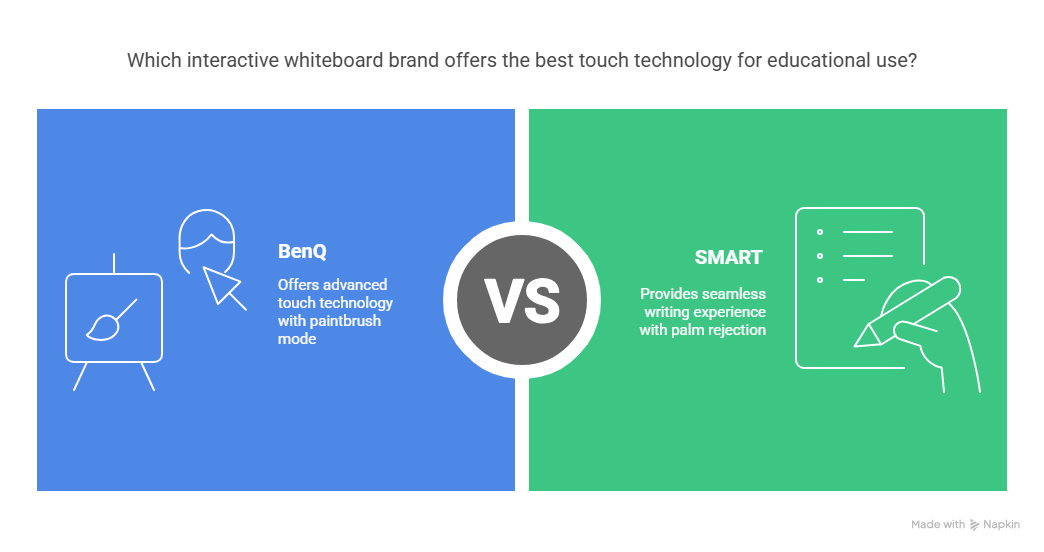
BenQ Interactive Displays use “Fine IR” technology that is optically bonded directly to the glass, supporting up to 40 simultaneous touch points. Their Paintbrush mode recognises real brush widths, which is relevant for art classes and language learning — including handwriting in languages with complex character sets. The result is a writing experience that feels close to natural on most surfaces.
SMART Interactive Whiteboards use their HyprTouch technology with 20+ touch points and intelligent palm rejection. SMART Ink is the standout feature here — it activates the moment a teacher picks up a pen, without requiring any menu navigation. For teachers who move quickly through lessons, this responsiveness matters. SMART’s multi-user differentiation is also particularly strong in collaborative settings.
Promethean Interactive Panels use Vellum touch technology with 20 touch points, delivering a solid and responsive writing experience. The palm eraser recognition works well, and most teachers find the feel comfortable for day-to-day use. Where Promethean’s touch performance tends to fall short is in complex multi-user scenarios, which we’ll cover in the collaboration section below.
Writing Feel: The Operational Difference That Spec Sheets Don’t Capture
Touch point counts and technology names tell you very little about what it actually feels like to write on these boards for six hours a day. Yet writing feel is consistently one of the factors teachers report most strongly when asked about their experience with a new interactive display. It’s also one of the most reliable predictors of whether a board gets used to its full potential or gradually reverts to a basic display screen.
SMART Boards are the benchmark for natural writing feel in this comparison. SMART uses optically bonded glass on their higher-series panels, which eliminates the parallax gap between the display surface and the active touch layer — meaning what you write appears exactly where the pen meets the glass, with no offset. Combined with SMART Ink’s near-zero activation latency, the experience is closer to writing on a whiteboard than any other platform in this category. For teachers who write extensively during lessons — annotating, diagramming, working through problems in real time — this distinction matters more than almost any other specification. If writing feel is your primary criterion, SMART’s premium series panels are difficult to match.
BenQ Interactive Displays use Fine IR technology bonded to the glass, which delivers a responsive and accurate writing experience across the board. Input latency is low, and the Paintbrush mode’s variable stroke width adds a dimension that most other platforms don’t offer. The writing feel on BenQ is consistently rated well by teachers, particularly at the price point — there’s no perceptible lag in normal use, and fine detail work is handled well. Where BenQ falls marginally short of SMART’s premium panels is in the subtle tactile refinement that comes with SMART’s higher-end bonded glass construction.
Promethean ActivPanels deliver a solid and comfortable writing experience through their Vellum touch technology. Day-to-day handwriting and annotation feel responsive, and most teachers adapt quickly. The Vellum surface has a slightly different texture to BenQ and SMART panels, which some teachers prefer — it’s worth noting that writing feel is somewhat subjective, and a hands-on demonstration before purchase is always advisable. Where Promethean’s writing experience occasionally draws criticism is in high-speed annotation on complex diagrams, where the touch processing can introduce minor latency that the other two platforms handle more cleanly.
Practical recommendation: If your school is replacing projector-based setups where teachers have been writing on physical whiteboards for years, the transition to interactive displays involves a period of adjustment regardless of brand. Scheduling a demonstration session with your teaching staff — not just your technology team — before finalising a decision is one of the most effective ways to identify whether a particular panel’s writing feel will support or impede adoption.
Software Compatibility and Ecosystems
Software ecosystem is where the long-term deployment implications of this choice become most visible. It’s also the area where marketing materials are most likely to understate the trade-offs.
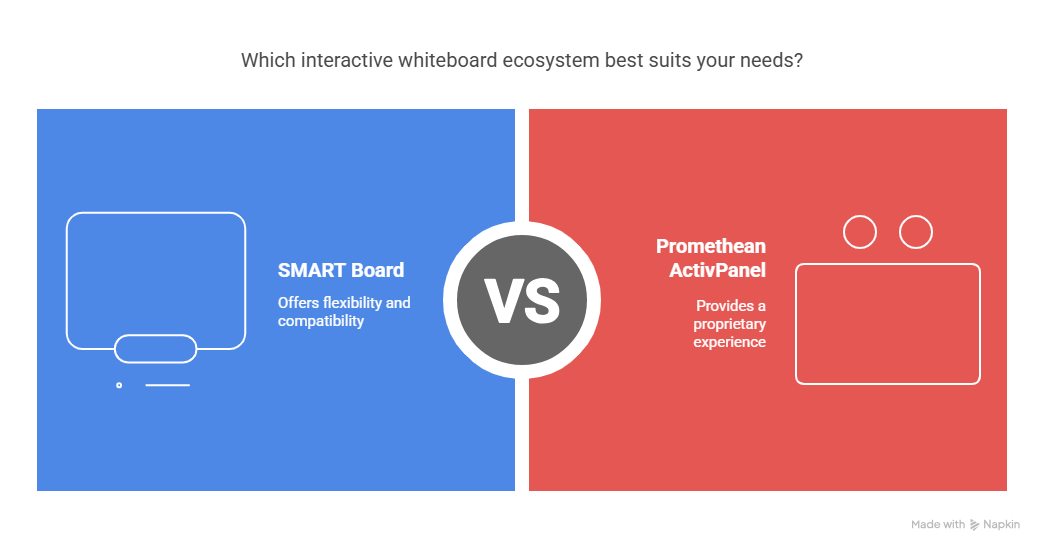
BenQ Interactive Displays run standard Android OS, which means they’re compatible with a wide range of educational platforms — including SMART Notebook, ActivInspire, Google Classroom, and Microsoft tools. For schools in Google Workspace environments, or those running mixed platforms across different year levels, this flexibility has genuine operational value. There’s no proprietary lock-in, and IT teams can manage BenQ devices through standard Android MDM tools. See our guide on Android SoC vs Windows OPS for interactive displays if you’re evaluating platform architecture in more depth.
SMART Boards are built around their iQ ecosystem, and it shows — the integration between SMART hardware, SMART Notebook, and the broader SMART platform is polished and well-supported. They run Android apps and generally work alongside other platforms. However, the full SMART experience — including cloud features and remote management — requires ongoing software subscriptions. Schools in Microsoft 365 environments will find SMART’s Teams integration particularly useful. For a detailed look at the SMART Board lineup itself, our SMART GX vs MX vs RX comparison breaks down the differences between series.
Promethean ActivPanels run ActivPanel OS, which is purpose-built for the Promethean ecosystem and optimised for ActivInspire. For schools that have been using ActivInspire for years, this is a genuine strength — the integration is deep and the experience is cohesive. For schools that aren’t already in the Promethean ecosystem, this same depth becomes a constraint. Running non-Promethean software on ActivPanels is possible, but the experience is less integrated, and some features may be unavailable.
Interactive Classroom Experience and Collaboration
Multi-User Collaboration Features
Multi-user collaboration is one of the most commonly cited decision factors in interactive whiteboard procurement — and one of the areas where real-world performance can diverge most from specification sheets.
SMART Boards are the strongest performers in this category. Multiple students can write, erase, and manipulate objects simultaneously, and SMART’s software differentiates between users in a way that prevents input conflicts. For schools running collaborative learning models, group work rotations, or student-led presentations, this is a meaningful operational advantage.
BenQ Boards offer solid multi-touch support that handles most classroom collaboration scenarios well. The 40-point touch capacity is the highest of the three brands. Where BenQ’s multi-user experience is slightly less refined than SMART’s is in the software layer — user differentiation is less intuitive, and simultaneous object manipulation can occasionally create conflicts. For the majority of classroom use cases, however, this distinction won’t be the deciding factor.
Promethean ActivPanels support multiple simultaneous writers effectively. Where limitations become apparent is when multiple users are attempting to move objects or erase content at the same time — input conflicts occur more frequently than on SMART or BenQ boards. In classroom environments where highly active multi-user collaboration is a daily priority, this is worth factoring into the decision.
Cloud Integration and Device Connectivity
Seamless device connectivity — the ability for teachers to share content to student devices and for students to interact with the board remotely — has become a baseline expectation in modern Australian classrooms, particularly following the widespread adoption of hybrid and blended learning models.
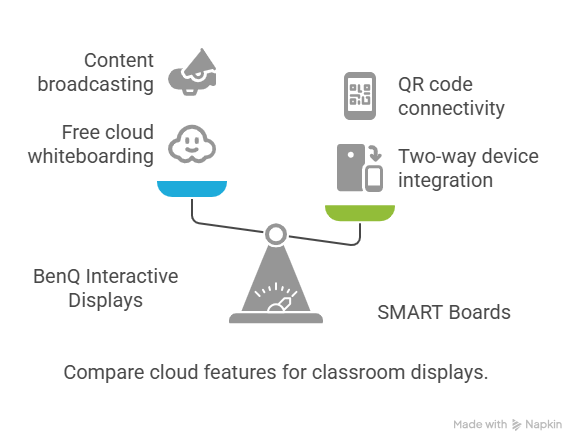
BenQ Interactive Displays include built-in cloud whiteboarding at no additional cost. Teachers can broadcast content to student devices and students can interact with the board remotely from their own devices. The integrated microphone array supports lesson capture without additional hardware, making BenQ a strong option for schools that need hybrid learning capability without per-seat licensing costs.
SMART Boards deliver strong two-way device integration through their iQ platform. Students join via QR code or class ID without needing accounts, which reduces the administrative friction that often undermines classroom technology adoption. The SMART whiteboard app includes integrated image and video search and ready-to-use templates for polls and collaborative activities. The trade-off is that accessing the full feature set requires software subscription investment.
Promethean ActivPanels present the most constrained cloud story of the three. The retirement of the ClassFlow platform has left a gap in Promethean’s device connectivity offering, and what remains is less integrated than the equivalent features on BenQ or SMART. Schools prioritising hybrid learning or regular student-device interaction should weigh this carefully. Advanced cloud features may require additional third-party subscriptions to replicate what the other two platforms include natively.
Lesson Recording and Content Creation
Lesson recording — for absent students, review purposes, or professional development — has become an expected capability in modern interactive display deployments. The ease with which teachers can initiate and manage recordings varies significantly between the three brands.
BenQ Interactive Displays support two-finger tap recording from any application, without requiring additional software or a connected computer. The integrated microphone array captures teacher voice from up to 15 feet, which means recordings are usable without clip-on microphones or additional audio equipment. This is a practical advantage in schools where lesson capture is expected to be a standard part of the teaching workflow.
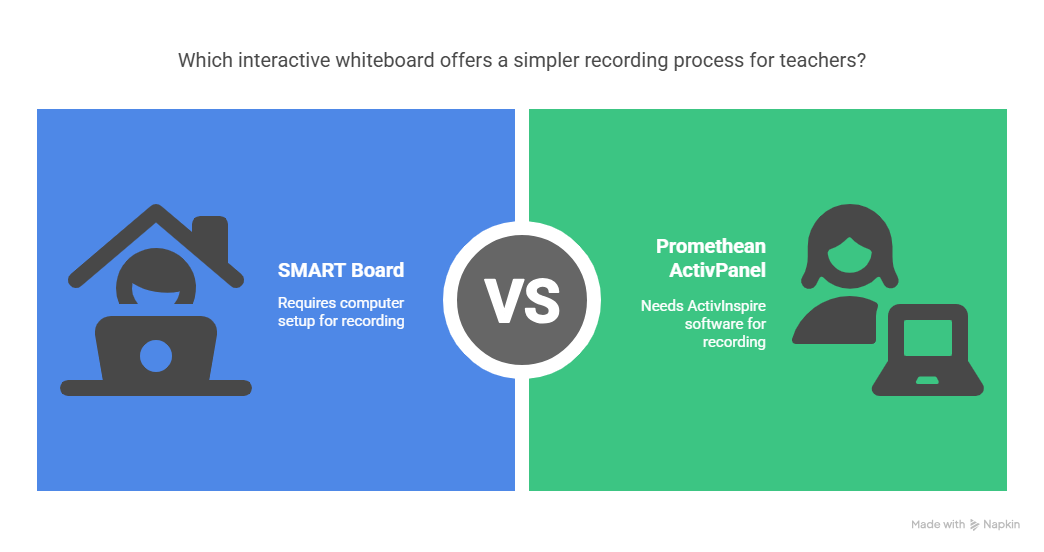
SMART Boards require recording to be initiated through a connected computer on many models. The process works reliably but is not as streamlined as BenQ’s approach. For teachers who record lessons regularly, this additional setup step adds friction that can, over time, reduce how consistently the feature is used.
Promethean ActivPanels require ActivInspire software on a connected computer to record lessons. This is the most involved workflow of the three, and in our experience, it’s the recording approach most likely to be bypassed by busy teachers when time is short.
Practical Considerations: Health, Security, and Long-Term Value
Health and Safety Features
In high-contact shared environments like classrooms, health and safety specifications carry real weight — particularly for school purchasing officers and principals with duty-of-care responsibilities.
BenQ Interactive Displays are the most comprehensively specified of the three brands in this area:
- Antimicrobial coating — TÜV certified, effective against common bacteria including E. coli
- Proximity sensors that reduce blue light emission when users are close to the screen
- Flicker-free backlighting with TÜV certification
- Selected models include air quality, CO2, and particulate monitoring for classroom environments
SMART Boards and Promethean ActivPanels both use tempered, anti-glare glass that is durable and appropriate for classroom use. Neither brand matches BenQ’s antimicrobial certification or proximity-based eye protection features. For schools where hygiene specifications influence procurement decisions, this is a distinguishing factor worth raising with your purchasing committee.
User Authentication and Security
Teacher login experience directly affects daily usability. A board that takes two minutes to set up at the start of each lesson creates friction that compounds across an entire school day.
BenQ Interactive Displays support several fast-login options through their “Tap ‘N Teach” system:
- QR code scan via teacher’s phone
- NFC card tap (compatible with existing staff access cards in many schools)
- Full integration with Microsoft Active Directory, Azure AD, and Google Workspace
- Teacher profile, apps, and network drives load instantly on authentication
SMART Boards require manual sign-in on the display for most models, with a companion app available as an alternative. The experience is functional but involves more steps than BenQ’s approach — particularly relevant in schools where teachers rotate between rooms.
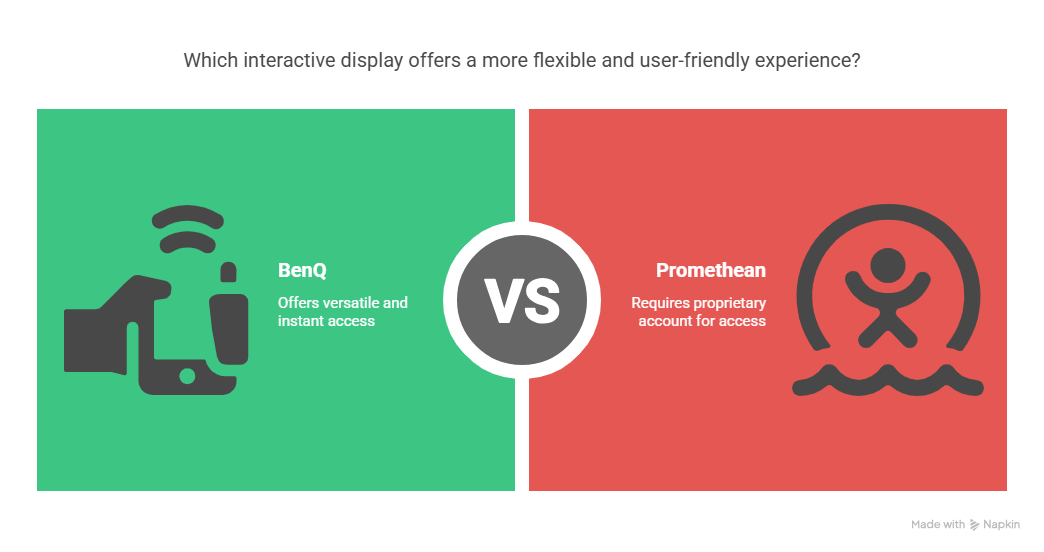
Promethean ActivPanels use ActivSync, which requires a proprietary Promethean account. For schools that have standardised on Google Workspace or Microsoft 365 identity management, introducing a third account system adds IT overhead and creates a friction point for teachers who manage multiple logins across different systems.
The Hidden Cost of Switching Interactive Whiteboard Platforms
One of the most consistently underestimated factors in interactive whiteboard procurement is the true cost of switching platforms. Hardware price comparisons are straightforward — but the operational cost of a platform change is rarely captured in a tender document.
We’ve supported a number of South Australian schools through platform transitions, and the pattern is consistent: the hardware cost is the easy part. What takes longer, costs more, and creates more organisational friction is everything that comes after installation.
Teacher Retraining
A teacher who has spent three years building familiarity with SMART Notebook or ActivInspire has a genuine investment in that platform — not just their lesson content, but their muscle memory, their classroom routines, and their confidence with the technology. Moving to a new platform resets that investment.
In our experience, the teachers most resistant to platform changes are often the most experienced and most effective users of the existing system. That’s not stubbornness — it’s a rational response to losing a tool they’ve mastered. Budget for structured retraining, not just a single professional development day. A half-day introduction to a new platform rarely translates into confident daily use.
Lesson Content Migration
SMART Notebook files (.notebook) don’t open natively in ActivInspire, and ActivInspire files (.flipchart) don’t open natively in SMART Notebook or BenQ’s EZWrite. Schools with large libraries of purpose-built lesson content face a real migration effort — either converting files manually, rebuilding lessons, or running a hybrid approach where legacy content is accessed on the old software while new content is created in the new platform.
The hidden cost here isn’t just staff time — it’s the temporary reduction in lesson quality while teachers are rebuilding their resource libraries. For schools with 20 or more classrooms, this transition period can extend across an entire academic year.
Staff Adoption Resistance
Even when hardware is installed and training is delivered, adoption is never guaranteed. Teachers who are unconvinced of the benefit of a new platform will find workarounds — using the new board as a basic display while continuing to teach the way they always have. This is an expensive outcome, and it’s more common than technology coordinators usually anticipate at the procurement stage.
Adoption resistance is most common in three situations: when teachers weren’t involved in the decision; when training was delivered too far in advance of installation; and when the new platform requires more steps to do things teachers could already do quickly on the old one. All three situations are avoidable with the right procurement and implementation process.
Workflow Disruption
Interactive whiteboards sit at the centre of classroom workflow — lesson delivery, student activities, assessment tools, content sharing, and increasingly, hybrid participation. A platform change doesn’t just affect how teachers write on a board. It affects how they prepare lessons, how they share content with students, how they manage classroom activities, and how they integrate with the school’s broader digital tools.
For schools considering a move away from Promethean — particularly those with deep ActivInspire library investment — we’d strongly recommend a structured pilot of at least one semester in a small number of classrooms before committing to a full rollout. The SMART and BenQ ecosystems are both strong, but the transition needs to be managed, not just installed.
If you’re evaluating the Promethean vs SMART decision specifically, our dedicated guide on Promethean vs SMART Board for Australian schools covers that comparison in detail.
Future-Proofing Your Investment
When committing to a multi-classroom interactive whiteboard deployment, the 7–10 year hardware lifespan means you’re not just choosing a display — you’re choosing a software ecosystem, a management infrastructure, and a set of constraints that will shape your school’s technology environment for the better part of a decade.
BenQ Interactive Display’s Future Outlook
- Open Android architecture simplifies compatibility with future applications and platforms
- No proprietary software dependency reduces vendor lock-in risk
- USB-C and wireless connectivity maintain compatibility with emerging student devices
- Standard MDM tools reduce IT management overhead as the fleet ages
SMART Board’s Future Outlook
- Regular software updates and a well-resourced developer ecosystem
- Strong backward compatibility history with older SMART hardware
- Subscription model funds continuous platform development
- Deep integration with Microsoft 365 and Google Workspace positions SMART well in either environment
Promethean ActivPanel’s Future Outlook
- Strong established presence in Australian schools provides continuity incentive
- Focused education positioning means features are designed specifically for classroom contexts
- Proprietary ecosystem depth is an advantage for committed Promethean schools — and a constraint for everyone else
- The retirement of ClassFlow has created some uncertainty around the cloud roadmap that prospective buyers should clarify directly with Promethean
Deployment perspective: BenQ offers the most flexibility and lowest vendor lock-in risk, which is valuable in environments where the technology strategy may evolve. SMART and Promethean offer more tightly integrated education ecosystems — which is genuinely valuable if those ecosystems align with your school’s direction, but carries more switching cost if your needs change.
Interactive Whiteboard Comparison Guides
If this comparison has raised questions about adjacent platforms or you’re evaluating interactive displays beyond the BenQ, SMART, and Promethean shortlist, the following guides may be useful:
- Interactive Whiteboard Hub — browse the full range of interactive display options available through Kickstart Computers
- Interactive Whiteboard for Classroom — full platform decision overview for Australian schools, covering ecosystem choice, writing feel, rollout planning, and total cost of ownership
- SMART Board GX vs MX vs RX — if SMART is on your shortlist, this guide helps you choose the right series for your school’s budget and requirements
- Promethean vs SMART Board — a deeper head-to-head for schools deciding between these two specific platforms
- Samsung Flip Pro vs WAD eBoard — if you’re considering alternative interactive display options for smaller rooms or meeting spaces
- Samsung Flip Pro vs Yealink MeetingBoard — useful for schools evaluating Microsoft Teams Rooms integration or staff collaboration spaces
- ViewSonic ViewBoard vs Hisense GoBoard — best-value commercial display options for budget-conscious deployments
- Android SoC vs Windows OPS — understanding the platform architecture decision and its implications for IT management and software compatibility
Making Your Decision: Which Interactive Whiteboard Is Right for You?
Interactive Whiteboard Brands Compared
Each brand has clear strengths — and the right choice depends on deployment context, existing infrastructure, and staff capability, not just hardware specifications.
Choose BenQ Interactive Displays if: your school runs Google Workspace, needs flexible software compatibility across platforms, wants built-in hybrid learning tools without subscription costs, or is deploying at scale and needs to minimise long-term IT management overhead. BenQ’s antimicrobial certification is a genuine differentiator for schools where hygiene specifications influence procurement.
Choose SMART Boards if: writing feel and multi-user collaboration are central priorities, your school is in a Microsoft 365 environment, or you want the most mature and comprehensively supported interactive whiteboard ecosystem available. SMART’s backwards compatibility record also means hardware investment is well-protected over a 7–10 year deployment cycle.
Consider Promethean ActivPanels if: your school is already running ActivInspire and teachers have built lesson libraries within that ecosystem. Staying within the Promethean platform avoids the switching costs described above. For schools entering fresh, weigh whether the ecosystem depth justifies the reduced flexibility relative to BenQ or SMART.
At Kickstart Computers, we work with all three brands across South Australian schools and recommend based on your deployment context — not vendor preference. We also supply the Samsung Flip Pro, WAD eBoard, and Yealink MeetingBoard for schools with requirements that fall outside the standard classroom interactive whiteboard category.
Frequently Asked Questions — Promethean vs BenQ vs SMART Interactive Whiteboards
What is the biggest difference between Promethean, BenQ, and SMART interactive whiteboards?
The biggest difference is ecosystem philosophy. SMART focuses heavily on premium collaboration and writing experience, Promethean focuses on education ecosystem continuity and teacher familiarity, while BenQ prioritises flexibility, value, and broad classroom compatibility. The best choice depends less on raw specifications and more on how your teachers and students interact with technology daily.
Is it difficult to switch from one interactive whiteboard brand to another?
It can be. The hidden cost of changing platforms is often teacher retraining, lesson migration, and workflow disruption rather than the hardware itself. Schools heavily invested in SMART Notebook or Promethean ActivInspire may face significant operational friction when switching ecosystems, even if the new display offers improved hardware specifications.
Which interactive whiteboard is best for Australian schools?
There is no universal “best” platform for every school. SMART is often chosen for premium writing experience and collaboration workflows, Promethean remains strong in schools already invested in the ActivInspire ecosystem, and BenQ is frequently selected for flexible classroom deployments with strong value positioning. The right choice depends on teacher familiarity, IT infrastructure, and long-term deployment strategy.
Do these interactive whiteboards require a dedicated classroom PC?
Not always. Modern interactive displays from SMART, Promethean, and BenQ include integrated Android-based operating systems capable of handling annotation, web browsing, cloud access, and classroom collaboration without requiring a separate PC. However, schools running specialised Windows applications or full desktop teaching environments may still benefit from OPS PC integration.
Which platform is easiest for teachers to learn?
Teacher familiarity usually matters more than technical complexity. Schools already using SMART Notebook or Promethean ActivInspire often find continuing within the same ecosystem reduces onboarding friction significantly. BenQ’s interface is generally considered flexible and approachable, particularly for schools already using Google Workspace environments.
Do I need to connect a computer to use these interactive displays?
All three interactive whiteboard brands function as standalone devices with built-in Android systems. No computer is required for basic functions, though connecting a computer expands capabilities and allows use of specialized software.
What’s the warranty coverage like for interactive whiteboards?
BenQ Interactive Displays: Typically 3-5 years depending on the model, with options for extension.
SMART Boards: Generally 3 years for hardware, with subscription-based software support.
Promethean ActivPanels: Usually offers 3-5 years depending on model and region.
At Kickstart Computers in Adelaide, we provide local warranty support for all interactive whiteboard brands we sell, making repairs and replacements much smoother than dealing directly with manufacturers.
What is the difference between Android SoC and Windows OPS in interactive displays?
Android SoC (System on Chip) platforms provide integrated functionality directly within the display, including whiteboarding, cloud access, and Android applications without requiring a separate PC. Windows OPS modules effectively turn the display into a full Windows computer, allowing schools to run desktop applications, domain logins, and specialised curriculum software directly from the panel.
Which interactive whiteboard platform is best for hybrid learning and collaboration?
All three brands now support hybrid learning environments, but they approach collaboration differently. SMART typically focuses on premium collaboration workflows and software integration, Promethean prioritises education continuity and classroom familiarity, while BenQ often appeals to schools seeking flexible device integration and broader classroom collaboration capability. The best deployment depends on whether collaboration, software familiarity, or deployment scalability is the primary operational priority.
Making the Right Interactive Whiteboard Decision for Your School
Choosing between Promethean, BenQ, and SMART interactive whiteboards is ultimately less about selecting a “winner” and more about identifying which platform aligns best with your school’s existing teaching workflows, software ecosystem, collaboration style, and long-term deployment strategy.
SMART continues to lead in premium collaboration and writing experience, Promethean remains deeply embedded within many education environments through ActivInspire familiarity, and BenQ offers a flexible, value-oriented platform with strong classroom versatility and broad compatibility.
For many Australian schools, the real decision often comes down to operational factors that specification sheets rarely explain clearly — including teacher onboarding, lesson migration, hybrid learning requirements, Google Workspace integration, Microsoft compatibility, long-term IT management, and the hidden costs of changing ecosystems.
At Kickstart Computers, we work with interactive display deployments across education, corporate, and commercial environments throughout Australia and help organisations evaluate which platform best suits their real-world operational requirements — not just marketing specifications.
Beyond SMART, Promethean, and BenQ, many organisations are also evaluating newer collaboration-focused platforms including the Samsung Flip Pro, Samsung WAD eBoard, Yealink MeetingBoard, and Google EDLA-certified Android interactive displays as hybrid learning and collaboration requirements continue evolving.
Need Advice on Interactive Whiteboards?
If you’re planning an interactive whiteboard deployment for your school, training environment, meeting room, or hybrid collaboration space, Kickstart Computers can help you compare platforms based on classroom suitability, collaboration requirements, ecosystem compatibility, and long-term operational fit.
Call 0416 353 501 or email sales@kickstartcomputers.com.au to discuss the right interactive display solution for your organisation.
This article combines manufacturer specifications, deployment experience, classroom workflow considerations, and real-world operational observations gathered from interactive display deployments across Australian education and commercial environments.