
Kickstart Computers has been supporting Australian businesses with commercial technology solutions since 2007, supplying commercial digital signage displays, video walls, interactive displays, digital menu boards, and business signage solutions across Australia for retail, hospitality, education, healthcare, corporate, and public-facing commercial environments.
Commercial display solutions are available across leading manufacturers including Samsung, LG, Philips, Sharp, BenQ, Sony, Hisense, Soniq, and other business-grade commercial signage platforms depending on deployment requirements, brightness capability, signage ecosystem compatibility, and overall project suitability.
Australia-wide commercial display supply and delivery is available, with access to selected supplier showroom demonstrations and commercial display solutions that can often be supplied preconfigured for straightforward deployment without requiring complex dedicated AV installation services.
Jump Ahead Too
ToggleCommercial Signage Quick Takeaways
- Supporting Australian businesses since 2007 with commercial technology, business display, and digital signage solutions
- Australia-wide commercial display supply and delivery available across retail, hospitality, education, healthcare, and corporate environments
- 500–700 nit commercial displays commonly suit most indoor retail, hospitality, and business communication environments
- 1500+ nit brightness capability is often recommended for shopfront window displays and higher ambient light environments
- Commercial digital signage displays are engineered for extended 16/7 and 24/7 business operation compared to standard consumer televisions
- IPS, VA, QLED, OLED, and Direct View LED technologies can vary significantly depending on viewing angle performance, brightness capability, deployment suitability, and commercial pricing
- Ultra-thin bezel video wall systems often require specialised commercial engineering, synchronisation capability, and precision panel alignment
- Selected supplier showroom demonstrations may be available for certain commercial display solutions depending on deployment requirements
- Many commercial signage deployments can often be supplied preconfigured and ready for straightforward installation without requiring complex dedicated AV deployment services
Understanding Commercial Digital Signage Displays
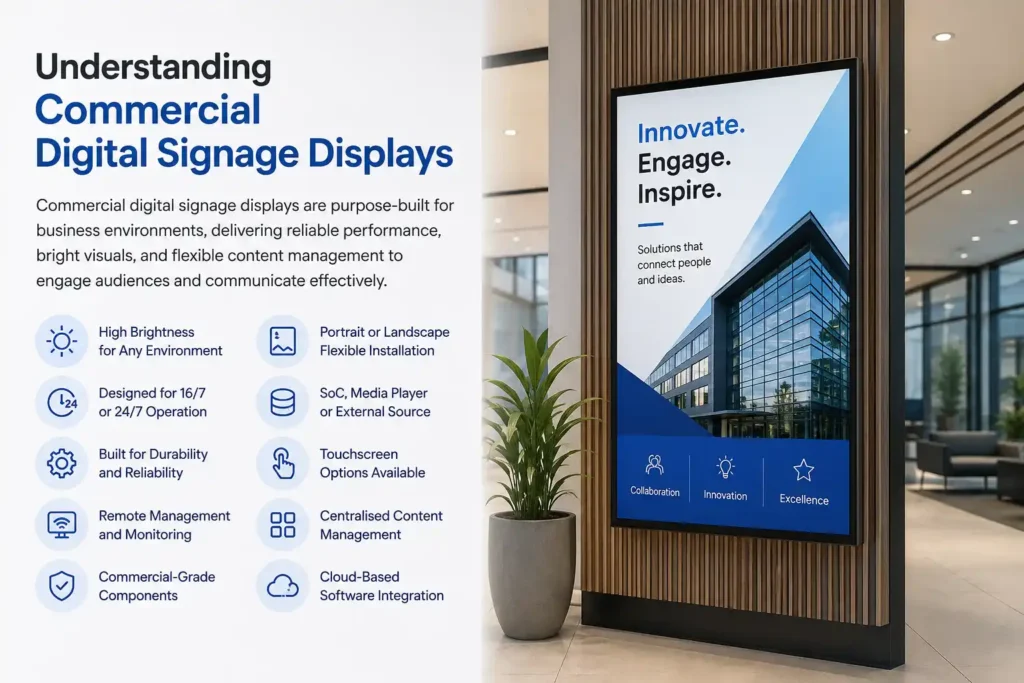
Commercial digital signage displays are specifically designed for business environments requiring professional-grade reliability, extended operating hours, higher brightness performance, and flexible content management capability across retail, hospitality, education, healthcare, corporate, and public-facing environments.
Many businesses researching commercial digital signage are often trying to understand the real-world differences between:
- 500 nit vs 700 nit commercial displays
- Samsung vs LG vs alternative commercial display brands
- consumer televisions vs commercial signage displays
- IPS vs VA vs OLED panel technologies
- 16/7 vs 24/7 commercial operating ratings
- indoor vs shopfront window brightness requirements
- integrated SoC platforms vs external media players
While many commercial displays may appear similar online, pricing can vary significantly depending on factors such as brightness capability, panel technology, thermal management systems, commercial operating ratings, bezel engineering, signage ecosystems, remote management functionality, and long-term deployment suitability.
Unlike standard consumer televisions, commercial digital signage displays are engineered specifically for professional business environments where displays may operate for extended periods throughout the day while supporting commercial signage software, portrait orientation, remote management capability, and customer-facing communication systems.
Modern commercial signage deployments can also vary considerably depending on:
- brightness requirements
- operating environments
- commercial operating schedules
- touchscreen functionality
- portrait or landscape installation
- content management requirements
- remote management capability
- System on Chip (SoC) functionality
- indoor and outdoor visibility requirements
- future scalability requirements
For many businesses, understanding these differences early can help avoid under-specifying a commercial signage deployment or unnecessarily overpaying for functionality that may not be required within the intended environment.
Kickstart Computers supplies commercial digital signage displays Australia-wide across leading manufacturers including Samsung, LG, Philips, Sharp, BenQ, Sony, Soniq, and other commercial display brands depending on project requirements, deployment environments, and current supplier availability.
In many cases, commercial signage displays can often be supplied preconfigured and ready for straightforward deployment without requiring complex dedicated installation services, particularly when businesses have a clear understanding of both their current requirements and future signage goals from the beginning.
If you've already done your research and are ready to browse the range, we've tagged all commercial digital signage displays so you can go straight to the products — browse the full digital signage display range here.
Why Commercial Digital Signage Pricing Can Vary Significantly
Many businesses researching commercial digital signage displays are often surprised by how dramatically pricing can vary between seemingly similar commercial display models.
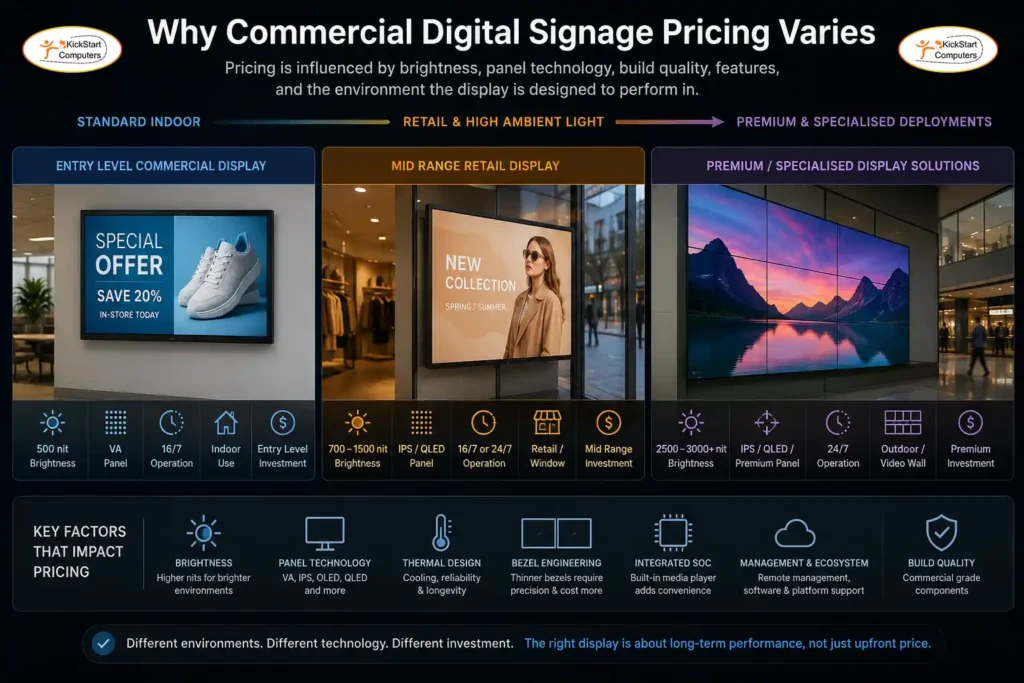
While two commercial displays may appear comparable online based purely on screen size and resolution, significant differences can exist depending on brightness capability, commercial operating ratings, panel technology, bezel engineering, signage ecosystems, and long-term deployment suitability.
Commercial display pricing can commonly be influenced by factors such as:
- 500 nit vs 700 nit vs ultra-high brightness capability
- 16/7 vs 24/7 commercial operating ratings
- VA, IPS, OLED, QLED, and commercial display technology differences
- indoor vs outdoor deployment requirements
- thermal management and cooling system design
- touchscreen functionality
- ultra-thin bezel video wall engineering
- integrated System on Chip (SoC) functionality
- remote management and signage software compatibility
- manufacturer ecosystem and enterprise platform support
Brightness capability can also heavily influence pricing.
Commercial display brightness commonly progresses through several typical deployment tiers depending on the intended environment:
- 250–350 nit — standard consumer television brightness
- 500 nit — typical indoor commercial signage environments
- 700 nit — brighter retail and high ambient light environments
- 1500 nit — shopfront window displays and higher visibility applications
- 2500 nit — outdoor and direct sunlight commercial environments
- 3000+ nit — ultra-high brightness specialised outdoor signage deployments
A standard indoor 500 nit commercial display designed for basic retail promotions may differ significantly in price compared to a 700 nit or ultra-high brightness commercial panel designed for direct sunlight shopfront environments requiring more advanced cooling systems, reinforced commercial components, and higher long-term thermal reliability.
Panel technology itself can also significantly influence both pricing and deployment suitability.
VA panel commercial displays are commonly regarded as a cost-effective commercial signage entry point and are often well suited to many standard retail, hospitality, and business communication environments.
IPS commercial panels, however, are often designed to provide improved colour consistency and wider viewing angle performance across the entire display surface — particularly important within environments where content may be viewed from multiple angles or across larger commercial spaces.
OLED commercial displays are commonly positioned within the premium end of the market, prioritising exceptional contrast, deep blacks, and higher-end visual presentation capability for specialised commercial environments.
QLED commercial display technology is commonly associated with enhanced colour vibrancy and higher brightness capability, particularly within premium commercial display environments where visual impact and brightness performance are prioritised.
Historically, some premium display technologies such as IPS panels were often primarily associated with professional environments including graphic design, photography, and colour-critical workflows due to the significantly higher manufacturing costs compared to more affordable panel technologies available at the time.
Even today, differences in panel technology can still contribute significantly to commercial display pricing depending on the intended deployment environment, brightness requirements, and visual performance expectations.
Video wall bezel engineering can also dramatically impact pricing between commercial display models.
For example, a standard commercial signage display with a thicker bezel may appear visually similar online to a specialised ultra-thin bezel video wall panel, while in reality the engineering tolerances, panel alignment precision, synchronisation capability, and seamless visual integration requirements can differ substantially.
As bezel gaps reduce toward micro-thin commercial video wall configurations, manufacturing complexity and deployment precision can increase considerably — often resulting in significant pricing differences between seemingly similar commercial display solutions.
Different manufacturers also position themselves differently within the commercial signage market. Premium commercial display ecosystems from manufacturers such as Samsung and LG may offer advanced signage platforms, enterprise management capability, ultra-high brightness technologies, and specialised commercial deployment features, while other manufacturers may focus more heavily on value-driven business signage solutions depending on the intended environment and project requirements.
Understanding these differences can help businesses better compare commercial signage solutions based on long-term deployment suitability rather than relying solely on basic specifications or upfront pricing comparisons.
Commercial Digital Signage Categories
Different commercial display environments often require different signage technologies, brightness capabilities, mounting configurations, and content management approaches depending on the intended business application.
Browse the digital signage categories below to explore commercial display solutions designed for retail stores, hospitality venues, education environments, corporate workplaces, customer engagement, and public-facing communication systems.

Digital Signage Displays
Commercial signage displays designed for retail promotions, reception areas, internal communication, hospitality venues, and customer-facing business environments requiring reliable day-to-day operation.

Video Walls
Large-format multi-display commercial video wall solutions designed for immersive visual communication, command environments, retail experiences, public engagement, and premium commercial deployments.

Digital Menu Boards
Dynamic commercial menu board systems designed for hospitality environments requiring flexible content scheduling, promotional updates, customer visibility, and modern digital communication.

Outdoor Digital Signage
Weather-resistant outdoor commercial signage solutions engineered for public communication, advertising visibility, transport environments, shopfront exposure, and high-brightness outdoor deployments.
Interactive Digital Signage
Interactive touchscreen commercial display systems designed for collaboration, education, wayfinding, customer engagement, and business environments requiring real-time user interaction.
Digital Kiosk Solutions
Self-service and interactive kiosk display solutions for retail, hospitality, healthcare, and public-facing business environments across Australia.
Commercial Displays vs Consumer Televisions
While commercial digital signage displays may visually resemble standard consumer televisions, they are engineered very differently internally to support professional business environments, extended operating schedules, and commercial deployment requirements.
Commercial displays are specifically designed for environments where reliability, brightness performance, content management flexibility, and long-term operational stability are critical.
| Commercial Digital Signage Displays | Standard Consumer Televisions |
|---|---|
| Designed for 16/7 or 24/7 operation | Typically designed for residential viewing hours |
| Higher brightness options available | Lower brightness designed for home environments |
| Portrait and landscape orientation support | Primarily landscape-only operation |
| Commercial warranty coverage | Residential warranty limitations |
| Integrated signage management compatibility | Limited signage functionality |
| Improved thermal management systems | Not designed for extended commercial operation |
| Remote management and monitoring support | Limited or unavailable remote management |
| Designed for static content environments | Greater risk of image retention in commercial usage |
While consumer televisions may appear attractive from a pricing perspective, long-term commercial usage can often expose limitations relating to brightness performance, heat management, operating schedules, signage software compatibility, warranty support, and overall reliability within business environments.
For many businesses, selecting the correct commercial digital signage display from the beginning can help reduce long-term replacement costs, minimise operational downtime, and provide a more professional customer-facing experience.
Trusted By Businesses Across Australia
Businesses across Australia rely on Kickstart Computers for commercial digital signage displays, sourcing guidance, and Australia-wide supply support.
“I got my Samsung 55” signage for my business in Perth and it was delivered so quickly. I had many questions and Andrew was very helpful.”
“Kickstart provided excellent service sourcing a difficult-to-find commercial display and arranging transport to a remote location. Helpful throughout the whole process.”
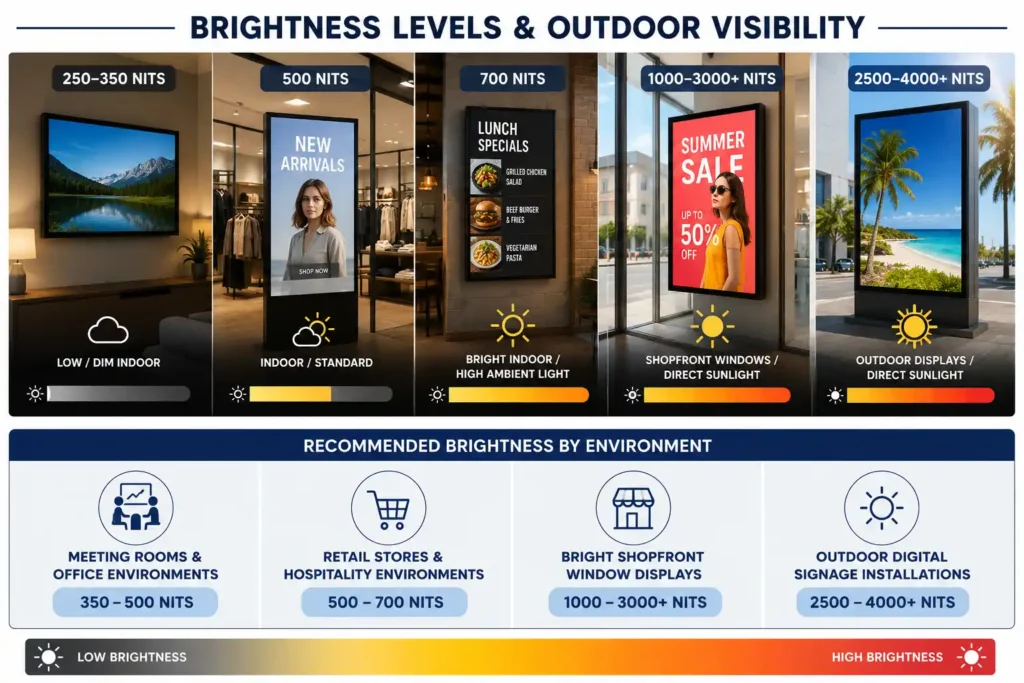
Brightness Levels & Outdoor Visibility
One of the most important considerations when selecting a commercial digital signage display is brightness, commonly measured in:
Nits
Brightness levels can significantly influence display visibility depending on ambient lighting conditions, installation environments, viewing distances, and whether the display is positioned indoors, near shopfront windows, or within outdoor environments exposed to direct sunlight.
Commercial display brightness commonly progresses through several typical deployment tiers depending on the intended environment:
- 250–350 nit — standard consumer television brightness
- 500 nit — typical indoor commercial signage environments
- 700 nit — brighter retail and high ambient light environments
- 1500 nit — shopfront window displays and higher visibility applications
- 2500 nit — outdoor and direct sunlight commercial environments
- 3000+ nit — ultra-high brightness specialised outdoor signage deployments
Higher brightness commercial displays become increasingly important for:
- retail shopfront windows
- high ambient light environments
- public-facing displays
- direct sunlight exposure
- outdoor digital signage deployments
| Environment | Recommended Brightness | Best Suited For |
|---|---|---|
| Meeting rooms & office environments | 350–500 nits | Reception areas, presentations, internal communication, professional indoor environments |
| Retail stores & hospitality environments | 500–700 nits | Indoor promotions, menu boards, customer engagement, business communication |
| Bright shopfront window displays | 1000–3000+ nits | Window-facing signage, high ambient light environments, retail visibility |
| Outdoor digital signage installations | 2500–4000+ nits | Direct sunlight environments, outdoor advertising, public-facing communication |
In many commercial environments, selecting a display with insufficient brightness capability can significantly reduce content visibility during peak daylight hours, particularly near shopfront windows or within high ambient light environments.
While higher brightness commercial displays often carry increased pricing due to more advanced cooling systems and thermal management requirements, selecting the correct brightness level from the beginning can substantially improve long-term signage visibility, customer engagement, and overall deployment suitability.
As brightness capability increases, commercial display pricing can also rise significantly depending on the panel technology, thermal management requirements, commercial operating rating, cooling systems, and overall display design.
For example, ultra-high brightness commercial displays designed for direct sunlight environments often require substantially more advanced cooling systems, specialised commercial components, improved heat dissipation, reinforced thermal management capability, and higher power delivery systems compared to standard indoor commercial displays.
Display technology itself can also significantly influence pricing, deployment suitability, and visual performance expectations.
- VA LED commercial displays are commonly regarded as a cost-effective signage entry point offering strong contrast performance for many indoor business environments
- IPS commercial panels often provide improved colour consistency and wider viewing angle performance for retail, collaboration, and customer-facing environments
- QLED commercial displays are commonly associated with enhanced colour vibrancy and higher brightness capability within premium commercial deployments
- OLED commercial displays prioritise premium contrast, deep blacks, and high-end visual presentation capability
- Direct View LED solutions are commonly utilised for large-scale seamless commercial environments including stadiums, public displays, command centres, and premium video wall deployments
Different commercial display technologies can vary significantly depending on viewing angle performance, contrast capability, brightness output, deployment suitability, and overall commercial pricing structure.
Commercial display design can also impact pricing considerably depending on the intended deployment environment.
For example, ultra-thin bezel commercial displays designed specifically for video wall environments often carry significantly higher pricing compared to standalone signage displays due to the precision alignment requirements, narrow bezel engineering, synchronised multi-display deployment capability, and more complex manufacturing tolerances.
Many entry-level commercial signage displays commonly support brightness levels suitable for indoor business environments, while premium commercial display manufacturers such as Samsung and LG offer specialised ultra-high brightness solutions designed specifically for challenging outdoor and direct sunlight applications.
Selecting the appropriate brightness level, display technology, and commercial panel design can significantly improve long-term visibility, customer engagement, deployment reliability, and overall commercial signage performance.
System on Chip (SoC) & Content Management
Many modern commercial digital signage displays now include integrated:
System on Chip (SoC)
technology, allowing the display to run signage content directly without requiring a separate external media player.
Integrated SoC platforms can often support:
- USB media playback
- image and video scheduling
- cloud-based signage software
- remote content updates
- network management
- multi-display synchronisation
- centralised signage management
For many businesses, integrated SoC functionality can simplify installations while reducing additional hardware requirements and overall deployment complexity.
Some commercial signage environments only require simple standalone media playback using:
- USB drives
- basic scheduling
- looping image or video content
However, larger organisations and multi-site deployments often require more advanced cloud-based signage ecosystems capable of remotely managing displays across multiple locations from a centralised platform.
| Deployment Type | Typical Solution |
|---|---|
| Simple in-store promotions | USB playback or integrated SoC scheduling |
| Retail chain deployments | Cloud-based signage management platforms |
| Multi-location business environments | Remote content management systems |
| Video wall synchronisation | Advanced media player or enterprise signage platform |
| Interactive customer engagement displays | Touchscreen-compatible signage software |
Some commercial digital signage deployments may also utilise dedicated external media players such as BrightSign or Windows-based signage systems to provide additional processing power, enterprise scalability, advanced scheduling functionality, HTML5 content support, and more complex signage deployments.
Different manufacturers also support different signage ecosystems and management platforms depending on their operating systems, SoC capability, software compatibility, and commercial deployment requirements.
Choosing The Right Commercial Digital Signage Display
Selecting the right commercial digital signage solution often involves balancing visibility requirements, operating environments, deployment goals, future scalability, and overall long-term business suitability rather than simply comparing display specifications alone.
While some businesses may only require a straightforward standalone display for promotional content or internal communication, other commercial environments may require ultra-high brightness visibility, touchscreen collaboration, advanced remote management capability, cloud-based signage ecosystems, or synchronised multi-display deployments.
The most suitable commercial signage solution often depends on how and where the display will be used within the intended business environment.
| Business Environment | Common Commercial Display Priorities |
|---|---|
| Retail stores | High brightness visibility, promotional flexibility, customer engagement, shopfront performance |
| Hospitality venues | Menu board scheduling, extended operating hours, flexible content updates, multiple display management |
| Corporate workplaces | Professional presentation, internal communication, collaboration capability, remote management |
| Education environments | Touchscreen interaction, collaboration functionality, wireless sharing, classroom engagement |
| Healthcare environments | Reliable operation, clear visibility, wayfinding communication, extended operating stability |
| Public-facing environments | High visibility, durability, remote monitoring, large-scale communication capability |
In many commercial deployments, selecting the correct brightness level, operating rating, signage ecosystem, and display technology from the beginning can help reduce long-term replacement costs, simplify deployment management, and improve overall reliability within demanding business environments.
Some organisations may prioritise simple standalone signage deployments with USB playback and basic scheduling functionality, while larger businesses and multi-location environments may require enterprise signage ecosystems capable of remotely managing displays across multiple sites from a centralised platform.
Commercial signage deployments can also vary significantly depending on future scalability requirements. Businesses planning future expansion, multi-display rollouts, interactive environments, or integrated customer engagement systems may benefit from selecting commercial signage platforms designed to support longer-term deployment flexibility from the beginning.
Commercial Display Manufacturers & Signage Ecosystems
Different commercial display manufacturers often position themselves differently depending on their signage ecosystems, deployment focus, brightness capability, collaboration technologies, enterprise management tools, and overall commercial market positioning.
Manufacturers such as Samsung and LG are commonly positioned within the premium commercial signage segment, often focusing heavily on enterprise signage ecosystems, ultra-high brightness commercial displays, video wall technologies, and larger-scale commercial deployment capability.
Other commercial display manufacturers including Philips, NEC, BenQ, Hisense, Sony, and Soniq may prioritise different areas of the commercial signage market ranging from value-driven deployments and collaboration environments through to reliability-focused enterprise solutions and cost-effective business signage applications.
Because commercial display availability, supplier promotions, incoming inventory, and project opportunities can fluctuate regularly across Australia, some commercial signage solutions and short-term pricing opportunities may not always appear publicly on the website.
Businesses considering commercial digital signage deployments are always welcome to contact Kickstart Computers directly for guidance regarding commercial display recommendations, signage ecosystem suitability, project pricing, and current Australia-wide commercial display availability.
Explore Commercial Digital Signage Manufacturers
Different commercial display manufacturers often focus on different deployment environments, signage ecosystems, brightness capabilities, collaboration technologies, and budget requirements.
Some manufacturers prioritise premium commercial signage ecosystems and ultra-high brightness performance, while others focus more heavily on value-driven deployments, collaboration functionality, or cost-effective business signage solutions.
Kickstart Computers supplies a wide range of commercial digital signage display solutions across leading manufacturers including Samsung, LG, Sharp, Philips, BenQ, Sony, Soniq, Hisense, and other commercial display brands depending on project requirements and availability.
The manufacturers below provide a starting point for exploring different commercial signage ecosystems, business display technologies, and deployment options across retail, hospitality, education, corporate, and public-facing environments.
Samsung Digital Signage
Industry-leading commercial displays, video walls, and digital signage solutions designed for professional business environments.
Explore Samsung Displays
LG Digital Signage
Advanced commercial display solutions from LG including digital signage displays, video walls, and high-impact business communication systems.
Explore LG Displays
Sharp Digital Signage
Reliable commercial-grade Sharp Display Solutions designed for retail, corporate, education, and public-facing environments across five distinct brightness tiers.
Explore Sharp Displays
BenQ Digital Signage
Professional BenQ commercial displays engineered for impactful visual communication, collaboration, and business engagement.
Explore BenQ Displays
Philips Digital Signage
Philips PPDS commercial signage displays deliver open Android flexibility, FailOver input protection, and reliable performance across eleven distinct product lines.
Explore Philips Displays
Sony Digital Signage
Sony Bravia Professional displays bring world-class picture quality heritage into commercial-grade hardware — Dolby Vision HDR, Full Array Local Dimming, and 3 and 5-year commercial warranties.
Explore Sony Displays
Soniq Digital Signage
Affordable commercial digital signage displays from Soniq designed for retail, hospitality, education, and business applications.
Explore Soniq DisplaysFeatured Commercial Digital Signage Displays
The commercial display solutions below represent some of the most commonly requested digital signage displays across retail, hospitality, education, corporate, and customer-facing business environments.
Availability, promotional pricing, and commercial stock opportunities can vary regularly depending on supplier inventory, project requirements, and incoming commercial shipments.
Need Help Choosing The Right Commercial Digital Signage Display?
Whether you're planning a retail signage upgrade, hospitality display deployment, corporate communication rollout, or customer-facing digital display environment, Kickstart Computers can help guide you through the available commercial display technologies, manufacturer options, and signage solutions best suited to your business requirements.
With access to 30+ suppliers across Australia, commercial pricing opportunities, clearance stock availability, and a wide range of leading signage manufacturers, businesses are welcome to contact us directly for guidance regarding commercial display recommendations, project pricing, and current stock availability.

What is the difference between a commercial digital signage display and a consumer TV?
The primary difference is operational durability, brightness capability, and long-term commercial reliability. Commercial digital signage displays are engineered for extended 16/7 or 24/7 business operation, while consumer televisions are generally designed for lower-hour residential usage.
Commercial displays commonly support:
- higher brightness capability for retail and shopfront environments
- improved thermal management and cooling systems
- portrait orientation support
- remote management functionality
- commercial signage software compatibility
- integrated SoC platforms such as Samsung Tizen and LG webOS
Consumer televisions may initially appear visually similar, however continuous commercial usage can contribute to overheating concerns, warranty limitations, reduced lifespan, or lower visibility within high ambient light environments.
What brightness level is recommended for commercial digital signage?
Recommended commercial display brightness depends primarily on ambient lighting conditions and installation environment. Most indoor business environments commonly utilise 500–700 nit commercial displays, while direct sunlight and outdoor signage deployments may require 2500–4000+ nit brightness capability.
Typical commercial brightness ranges include:
- 350–500 nits — meeting rooms and office environments
- 500–700 nits — retail stores and hospitality environments
- 1000–3000+ nits — shopfront window displays
- 2500–4000+ nits — outdoor digital signage installations
Selecting insufficient brightness capability can significantly reduce visibility and customer engagement within bright commercial environments.
Can commercial digital signage displays run 24/7?
Many commercial digital signage displays are specifically engineered to support extended 16/7 or 24/7 operation depending on the model and intended deployment environment. Commercial displays commonly incorporate improved cooling systems, reinforced thermal management capability, and higher-grade internal components designed for continuous business usage.
24/7 commercial signage deployments are commonly utilised within:
- retail stores
- hospitality venues
- transport hubs
- healthcare environments
- public-facing commercial environments
- control rooms and monitoring centres
Businesses planning continuous signage operation should always verify the commercial operating rating of the selected display model before deployment.
What happens if I use a consumer TV for digital signage?
Using a consumer television for commercial digital signage may result in reduced lifespan, overheating concerns, lower brightness visibility, or warranty limitations compared to purpose-built commercial signage displays.
Consumer televisions are generally not designed for:
- continuous 16/7 or 24/7 operation
- shopfront window brightness requirements
- portrait orientation usage
- commercial signage software environments
- enterprise remote management capability
While some low-demand environments may temporarily utilise consumer televisions, long-term business deployments commonly benefit from commercial-grade display solutions engineered specifically for professional signage environments.
Do I need professional installation for commercial digital signage?
Many commercial digital signage deployments can often be supplied preconfigured and ready for relatively straightforward installation depending on the display size, mounting environment, and signage requirements. Complex dedicated AV installation services are not always required.
Straightforward deployments commonly include:
- reception displays
- menu boards
- retail promotions
- internal communication displays
- standalone business signage environments
More advanced deployments such as video walls, outdoor signage, ceiling-mounted displays, and synchronised multi-display environments may still require specialised commercial installation services depending on the project scope.
What is SoC in commercial digital signage displays?
System on Chip (SoC) technology refers to integrated processing capability built directly into many modern commercial digital signage displays. SoC platforms allow displays to run signage content without requiring a separate external media player.
Integrated SoC functionality commonly supports:
- USB media playback
- cloud-based signage software
- scheduling functionality
- remote content updates
- centralised signage management
- multi-display synchronisation
Popular commercial signage ecosystems commonly include Samsung Tizen and LG webOS commercial signage platforms.
What is the difference between IPS, VA, QLED, OLED, and Direct View LED displays?
Different commercial display technologies prioritise different strengths depending on brightness capability, viewing angle performance, contrast levels, deployment suitability, and overall commercial pricing.
Common commercial display technologies include:
- VA panels — cost-effective signage entry point with strong contrast performance
- IPS panels — improved colour consistency and wider viewing angles
- QLED displays — enhanced brightness capability and colour vibrancy
- OLED displays — premium contrast performance and deep blacks
- Direct View LED — seamless large-format commercial display environments
Different technologies are commonly selected depending on the intended commercial environment, deployment goals, customer visibility requirements, and long-term signage expectations.
Which commercial digital signage brands are most commonly used?
Commercial digital signage deployments commonly utilise manufacturers such as Samsung, LG, Philips, NEC, BenQ, Panasonic, Hisense, and Soniq depending on brightness requirements, signage ecosystem preferences, deployment scale, and overall project budget.
Commercial display manufacturers often prioritise different strengths including:
- ultra-high brightness capability
- enterprise signage ecosystems
- collaboration functionality
- video wall technologies
- value-focused commercial deployments
- long-term commercial reliability
Kickstart Computers has supplied commercial display and business technology solutions across Australia since 2007, supporting a wide range of retail, hospitality, education, healthcare, and corporate deployment environments.