Jump Ahead Too
ToggleLG Digital Signage & Commercial Displays Australia
LG digital signage has established a distinctive position within the Australian display market — one that sits slightly differently from Samsung's broader commercial ecosystem approach. Where Samsung has built depth across a wide range of deployment categories, LG has developed particularly strong credentials within premium visual environments: architectural retail spaces, OLED-driven hospitality and corporate installations, and high-brightness storefront deployments where presentation quality and industrial design carry as much operational weight as brightness specifications and duty cycle ratings.
That positioning matters for procurement decisions. Organisations evaluating LG are often doing so because the environment they are fitting out has specific visual quality or design requirements that standard commercial panel deployments don't fully address. Understanding where that positioning is genuinely earned — and where alternatives may be more operationally practical — is the purpose of this guide.
LG's Position Within the Australian Display Market
Within the Australian display market, LG and Samsung occupy similar territory across several deployment categories while diverging meaningfully in others. Both manufacturers have historically dominated the ultra-high-brightness storefront signage segment — one of the more demanding applications in the Australian context, where west-facing retail windows in summer create conditions that expose the operational difference between a properly specified display and one that simply appeared adequate in a showroom environment.
That shared dominance is worth acknowledging honestly, because the market is changing. Manufacturers including Hisense and TCL are pushing aggressively into high-brightness commercial panel categories with increasingly competitive products. The procurement question in this segment is no longer simply about which major brand offers sufficient brightness — it is about which manufacturer delivers consistent long-term thermal stability, brightness uniformity over extended operating hours, and support infrastructure that holds up when something goes wrong eighteen months into a deployment. On those criteria, the established players still hold meaningful advantages, though that gap is narrowing faster than it was a few years ago.
Where LG has developed a more distinct identity is within premium presentation-focused environments — OLED deployments, architectural installations, and spaces where the display is part of the designed customer experience rather than simply a communication surface mounted on a wall. That is where the manufacturer's real differentiation lives, and it is the most useful frame through which to evaluate LG for any specific deployment brief.

LG OLED Commercial Displays & Architectural Environments
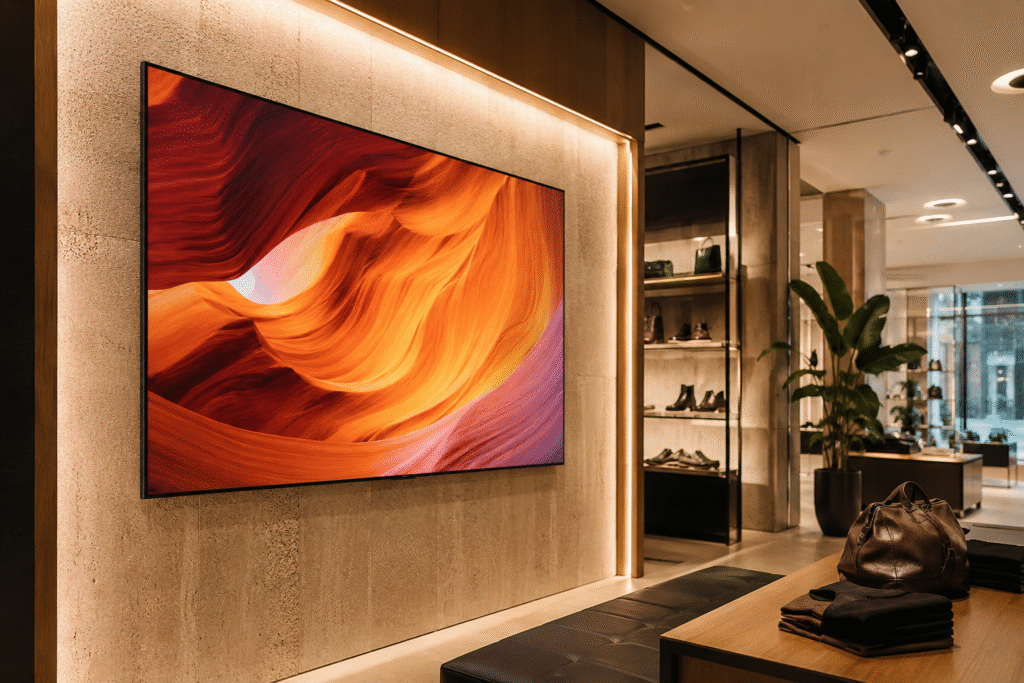
OLED technology represents LG's most significant point of genuine differentiation within the commercial display market. The visual characteristics of OLED — absolute black levels, near-infinite contrast ratios, and panel designs thin enough to function as architectural elements rather than conventional display hardware — create a presentation quality that LCD-based commercial displays cannot replicate regardless of specification level.
The environments where this matters most are those where the display experience is part of what the space is trying to communicate. Luxury retail flagships, executive briefing centres, premium hotel lobbies, and high-end corporate experience spaces all fall into this category. In these environments, a display that produces genuinely deep blacks and precise colour against a carefully designed interior contributes to the spatial experience in a way that a standard commercial panel simply doesn't — and clients and visitors notice the difference even when they cannot articulate why.
The honest operational counterpoint is that OLED commercial displays are not universally appropriate. Static content retention — the risk of image persistence with fixed on-screen elements over long operating periods — remains a genuine consideration for deployments running consistent layout templates, menu structures, or persistent graphic elements. This is not a reason to avoid OLED in every context, but it is a reason to evaluate content strategy alongside display selection rather than treating them as separate decisions. Environments running dynamic, frequently changing content are far better suited to OLED deployment than those running largely static signage layouts.
Peak brightness is the other honest limitation. OLED panels typically operate at lower brightness levels than high-performance LCD commercial displays — which means OLED is generally better suited to controlled interior environments than to high-ambient-light retail or window-facing installations. Specifying OLED for a sun-facing shopfront is the wrong tool for the environment regardless of how premium the installation appears on paper.
webOS Signage Platform & Multi-Site Content Management
LG's webOS signage ecosystem is the content management story that often gets underweighted in LG evaluations, and it deserves the same operational attention that Samsung's MagicINFO and VXT platforms receive in Samsung assessments.
The practical foundation of webOS in commercial signage is System-on-Chip integration — the display hardware and the signage platform run together without requiring external media players for the majority of deployment scenarios. In practice this means a retail chain rolling out fifty screens across ten locations is not also managing fifty separate media players, their power supplies, their firmware updates, and their failure points. The installation is cleaner, the ongoing management overhead is lower, and the points of potential failure are reduced. For organisations managing signage networks at scale — franchise groups, shopping centre tenants, multi-site hospitality operators, school networks — that operational simplicity compounds meaningfully over the life of a deployment.
webOS has matured substantially as an enterprise signage platform. Multi-site content scheduling, remote device monitoring, display status alerts, and centralised policy management are all available within the ecosystem — covering the majority of what retail chains, franchise networks, and corporate multi-site operators need from a signage management infrastructure. For organisations already comfortable within the LG ecosystem, the native webOS toolset handles most deployment requirements without the additional cost and complexity of a third-party CMS platform layered on top.
Where third-party CMS platforms become the more practical choice is in multi-manufacturer environments — organisations running a mix of LG, Samsung, and other display brands across their network, where a manufacturer-agnostic platform provides cleaner centralised management. LG's webOS is reasonably open to third-party CMS integration, which makes this transition less disruptive than it might otherwise be. For organisations at the planning stage for larger signage networks, confirming CMS strategy before committing to hardware remains sound operational advice regardless of manufacturer.
LG High-Brightness Signage & Storefront Deployments
Brightness specifications in commercial signage are frequently quoted accurately and understood poorly. A display rated at 2,500 nits will maintain visibility in direct sunlight where a 500-nit panel becomes unreadable — but the figure alone does not tell the full operational story of how that display will perform across a five-year retail deployment running twelve or more hours daily in a thermally demanding environment.
The more meaningful evaluation criteria for high-brightness storefront deployments are thermal management design, brightness consistency over extended operating periods, and the manufacturer's track record of long-term reliability in Australian conditions. A west-facing Sydney or Brisbane shopfront in January subjects a display to sustained thermal stress that accelerates panel degradation in ways that controlled testing environments do not replicate. Displays that meet brightness specifications in a showroom can underperform significantly in practice when thermal management has not been engineered for sustained real-world operating conditions.
LG's high-brightness commercial panel range has been deployed across demanding Australian retail and transportation environments with a reasonable long-term reliability track record. The honest market context is that this segment is becoming more competitive, and newer entrants from Hisense and other manufacturers are closing the specification gap at more accessible price points. The case for established manufacturers in this category rests increasingly on support infrastructure, deployment maturity, and thermal management engineering rather than brightness figures alone.
LG Video Wall Displays & Large-Format Environments
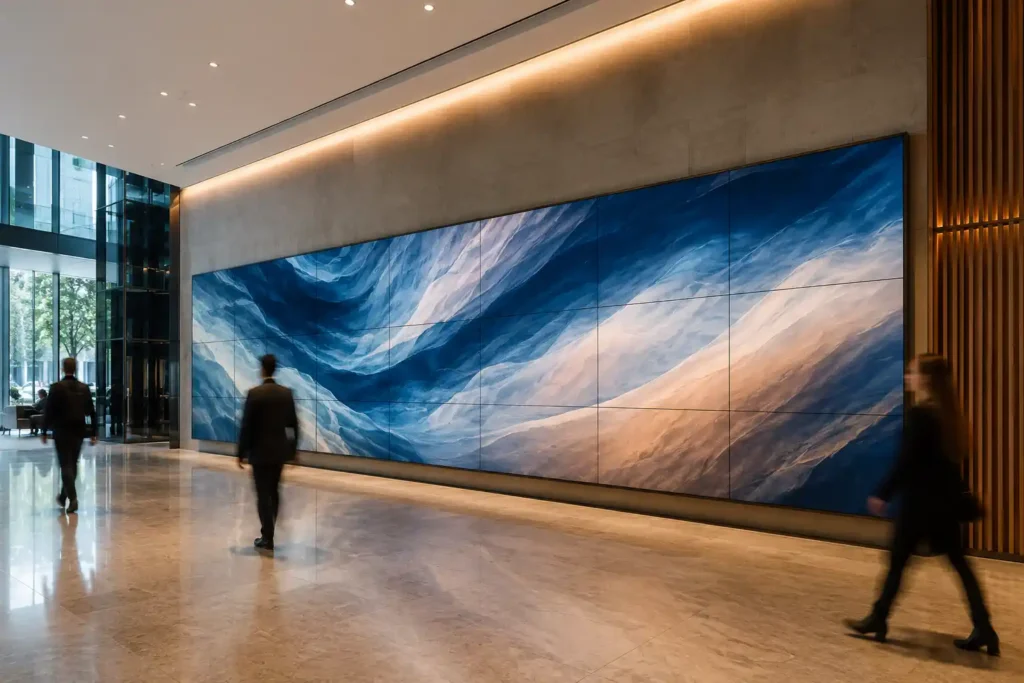
LG video wall displays featuring ultra-narrow bezels have maintained a consistent presence in Australian corporate, hospitality, and public environment installations — often in direct competition with Samsung's equivalent commercial panel range for the same project briefs.
The operational considerations for video wall deployments are largely consistent regardless of manufacturer: bezel uniformity, brightness matching across panels, content management integration, and structural mounting infrastructure all have more impact on the finished installation quality than panel brand selection alone. Where LG has developed a specific advantage is within premium architectural installations where the visual quality of individual panels — particularly colour accuracy and uniformity — contributes to the overall spatial experience.
The OLED video wall category, where LG holds a particularly strong market position, extends this advantage into large-format premium installations where conventional LCD panel walls would not achieve the same visual result. For standard corporate and hospitality video wall deployments, the decision between LG and Samsung typically comes down to existing ecosystem relationships, commercial terms, and specific panel specifications for the installation geometry rather than fundamental capability differences.

LG Interactive Whiteboard — CreateBoard for Collaboration & Education
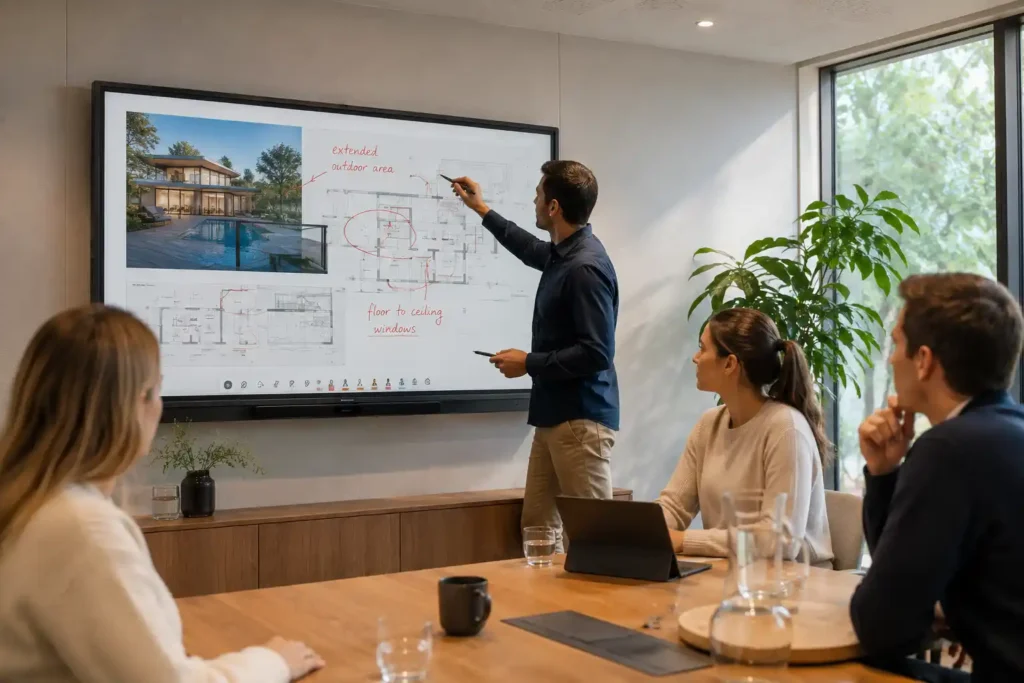
LG interactive whiteboard technology through the CreateBoard range positions the manufacturer within the collaboration display market — a category that has expanded considerably as hybrid work and hybrid learning have shifted from accommodation to standard operational expectation across corporate and education environments.
CreateBoard's deployment philosophy sits closer to the flexible Android-native collaboration approach than to the education-first software ecosystems that characterise SMART Board and Promethean ActivPanel. The platform runs on Android with OPS slot compatibility for Windows module expansion — giving it reasonable flexibility across corporate environments that need both Android collaboration workflows and occasional Windows application access without committing to a full Windows-first deployment architecture.
Google Workspace integration and Google Meet compatibility make CreateBoard a practical consideration for organisations operating heavily within the Google ecosystem — a segment where Samsung's Flip Pro is also competitive but where the specific depth of Google integration can be a meaningful differentiating factor for schools and businesses already standardised on Google infrastructure.
The honest comparison with Samsung's Flip Pro comes down to writing experience and annotation quality on one side, and ecosystem depth and price positioning on the other. The Flip Pro's optical bonding, pressure-sensitive line simulation, and low-latency writing performance have established it as the benchmark for annotation quality within the mainstream collaboration display category. CreateBoard competes effectively on platform flexibility, Google ecosystem depth, and value positioning — but organisations for whom daily sustained annotation quality is the primary deployment requirement will generally find the Samsung Flip more closely matches that brief.
For environments where conferencing integration, wireless sharing, and general collaboration workflows are the primary requirements rather than annotation intensity, the gap narrows considerably and CreateBoard becomes a straightforward competitive option worth evaluating directly.
For a detailed operational comparison across the interactive whiteboard category — covering Samsung, LG, SMART, Promethean, BenQ, ViewSonic, and Yealink — the Interactive Whiteboard Hub addresses deployment suitability across education and corporate environments in detail.

LG's commercial display range spans several of the major digital signage categories. If you are still orientating your research across the broader market, the links below cover each category in full — across all manufacturers, not LG alone.
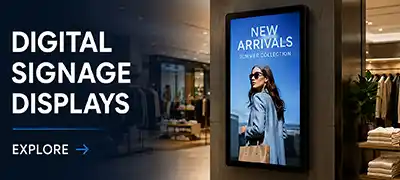
Digital Signage Displays
Professional commercial displays designed for retail stores, hospitality venues, schools, and corporate environments.
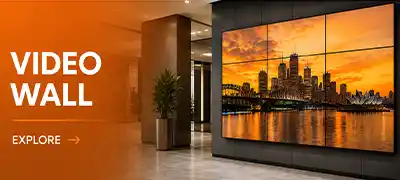
Video Walls
Large-format multi-screen display systems designed for immersive commercial communication and visual impact.
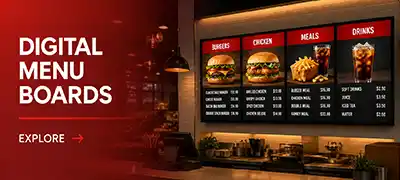
Digital Menu Boards
Dynamic menu board solutions for cafes, restaurants, takeaway stores, and hospitality businesses.

Outdoor Digital Signage
Weather-resistant outdoor display solutions designed for advertising, public communication, and high visibility.
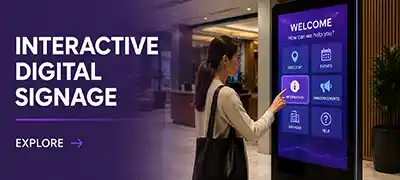
Commercial vs Consumer Display Realities
The question of why commercial displays rather than consumer televisions comes up consistently in procurement conversations, and it deserves a direct answer rather than a vague reference to "commercial grade" specifications.
Consumer televisions are designed around viewing patterns that typically involve a few hours of daily use, predominantly passive content consumption, and domestic thermal environments. A modern consumer television placed in a retail environment running ten to twelve hours daily, often in portrait orientation, frequently displaying static or near-static content layouts, will show the consequences of that mismatch within months rather than years — through accelerated panel degradation, thermal management failures, and warranty conditions that explicitly exclude the operating environment it has been placed in.
Commercial displays are engineered with those operational realities as the design brief rather than the exception. Duty cycle ratings, thermal management design, portrait orientation support, remote management capability, and warranty conditions that actually cover the deployment environment are not premium add-ons — they are fundamental engineering decisions that separate a display designed for sustained operation from one that happens to be large enough to look similar on a specification sheet.
The total cost of ownership calculation almost always favours properly specified commercial displays once accelerated replacement cycles, installation labour costs, and operational downtime are factored in. The upfront price differential narrows considerably under that analysis — and in many cases inverts entirely once the second consumer television replacement is being quoted.
Choosing the Right LG Display for Your Environment
Display selection becomes more straightforward once the evaluation is framed around deployment environment and operational requirements rather than specifications and price points.
For premium retail and architectural environments where visual presentation quality, OLED display technology, and industrial design contribute directly to the customer experience, LG's commercial OLED range and ultra-slim LCD panels are among the strongest options in the Australian market. The caveat remains content strategy — OLED deployments require dynamic content planning to manage static retention risk effectively.
For storefront and window-facing installations requiring sustained high-brightness performance across extended daily operating hours, LG's high-brightness commercial panel range covers the majority of Australian retail deployment requirements. The evaluation should prioritise thermal management track record and long-term brightness consistency alongside peak brightness specifications.
For corporate lobbies, reception environments, and internal communications networks, LG's standard signage range combined with webOS content management covers most multi-site deployment requirements at competitive total cost of ownership. The SoC integration advantage becomes most apparent in networks of ten or more screens where media player elimination simplifies both installation and ongoing management.
For video wall installations, LG's ultra-narrow bezel panels are a consistent choice for corporate, hospitality, and public environment deployments across Australia. OLED video wall configurations are worth evaluating for premium architectural installations where conventional panel walls would not achieve equivalent visual quality.
For interactive whiteboard and collaboration environments, CreateBoard suits organisations prioritising Google ecosystem integration, Android flexibility, and value-conscious deployment. Environments where sustained daily annotation quality is the primary operational requirement should evaluate Samsung's Flip Pro alongside CreateBoard — the writing experience difference is most apparent under extended real-world use conditions rather than brief demonstration.
Comparing LG Against Other Commercial Display Ecosystems
LG is one of several serious display ecosystems available in the Australian market, and a well-informed evaluation should engage with the alternatives directly rather than treating brand reputation as a substitute for deployment fit assessment.
For organisations comparing LG against Samsung across retail signage, high-brightness storefront deployments, or video wall applications, the honest starting point is acknowledging that both manufacturers are genuinely competitive across most of those categories. The differentiation is environmental — LG's OLED and architectural design credentials give it a meaningful edge in premium presentation spaces, while Samsung's broader ecosystem depth and MagicINFO management maturity may suit organisations running larger mixed-category signage networks.
For organisations evaluating interactive whiteboards and collaboration displays across multiple manufacturers simultaneously, the Interactive Whiteboard Hub covers LG CreateBoard, Samsung Flip Pro, SMART Board, Promethean ActivPanel, BenQ, ViewSonic, and Yealink across classroom, corporate, and hybrid meeting deployment contexts.
Additional comparison resources covering LG versus Samsung, LG versus BenQ, and LG versus Hisense across specific deployment categories are in development.
You're right to call that out — that's my fault. I gave you the cards without properly wrapping them in the grid container from the start. You shouldn't have to diagnose that yourself. Here's the complete self-contained block, correctly wrapped, ready to drop straight in and work immediately: html
Compare Other Display Manufacturers
Kickstart Computers supplies and advises across multiple commercial display and interactive technology manufacturers — not a single brand. The manufacturers below occupy similar or adjacent territory to LG across commercial signage, video walls, interactive displays, and collaboration environments. If LG is not the right fit for your specific deployment brief, the pages below cover each manufacturer in the same operational depth as this guide.
Samsung Digital Signage
Samsung's commercial display ecosystem spans retail signage, video walls, outdoor displays, and interactive whiteboards — LG's closest competitor across the broadest range of deployment categories.
Explore Samsung Displays
Sharp Digital Signage
Sharp NEC Display Solutions competes with LG across professional commercial display tiers — offering five distinct brightness tiers from essential signage through to 700-nit premium professional displays with SpectraView colour precision.
Explore Sharp Displays
BenQ Digital Signage
BenQ competes with LG CreateBoard across interactive whiteboard and collaboration display environments — particularly within education and corporate spaces where Google ecosystem depth and AI-assisted annotation are priorities.
Explore BenQ Displays
Philips Digital Signage
Philips commercial displays occupy similar territory to LG across professional indoor signage environments — worth evaluating directly for organisations comparing multiple brands across retail, corporate, and hospitality deployments.
Explore Philips Displays
Sony Digital Signage
Sony professional displays compete with LG in premium corporate and presentation environments — particularly where image processing quality and visual precision are central to the deployment brief.
Explore Sony Displays
Soniq Digital Signage
Soniq offers value-tier commercial digital signage, interactive displays, and kiosk solutions — worth considering for budget-conscious deployments where LG's commercial pricing is the primary constraint.
Explore Soniq DisplaysLG Commercial Displays Australia — Deployment Support
Whether the brief involves a single premium OLED retail installation, a multi-site webOS signage network across a franchise group, a corporate video wall, or an interactive whiteboard rollout across an Australian school or university, Kickstart Computers provides deployment advisory and display selection support across the full LG commercial range.
If you are evaluating LG against Samsung, BenQ, Hisense, or other display ecosystems for a specific environment, we can help assess deployment suitability, compare platform trade-offs, and work through the operational requirements before a commitment is made — rather than after.
LG sits within a broader commercial display and digital signage market that spans multiple manufacturers and deployment categories. If you are still orientating your research across the full market before committing to a direction, the Digital Signage Hub covers every manufacturer and solution type we supply across Australia.
Digital Signage HubSamsung is LG's primary competitor across commercial displays, video walls, and interactive whiteboards in the Australian market. If you are comparing both manufacturers side by side before making a decision, the Samsung Digital Signage page covers their full commercial range in the same operational depth as this guide.
Samsung Digital SignageLG's CreateBoard interactive whiteboard range is available within our dedicated Interactive Whiteboard shopping category. The link below filters directly to LG models so you can browse and compare without wading through other brands.
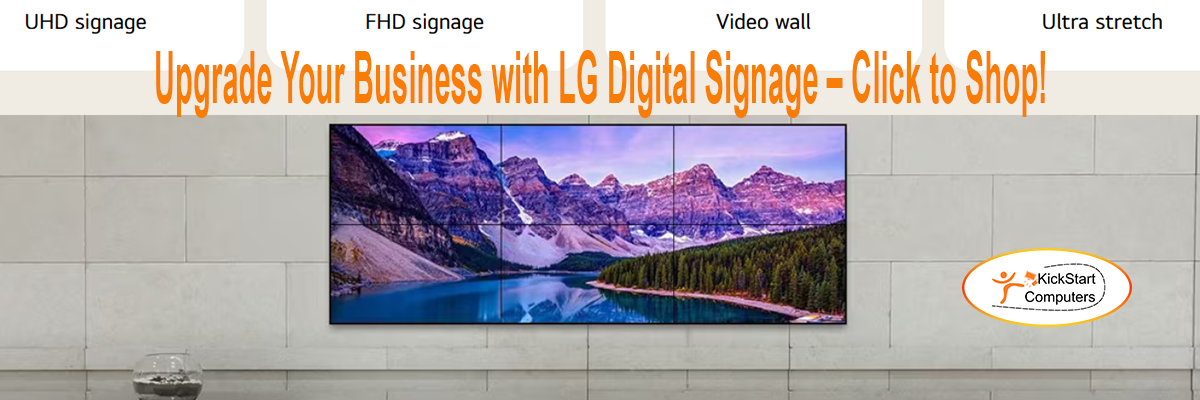
Shop LG Interactive WhiteboardsThe full LG commercial display range — including OLED panels, high-brightness storefront displays, video wall configurations, menu board solutions, and standard signage — is available to order through Kickstart Computers. Click the banner below to browse LG digital signage products directly.
📞 0416 353 501
📩 sales@kickstartcomputers.com.au