Manufacturer overview
Jump Ahead Too
TogglePhilips PPDS Professional Displays
Philips PPDS occupies a position in the commercial display market that few manufacturers can match for breadth and operational practicality. Where Sony wins on picture quality heritage and Samsung wins on ecosystem scale, Philips wins on something more operationally valuable for most Australian businesses — open platform flexibility, deployment practicality, and a product range that solves specific commercial problems other manufacturers haven't addressed at all.
The Philips PPDS range spans everyday office signage through to zero-power portable healthcare displays, stretched bar formats for retail shelf-edge applications, and ultra-high-brightness window-facing panels. Few manufacturers offer the same breadth across a single coherent range.
Philips PPDS is the right starting point for
A note on Philips PPDS range stability and Australian availability
Philips doesn't refresh its professional display range at the same pace as Samsung or LG. For a consumer electronics buyer that might sound like a negative. For a procurement manager specifying displays across ten locations over a three-year rollout, it's a significant operational advantage — the model you specify today will still be available, still be supported, and still be orderable when you need to add to the installation twelve months later.
For any model not held in our current stock, Philips' distribution network across Australia means virtually any model in the range can be sourced and landed at your door within approximately one week.

What sets Philips PPDS apart
Three operational advantages no other manufacturer delivers together
Philips PPDS doesn't compete with Sony on picture quality or with Samsung on ecosystem depth. It wins on a different set of operational advantages that matter more to most commercial buyers — the ones who are deploying displays across multiple sites, managing them remotely, and need them to work reliably without expensive proprietary infrastructure around them.
Open Android — removes the hardware tax
Every core Philips PPDS display runs on an open Android platform with Google Play Store access built directly into the display. No locked proprietary operating system, no forced CMS subscription, no external media player hardware. Signage platforms including SignageLive, Embed Signage, and PosterBooking install directly on the display — no additional cabling, no additional points of failure. Removing the media player from every installation reduces hardware cost, simplifies maintenance, and meaningfully improves long-term reliability across the fleet.
FailOver — the display that never goes dark
Philips PPDS displays include an integrated FailOver input protection system across the commercial range. If a connected media player crashes, a network connection drops, or a primary content source fails, the display automatically switches to a secondary backup source — a locally stored file on an internal micro-SD or USB drive — without showing a "No Signal" error or a blank screen. For retail environments, transport hubs, and any deployment where a dark screen represents lost revenue or damaged brand perception, FailOver is an operational insurance policy built into the hardware at no additional cost.
PPDS Wave — remote fleet management from anywhere
Modern Philips PPDS displays are PPDS Wave-ready — Philips' cloud-native fleet management platform that gives IT managers and facilities teams the ability to push firmware updates, monitor fleet power consumption, schedule content changes, and manage device health across multiple regional sites from a single centralised cloud console. Wave gives Philips PPDS a centralised fleet management layer comparable to the remote management ecosystems offered by Samsung and LG — without locking buyers into proprietary hardware or single-vendor software agreements.
The range at a glance
Eleven product lines — one coherent commercial display ecosystem
Philips PPDS covers more distinct commercial display categories than any other manufacturer on this site — from standard 18/7 office signage through to zero-power ePaper healthcare displays. The range is structured around operational purpose rather than arbitrary size or brightness tiers, which makes matching the right product to the right environment more straightforward than it might first appear.
| Line | Category | Duty cycle | Key specification | Primary application |
|---|---|---|---|---|
| Q-Line | Core commercial signage | 18/7 | 350–400 nits, Android SoC | Office, retail, education, hospitality |
| D-Line | 24/7 heavy duty | 24/7 | 450–500 nits, portrait-safe | QSR, transport, 24/7 retail, reception |
| B-Line | Meeting room hybrid | 16/7–18/7 | TV tuner, Chromecast built-in | Huddle rooms, hospitality, pub/club |
| E-Line | Interactive collaboration | 18/7 | 50-point touch, Android 14, 128GB | Boardrooms, education, training |
| X-Line | Videowall | 24/7 | Sub-2mm bezel, 10x10 tiling | Retail walls, lobbies, control rooms |
| T-Line | Interactive signage | 24/7 | Ruggedised touch, open Android | Wayfinding, kiosks, retail interactive |
| U-Line | Large format prestige | 24/7 | 84" and 98", 500 nits IPS | Lobbies, exhibition, large reception |
| V-Line | High brightness / clinical | 24/7 | 2,000 nits, DICOM compatible | Healthcare, high ambient light retail |
| H-Line | Ultra high brightness | 24/7 | 2,500–3,000 nits | Window-facing, direct sunlight |
| P-Line | Industrial / medical | 24/7 | DICOM, ruggedised chassis | Clinical areas, control rooms |
| S-Line | Stretched bar display | 24/7 | 32:9 ultrawide, 700 nits | Shelf-edge, rail, departure boards |
| L-Line | Direct View LED (dvLED) | 24/7 | Bezel-free modular LED, multiple pixel pitches | Indoor video walls, premium retail, lobbies |
| I-Line / Tableaux | ePaper zero-power | Zero power static | E Ink Spectra 6, 6 colours | ESG signage, healthcare bedside |
The L-Line Direct View LED range spans multiple pixel pitch configurations — viewing distance, ambient light, and content type all determine the correct specification. See our video wall category for full L-Line configuration guidance.

The range — core tiers
Four lines covering the majority of commercial display deployments
The Q-Line, D-Line, E-Line, and B-Line account for the vast majority of Philips PPDS commercial display deployments in Australian business environments. Understanding which tier fits your operational requirements — duty cycle, interactivity, content management, and environment — is the starting point for any Philips specification.
Q-Line — Core Commercial Signage
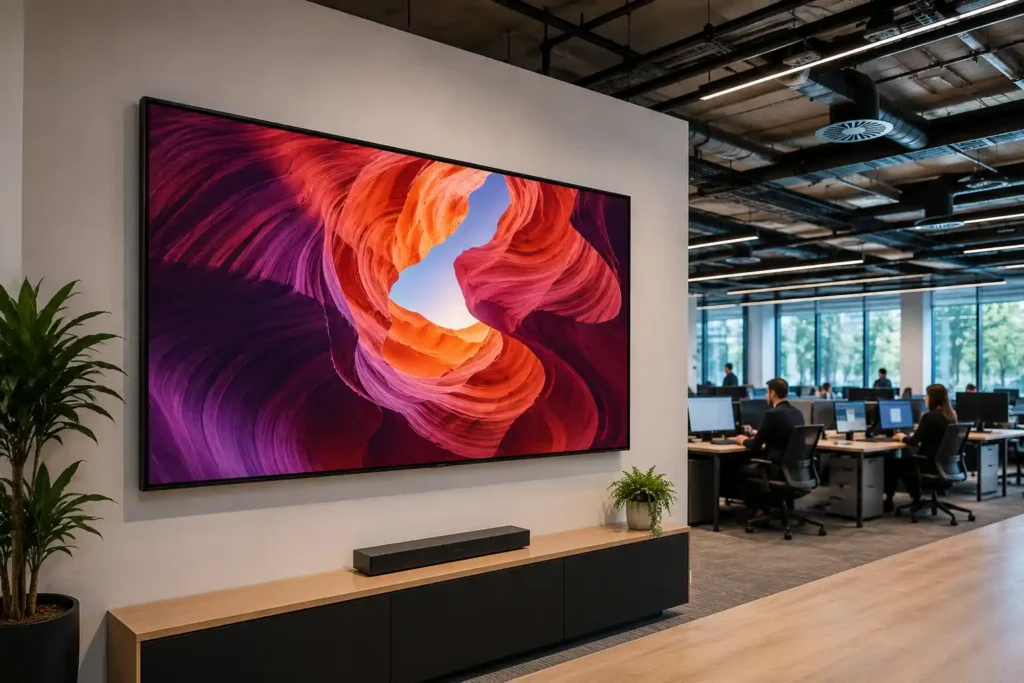
18/7 entry tierThe Q-Line is the volume heart of the Philips PPDS LCD display range — bridging the gap between high-performance digital signage and entry-level practicality. Powered by an open Android SoC platform with Google Play Store access, the Q-Line covers the vast majority of retail, corporate, and education environments that operate within standard business hours. If your installation requires a clean, reliable 4K display with open platform deployment flexibility but doesn't require continuous overnight runtime, the Q-Line is the definitive starting point. FailOver input protection and PPDS Wave management compatibility are integrated across the series.
Best suited for: corporate meeting spaces, standard business hours retail signage, school classrooms, hospitality common areas, medical and dental waiting rooms, multi-site entry-level signage rollouts
D-Line — 24/7 Heavy Duty Fleet Deployment
24/7 workhorseThe D-Line is the step up from the Q-Line for any environment requiring continuous around-the-clock operation. With a true 24/7 continuous duty cycle rating, higher brightness output, and a cooling architecture built for sustained operation, the D-Line handles what the Q-Line cannot. It is portrait-safe — the thermal management prevents panel degradation when displays are rotated vertically and run continuously, which is a common failure point when standard displays are used in portrait-orientation menu board or wayfinding applications. With 58 products in the range it's the broadest single series in the Philips PPDS lineup and the most specified for large-scale fleet deployments.
Best suited for: QSR digital menu boards, transport hubs, 24/7 retail environments, corporate reception lobbies, public wayfinding, portrait-orientation signage networks, large fleet deployments requiring remote management
E-Line — Large Format Interactive Collaboration
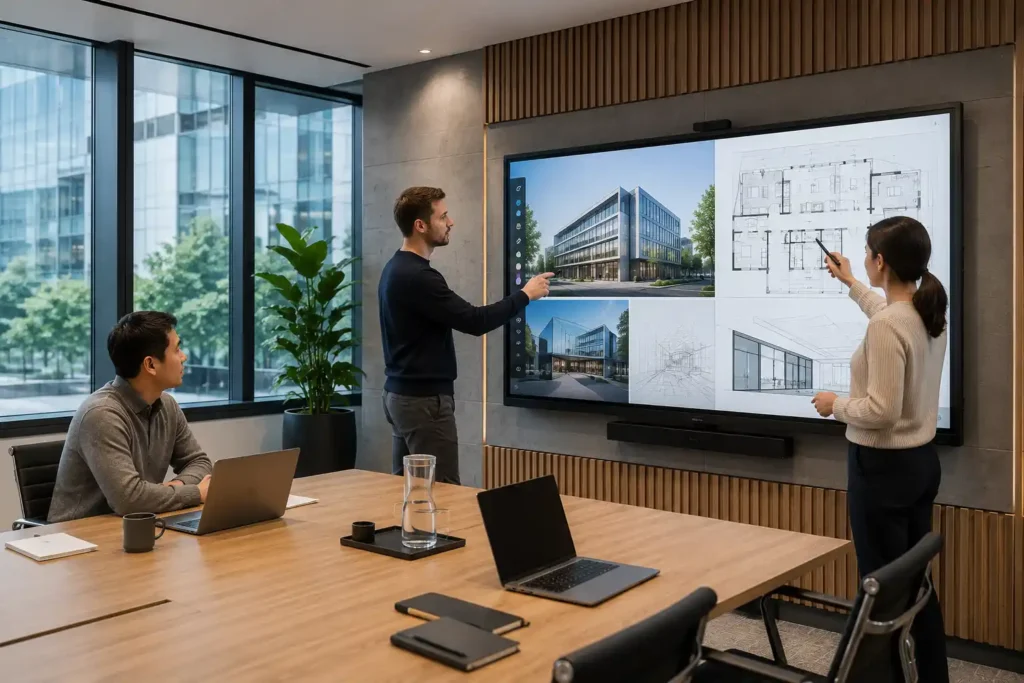
Interactive tierThe E-Line is Philips PPDS's dedicated solution for the modern collaborative workspace and hybrid classroom — a large-format interactive display engineered for meeting rooms, training environments, education, and any space where multiple people need to work on a shared digital canvas simultaneously. Running Android 14 with 128GB of on-board storage and 8GB RAM, it has the processing headroom for demanding collaboration applications without an external compute device.
USB-C with up to 65W pass-through charging means a connected laptop charges while presenting — no separate charger required. The built-in microphone array and 2x20W speakers remove the need for separate room audio hardware. The OPS slot accepts optional dedicated Windows compute modules for organisations that need a full PC on the display without external cabling. 9H tempered safety glass with anti-glare coating and blue light filter is rated for high-traffic touch environments.
Best suited for: corporate boardrooms, executive meeting rooms, education lecture theatres, training rooms, collaborative workspaces, higher education breakout rooms
B-Line — Meeting Room Hybrid with Native Casting
Hybrid tierThe B-Line occupies a unique position in the Philips PPDS range — the only series that combines a commercial display platform with a traditional TV tuner, native Google Chromecast, and Google Play Store access in a single panel. For corporate huddle rooms, hospitality environments, and any space where both broadcast television and wireless device casting are required simultaneously, the B-Line eliminates the need for external streaming hardware entirely.
The operational cost saving is straightforward: no external Chromecast dongle, no additional power and HDMI cabling behind the panel, no additional point of failure per room. In a ten-room corporate fitout that saving compounds into a meaningful hardware budget reduction. Commercial firmware controls including Crestron and Extron integration, Pro Mode, and HDMI hot-plug auto-switching ensure it performs as a proper commercial display despite the consumer-facing smart platform features.
Best suited for: corporate huddle rooms, hospitality venues requiring both TV and digital signage, pub and club environments, higher education breakout spaces, any environment where broadcast TV and wireless casting coexist on the same screen

Videowall and interactive signage
X-Line and T-Line — dedicated multi-screen and touch platforms
The X-Line and T-Line are purpose-built for two specific deployment categories that standard commercial displays are not engineered to handle well — large-format multi-panel video wall installations and high-traffic public interactive signage. Both lines are available through Kickstart Computers on request and link directly to dedicated product categories on our site.
X-Line — Dedicated Commercial Videowall
The X-Line (Videowall series) is Philips PPDS's engineered multi-panel video wall architecture — 11 products built with ultra-narrow bezels down to sub-2mm total bezel-to-bezel boundaries, factory-calibrated backlights, and advanced grayscale standardisation ensuring colour uniformity across massive multi-screen walls. Tiling software supports configurations up to 10x10 in 4K. Unlike standard commercial panels adapted for video wall use, the X-Line is built specifically for tiled deployment from the ground up. For retail feature walls, corporate lobbies, control rooms, and broadcast environments where visual impact at scale is the brief, the X-Line is the engineered solution rather than a workaround.
T-Line — High-Traffic Interactive Signage
The T-Line (Multi-Touch series) covers dedicated multi-touch commercial deployments outside of standard meeting rooms — 27 products built with ruggedised chassis construction, scratch-resistant glass, and high-precision multi-touch overlays designed to withstand continuous public interaction. Running on open Android with Google Play Store access, the T-Line supports native installation of wayfinding software, product catalogues, interactive retail kiosks, and self-service terminals without external media player hardware. For any public-facing interactive deployment where reliability under constant touch is the operational brief, the T-Line is the correct specification.
Specialist applications
Six lines built for environments standard displays cannot serve
Beyond the core tiers, Philips PPDS offers six specialist product lines addressing specific deployment problems that fall outside standard commercial signage requirements. Each is available on request through Kickstart Computers — contact us to discuss specifications, availability, and project pricing.
U-Line — Large Format Prestige On request
84" and 98" IPS panels at 500 nits with a 50,000-hour MTBF rating — engineered for corporate lobbies, large reception areas, and exhibition spaces where a single commanding screen is the brief but a video wall is architecturally unsuitable. When one large screen is the answer, the U-Line is the specification.
V-Line — High Brightness and Clinical On request
2,000 nits of brightness with Clinical D-image presets and DICOM Part 14 compatibility — sitting at the intersection of high-brightness commercial signage and clinical display requirements. The 10x10 tiled matrix support makes it video wall capable. Heat control and temperature sensors built in, with a 60,000-hour MTBF rating exceeding the standard commercial range. For healthcare environments and high-ambient-light retail requiring medically accurate colour rendering.
H-Line — Ultra High Brightness Window-Facing On request
Engineered for one specific problem: displays facing direct sunlight through storefront windows. Standard commercial panels solarise under direct afternoon sun — the image washes out completely and the panel sustains thermal damage under sustained solar loading. The H-Line's 2,500 to 3,000 nit output fights through intense ambient light while the thermal architecture manages the heat load. For street-facing retail, transport hubs with glazed facades, and any installation competing with direct sunlight. 2 products in the range.
P-Line — Industrial and Medical Grade On request
Philips PPDS's ruggedised commercial display range for mission-critical environments where standard commercial displays are insufficient. DICOM Part 14 clinical image preset compatibility, ruggedised chassis construction, and 24/7 operational ratings across demanding temperature and humidity ranges. For hospital clinical areas, industrial control rooms, and any environment where display failure carries operational or clinical consequences. 9 products in the range.
S-Line — Stretched Bar Display On request
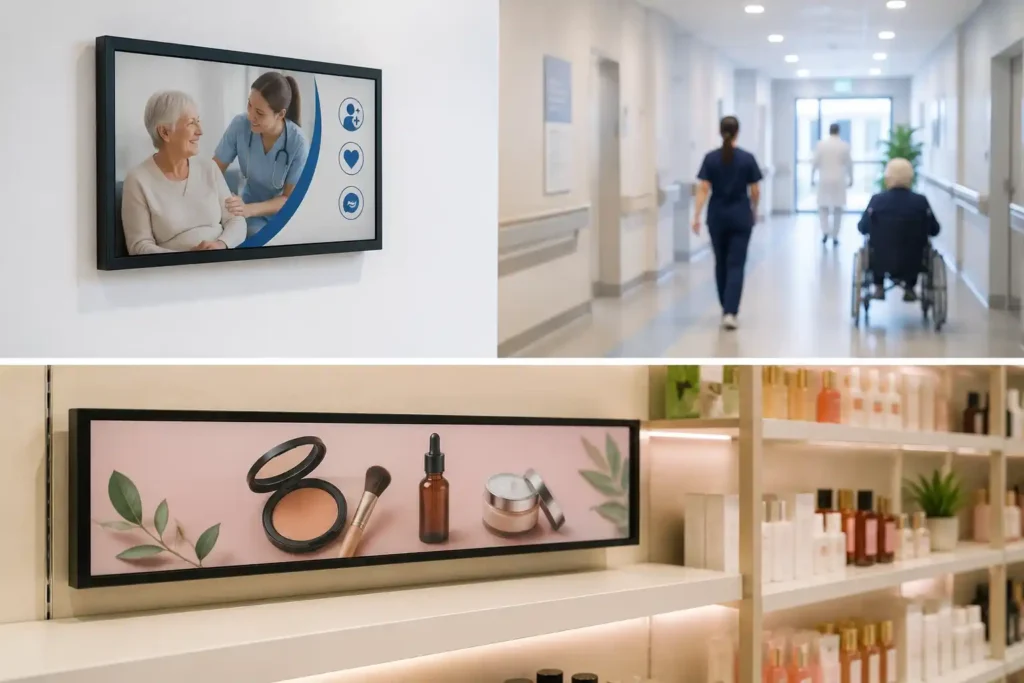
A 37" stretched display in a 32:9 ultrawide aspect ratio — 1920x540 resolution — running Android 13 at 700 nits with 24/7 portrait and landscape rating. Purpose-built for shelf-edge retail signage, price display rails, supermarket gondola strips, transport departure boards, and queue management applications where a standard 16:9 display is the wrong shape for the space. For any signage application where the content is inherently horizontal and narrow, the S-Line solves a problem standard displays cannot.
I-Line / Tableaux — ePaper Zero-Power Displays On request — unique
The Tableaux range is Philips PPDS's most distinctive product category and the one with no direct equivalent from any other manufacturer on this site. Using E Ink Spectra 6 technology, Tableaux displays show full-colour static content — six colours including black, white, red, yellow, blue, and green — with zero power consumption while the image is static. Power is drawn only during content refresh.
For sustainability and ESG applications: retail environments and any organisation with sustainability commitments can deploy static signage with virtually no ongoing power draw. For locations where running 240V mains cabling is architecturally impossible or cost-prohibitive, Tableaux removes the constraint — content updates via WiFi, BLE, or NFC from an internal battery.
For healthcare: the 13" Tableaux Healthcare eSign (13BDL2250I) is a portable patient information display that travels bedside to bedside and ward to ward without a mains power connection. Rechargeable via USB-C and designed to be wiped down with alcohol-based hospital cleaning fluids — meeting healthcare hygiene standards standard commercial displays cannot satisfy.

Explore by application
Where Philips PPDS fits across commercial display categories
Philips PPDS covers a broader operational spectrum than any other manufacturer on this site. The right series depends on what the display needs to do, not just where it sits — duty cycle, interactivity, ambient light, content management, and environment all determine which line is the correct specification.
Everyday commercial display environments
The Q-Line covers standard business hours digital signage display deployments across retail, corporate, and education. The D-Line steps up for any environment requiring continuous 24/7 operation — the duty cycle distinction between these two lines is the most important specification decision in the Philips range.
Hospitality and QSR menu boards
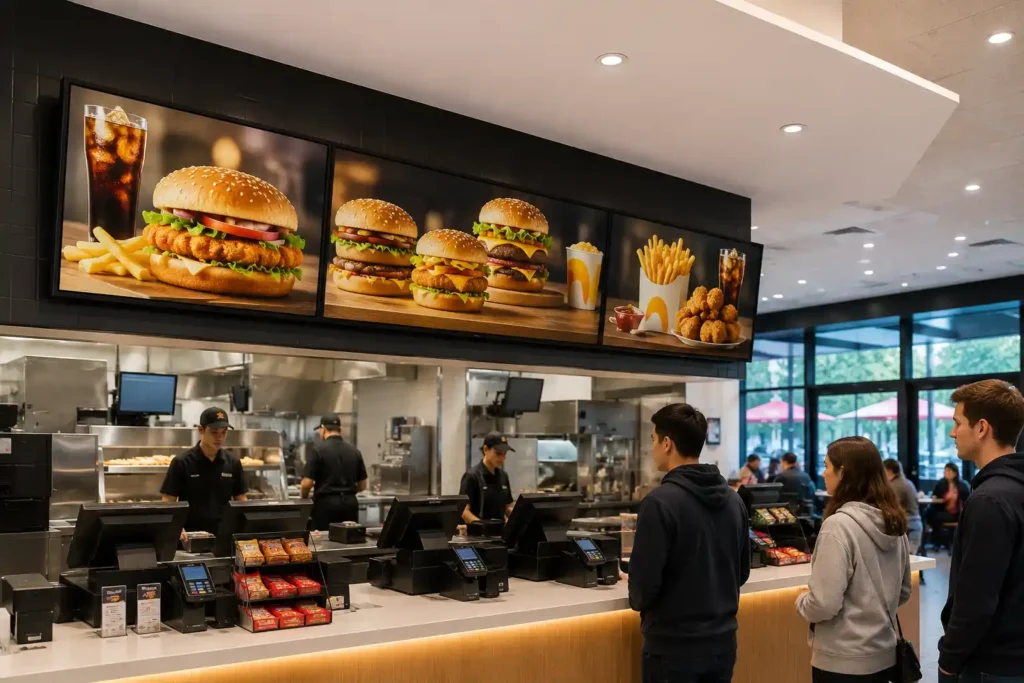
The D-Line's 24/7 duty cycle and FailOver input protection make it the correct specification for digital menu board deployments in cafes, restaurants, and quick service restaurant environments. The B-Line suits venues where broadcast TV and menu content share the same screen.
Multi-screen and video wall configurations
The X-Line is engineered specifically for seamless video wall tiled deployment — sub-2mm bezels and factory colour calibration across panels. The U-Line 98" is worth evaluating as a single-screen alternative before committing to a multi-panel configuration.
High ambient light and outdoor-adjacent environments
The V-Line at 2,000 nits and H-Line at 2,500 to 3,000 nits cover window-facing and high ambient light installations. For fully weatherised applications requiring complete environmental protection, see our outdoor digital signage category.
Touchscreen, kiosk, and interactive deployments
The T-Line covers high-traffic public interactive signage deployments — wayfinding, retail kiosks, and self-service terminals. The E-Line covers collaborative meeting room and education environments where 50-point touch and Android 14 are the brief.
Who Philips PPDS is right for
Environments where operational practicality outweighs brand prestige
Philips PPDS performs best for organisations that prioritise deployment practicality over brand prestige — buyers who need displays to work reliably, integrate with existing software platforms without additional hardware costs, and be manageable at scale across multiple sites. The combination of open Android, FailOver protection, PPDS Wave fleet management, and genuine category breadth makes Philips the strongest operational choice for the deployments listed below.
| Philips PPDS performs best for | Consider other manufacturers when |
|---|---|
| ✓ Multi-site retail networks requiring remote fleet management via PPDS Wave | → Ultra-premium picture quality and Dolby Vision HDR are the primary brief — consider Sony |
| ✓ QSR and hospitality operators needing 24/7 menu board reliability with FailOver protection | → A large proprietary ecosystem with deep third-party integration is required — consider Samsung |
| ✓ Education and corporate environments deploying interactive collaboration displays | → A single prestige installation where brand recognition carries weight in procurement — consider Sony or Samsung |
| ✓ Healthcare organisations requiring clinical-grade displays and portable patient information solutions | → Ultra-high-volume outdoor installations above 3,000 nits requiring full weatherised enclosures |
| ✓ Sustainability-focused organisations seeking zero-power static signage with ESG credentials | |
| ✓ Regional Australian businesses where range stability and one-week national sourcing matter | |
| ✓ Any deployment where removing the external media player reduces per-unit cost and complexity | |
| ✓ Shelf-edge, rail, and stretched bar signage applications requiring 32:9 ultrawide format displays |
Compare other manufacturers
Compare Other Display Manufacturers
Kickstart Computers supplies and advises across multiple commercial display and interactive technology manufacturers — not a single brand. The manufacturers below occupy similar or adjacent territory to Philips PPDS across commercial signage, interactive displays, and professional display environments. If Philips is not the right fit for your specific deployment brief, the pages below cover each manufacturer in the same operational depth as this guide.
Samsung Digital Signage
Samsung competes with Philips across commercial signage, interactive displays, and video wall environments — offering deeper proprietary ecosystem integration through MagicINFO and VXT for organisations that prioritise platform depth over open Android flexibility.
Explore Samsung Displays
LG Digital Signage
LG competes with Philips across professional commercial display and interactive whiteboard environments — OLED technology and architectural display credentials give LG a distinct advantage in premium presentation spaces where Philips focuses on operational practicality.
Explore LG Displays
Sharp Digital Signage
Sharp NEC Display Solutions competes with Philips across professional commercial display tiers — five distinct brightness tiers with SpectraView colour precision and enterprise AV integration for control room and mission-critical environments.
Explore Sharp Displays
Sony Digital Signage
Sony professional displays compete with Philips in premium corporate and prestige retail environments — the choice for organisations where ultra-premium picture quality and Dolby Vision HDR are the primary brief over operational fleet management.
Explore Sony Displays
BenQ Digital Signage
BenQ competes with Philips E-Line across interactive collaboration and education display environments — particularly strong within Google Workspace deployments and AI-assisted classroom technology where Philips focuses on general collaboration practicality.
Explore BenQ DisplaysNot sure which Philips PPDS line suits your environment? Our team can match the right series to your installation requirements — duty cycle, interactivity, brightness, fleet management, and content platform included. Most Philips models not in current stock can be sourced and delivered nationally within approximately one week.
Shop Philips PPDS DisplaysPhilips PPDS sits within a broader commercial display and digital signage market spanning multiple manufacturers and deployment categories. If you are still orientating your research across the full market before committing to a direction, the Digital Signage Hub covers every manufacturer and solution type we supply across Australia.
Digital Signage HubTo discuss your Philips PPDS requirements or request a quote for a specific model or project:
Frequently Asked Questions About Philips PPDS Professional Displays
Philips PPDS (Professional Display Solutions) is Philips' dedicated commercial display division — entirely separate from the consumer television range. Where consumer Philips products are built for home entertainment, Philips PPDS displays are engineered specifically for commercial deployment.
What Philips PPDS is built for:
- Digital signage and commercial display environments
- Interactive collaboration in meeting rooms and education
- Hospitality and healthcare display applications
- Enterprise fleet management across multiple sites
- Zero-power ePaper signage for sustainability and specialist environments
Commercial engineering differences from consumer displays:
- 18/7 and 24/7 duty cycle ratings for continuous operation
- Commercial thermal management for sustained brightness under load
- FailOver input protection — automatic backup source switching
- Enterprise remote management via PPDS Wave platform
- Open Android SoC with Google Play Store access
- Commercial warranties — not consumer terms
Every core Philips PPDS display runs on an open Android platform with Google Play Store access built directly into the display hardware — not a locked proprietary operating system.
What this means operationally:
- Signage platforms install natively on the display — no external media player required
- Compatible platforms include SignageLive, Embed Signage, and PosterBooking
- No additional HDMI or power cabling for a separate player
- No additional point of failure per installation
- Software updates managed through the app platform directly
The financial impact per site:
- External media players typically cost $200–$400 per screen
- In a 20-screen deployment that's $4,000–$8,000 in hardware removed from the budget
- Maintenance and replacement costs for external players are also eliminated
- Network-wide app updates require no physical site visits
PPDS Wave is Philips' cloud-native fleet management platform for managing Philips PPDS display networks remotely from a centralised console.
What Wave enables:
- Remote firmware updates pushed across entire display networks simultaneously
- Hardware health monitoring and fault detection without site visits
- Power consumption analysis across the fleet
- Screen scheduling — on/off times managed remotely per location
- Content management and device configuration from a single interface
The operational saving for multi-site deployments:
- A technician site visit for a firmware update or settings change is eliminated
- Regional or rural Australian locations where call-out fees are significant benefit most
- Franchise networks, school systems, and retail chains manage consistent configurations across all sites from one console
- Wave is comparable to Samsung's MagicINFO and LG's webOS fleet management — without locking buyers into proprietary hardware ecosystems
FailOver is an integrated input protection system built into Philips PPDS commercial displays at the hardware level — not a software feature or optional add-on.
How FailOver works:
- Primary content source is monitored continuously
- If a media player crashes, network drops, or primary source fails — the display automatically switches to a pre-configured backup source
- Backup source is typically a locally stored media file on an internal micro-SD or USB drive
- The switch happens seamlessly without displaying a "No Signal" error or blank screen
Why this matters in commercial environments:
- Retail — a blank screen during trading hours loses revenue and damages brand perception
- QSR — a dark menu board during a lunch rush is an operational failure
- Transport hubs — a blank departure board creates immediate public confusion
- Healthcare — a failed wayfinding display creates navigational problems for patients
FailOver is standard across the Philips PPDS commercial range at no additional licensing cost.
The Q-Line and D-Line are the two core commercial signage tiers in the Philips PPDS range. The distinction between them is the single most important specification decision a buyer makes in the Philips range.
Q-Line:
- 18/7 duty cycle — standard business hours operation
- 350–400 nits brightness
- Android SoC, Google Play Store, FailOver, PPDS Wave
- Correct specification for displays that switch off overnight
D-Line:
- 24/7 duty cycle — continuous around-the-clock operation
- 450–500 nits brightness
- Portrait-safe thermal management for vertical mounting
- Correct specification for any display running outside business hours
The critical warning:
- Specifying a Q-Line for 24/7 use voids the commercial warranty
- Running a Q-Line continuously causes premature panel degradation
- If a display will ever run unattended overnight, the D-Line is the correct specification — not the Q-Line
Choose Q-Line when: displays run standard business hours and switch off overnight. Choose D-Line when: displays run continuously, operate in portrait orientation, or cannot be switched off.
Philips PPDS structures its commercial display range around operational purpose rather than size or brightness tiers.
Q-Line — core commercial signage:
- 18/7, 350–400 nits, Android SoC
- Standard business hours retail, corporate, education
D-Line — 24/7 heavy duty:
- 24/7, 450–500 nits, portrait-safe
- QSR, transport, 24/7 retail, reception
B-Line — meeting room hybrid:
- 16/7–18/7, TV tuner, native Chromecast, Google Play
- Corporate huddle rooms, hospitality, pub and club
E-Line — interactive collaboration:
- 18/7, 50-point touch, Android 14, 128GB storage
- Boardrooms, education, training rooms
X-Line — videowall:
- 24/7, sub-2mm bezel, 10x10 tiling, colour-calibrated
- Retail walls, corporate lobbies, control rooms
T-Line — high-traffic interactive signage:
- 24/7, ruggedised touch, open Android
- Wayfinding, retail kiosks, self-service terminals
Yes — and the D-Line is specifically the correct specification for QSR and hospitality menu board deployments.
Why D-Line suits QSR menu boards:
- 24/7 duty cycle covers overnight and early-morning operation
- Portrait-safe thermal management — menu boards typically mount vertically
- FailOver protection ensures menus remain visible even if network drops
- PPDS Wave allows content and pricing updates pushed remotely across multiple locations simultaneously
- Open Android means menu board software installs directly on the display
For hospitality venues requiring both TV broadcast and digital menu content on the same screen:
- The B-Line's native TV tuner and Chromecast support covers this without additional hardware
Philips Tableaux is the most distinctive product category in the Philips PPDS range — and the one with no direct equivalent from any other manufacturer on this site. Using E Ink Spectra 6 technology, Tableaux displays show full-colour static content with zero power consumption while the image is static.
How the zero-power technology works:
- Six colours displayed — black, white, red, yellow, blue, green
- Power is drawn only during content refresh — not while displaying static content
- Content updates via WiFi, Bluetooth, or NFC
- Internal 3000mAh battery provides power between refreshes
- Rechargeable via USB-C
Two distinct deployment problems Tableaux solves:
For sustainability and ESG applications:
- Static signage with virtually zero ongoing power draw
- Satisfies corporate ESG and environmental sustainability metrics
- Ideal for organisations with carbon reduction commitments
For locations where mains power cabling is impossible:
- Heritage buildings, glass partitions, public thoroughfares where trenching for 240V cabling is architecturally prohibited or cost-prohibitive
- Tableaux operates entirely unplugged between remote content updates
For healthcare — the 13" Tableaux Healthcare eSign (13BDL2250I):
- Portable patient information display — travels bedside to bedside without mains power
- Alcohol-based cleaning fluid compatible — meets hospital hygiene standards
- Patient details display indefinitely without power once content is updated
Yes — but only specific series are engineered for continuous portrait mounting.
Portrait-safe Philips PPDS series:
- D-Line — 24/7, industrialised cooling architecture for sustained vertical operation
- S-Line — 32:9 ultrawide stretched display, rated for both portrait and landscape at 24/7
- X-Line — video wall panels, portrait and landscape capable
Series where portrait mounting requires caution:
- Q-Line — 18/7 rated, not engineered for continuous vertical thermal load
- B-Line — 16/7 to 18/7 rated, landscape primary orientation
- E-Line — 18/7 landscape rated for collaboration use
The key issue: displays running in portrait orientation under continuous load generate heat differently from landscape operation. The D-Line's thermal architecture is specifically designed to manage this. Mounting a Q-Line or B-Line vertically for extended continuous operation risks panel degradation and voids the commercial warranty.
Suitability by tier and environment:
Standard office and indoor retail lighting:
- Q-Line at 350–400 nits handles controlled indoor ambient light
Brighter retail environments and corporate lobbies:
- D-Line at 450–500 nits with anti-glare finish
High ambient light near windows and glazed facades:
- V-Line at 2,000 nits — also DICOM compatible for clinical environments
Direct sunlight through storefront windows:
- H-Line at 2,500–3,000 nits — specifically engineered for solar loading and window-facing thermal stress
Fully outdoor and weatherised installations:
- Dedicated outdoor digital signage solutions are the appropriate category — the H-Line is for window-facing indoor applications, not external weatherised deployment
Philips PPDS appeals to organisations that prioritise operational practicality over brand prestige or premium image performance.
Philips PPDS wins when:
- Open Android flexibility and CMS choice matter more than proprietary ecosystems
- Removing external media player hardware reduces per-site cost and complexity
- FailOver protection is required for mission-critical customer-facing deployments
- Remote fleet management via PPDS Wave is operationally important
- Sustainability and zero-power ePaper signage are part of the brief
- Range stability across a long procurement timeline matters
- Specialist formats — stretched bar, clinical, ultra-high-brightness — are required
Other manufacturers win when:
- Ultra-premium picture quality and Dolby Vision HDR are the primary brief — Sony
- Deep proprietary ecosystem integration is required — Samsung
- A single prestige installation where brand recognition carries procurement weight — Sony or Samsung
Philips is especially strong for:
- Multi-site retail and franchise networks
- QSR and hospitality operators
- Education campuses and government deployments
- Healthcare organisations
- Regional Australian businesses where range stability and national sourcing matter
- Any IT manager who wants Android openness without a proprietary CMS lock-in
Kickstart Computers supplies Philips PPDS professional displays to businesses, schools, government organisations, and commercial installers across Australia.
What Kickstart Computers offers:
- Philips PPDS commercial display range across Q-Line, D-Line, B-Line, E-Line, X-Line, T-Line, and specialist series
- Competitive pricing including GST — no hidden fees at checkout
- National shipping to metro and regional locations across Australia
- Pre-purchase advisory — matching the right Philips series to your duty cycle, environment, and budget
- Access to the full Philips PPDS range including specialist models available on request within approximately one week Australia-wide
Who we supply:
- Retail businesses and franchise networks
- Corporate and government organisations
- Schools, universities, and education facilities
- Hospitality venues and QSR operators
- Healthcare providers and medical facilities
- AV integrators and commercial installers
To discuss your requirements or request a quote:
- Email: sales@kickstartcomputers.com.au
- Call: 0416 353 501
- Or visit kickstartcomputers.com.au to browse the full Philips PPDS range
