
Jump Ahead Too
ToggleOutdoor Digital Signage Australia — Commercial Deployment Overview
Outdoor digital signage deployments within Australian environments commonly require specialised commercial engineering designed to manage direct sunlight visibility, high ambient temperatures, environmental exposure, and long-term operational reliability.
Depending on deployment conditions, outdoor commercial signage solutions may utilise ultra-high brightness displays ranging from 1500–5000+ nits, advanced thermal management systems, weather-resistant enclosure protection, anti-reflective technology, cloud-based signage ecosystems, and long-term 24/7 commercial operating capability.
Outdoor digital signage solutions can vary considerably depending on whether the deployment involves retail shopfronts, drive-through environments, mining and industrial sites, transport infrastructure, public communication systems, hospitality venues, or large-format Direct View LED (DVLED) advertising environments.
Kickstart Computers supplies outdoor digital signage solutions Australia-wide across high-brightness commercial LCD displays, outdoor kiosks, menu boards, DVLED systems, and weather-resistant commercial signage deployments depending on project requirements and deployment suitability.
Outdoor Digital Signage — Key Commercial Takeaways
Brightness Directly Impacts Visibility
Within Australian outdoor environments, brightness capability can significantly influence display readability. Many direct sunlight deployments commonly require 2500–5000+ nit commercial displays to maintain visibility throughout peak daylight conditions.
Thermal Management Is Critical
Ultra-high brightness outdoor displays commonly generate substantial heat. Professional outdoor signage deployments often rely on advanced cooling systems, airflow management, and thermal engineering to support long-term operational reliability.
Environmental Protection Matters
Outdoor commercial displays commonly utilise IP65, IP66, and IP67-rated protection systems designed to assist with dust ingress, rainfall exposure, humidity management, and challenging Australian environmental conditions.
Outdoor digital signage is part of the broader commercial display landscape. If you're also researching indoor commercial displays, video walls, interactive solutions, or digital menu boards, our commercial display and signage guide covers the full range of technologies available in Australia.

Engineering Outdoor Digital Signage For Australian Conditions
Outdoor digital signage deployments within Australia require substantially more than simply placing a standard display inside a weather-resistant enclosure.
Australian outdoor environments can expose commercial displays to:
- direct sunlight and extreme UV exposure
- 45°C+ summer temperatures
- high ambient heat buildup
- dust, humidity, and coastal salt air
- heavy rain and storm environments
- continuous public-facing commercial operation
Because of these conditions, outdoor digital signage solutions commonly require specialised engineering including ultra-high brightness panels, advanced cooling systems, intelligent thermal management capability, weather-resistant enclosures, anti-reflective glass technology, and commercial-grade operating reliability.
| Outdoor Requirement | Why It Matters In Australian Conditions |
|---|---|
| 2500–5000+ nit brightness | Maintains visibility within direct sunlight and high ambient light environments |
| IP66 / IP67 weather protection | Helps protect displays from rain, dust, humidity, and outdoor environmental exposure |
| Advanced thermal management | Reduces overheating risk during Australian summer temperatures and prolonged operation |
| Anti-reflective display technology | Improves readability and reduces glare within bright outdoor environments |
| Commercial 24/7 operating capability | Supports long-term reliability within public-facing business environments |
Outdoor displays are always 24/7 environments — but 24/7 duty cycle rating is only one of two warranty conditions that must be met. Operating temperature range is the other, and it is the one most commonly overlooked in outdoor deployments.
Our dedicated duty cycle page covers what each rating means in plain language, why enclosure cooling must be sized against the panel's thermal output rather than the enclosure volume, what direct radiant solar heat does to panel surface temperatures independently of ambient air temperature, and what happens to the warranty claim when either condition is breached.
Commercial Display Duty Cycle — What It Means and How to Specify It Correctly →Since 2007, Kickstart Computers has supplied commercial display and signage solutions across Australia, helping businesses evaluate outdoor digital signage deployments based on environmental conditions, visibility requirements, deployment environments, operating schedules, and long-term commercial suitability.
Outdoor digital signage solutions are commonly deployed across:
- retail shopfronts
- hospitality venues
- shopping centres
- schools and universities
- transport hubs
- public-facing communication environments
- mining and industrial environments
Explore Related Commercial Signage Solutions
Outdoor digital signage deployments are often implemented alongside other commercial display technologies depending on customer engagement requirements, operating environments, collaboration functionality, content management strategies, and long-term business communication goals.
Businesses researching outdoor digital signage may also evaluate interactive displays, video wall systems, digital menu boards, and commercial indoor signage platforms depending on deployment scale, audience engagement objectives, and operational requirements.

Commercial Digital Signage Displays
High-brightness commercial display solutions designed for retail visibility, customer engagement, internal communication, and business signage deployments.

Commercial Video Walls
Large-format multi-display communication systems designed for public visibility, immersive commercial environments, and large-scale audience engagement.

Outdoor Digital Menu Boards
Commercial menu board systems designed for hospitality environments, drive-through deployments, scheduled promotions, and dynamic content management.

Interactive Commercial Displays
Interactive touchscreen signage systems designed for wayfinding, customer engagement, collaboration environments, and self-service communication applications.
Explore Outdoor Digital Signage by Manufacturer
The three manufacturers most commonly specified for outdoor digital signage deployments in Australia each bring different strengths across high-brightness LCD, Direct View LED, and commercial display categories. These pages cover their full commercial range in detail.
Samsung Commercial Displays
Samsung's outdoor and high-brightness commercial display range spans direct view LED systems, high-brightness LCD panels, and commercial signage platforms — backed by one of the broadest commercial display ecosystems available in Australia.
LG Commercial Displays
LG's commercial display range includes high-brightness outdoor-adjacent panels and large-format display solutions suited to retail, hospitality, transport, and public-facing outdoor signage environments across Australia.
Philips PPDS Commercial Displays
Philips' H-Line covers window-facing and high-brightness outdoor-adjacent environments — with commercial display engineering specifically designed for Australian retail, hospitality, and public-facing signage deployments.
Australian Climate Deployment Matrix
Outdoor digital signage deployments across Australia can vary significantly depending on climate conditions, environmental exposure, sunlight intensity, humidity levels, airborne dust, coastal corrosion risk, and long-term operating requirements.
A commercial outdoor signage solution suitable for a shaded metropolitan retail environment may differ substantially from a deployment operating within mining environments, tropical regions, coastal areas, or direct sunlight public-facing installations.
Matching the appropriate commercial display technology, enclosure protection, brightness capability, cooling systems, and environmental protection rating to the intended Australian deployment environment can significantly improve long-term reliability and deployment suitability.
| Australian Environment | Recommended Commercial Solution | Key Environmental Challenge | Typical Commercial Considerations |
|---|---|---|---|
|
Tropical Northern Australia Darwin, Far North Queensland | IP67 commercial enclosures with advanced cooling and humidity management systems | Humidity, condensation, heavy rainfall, prolonged heat exposure | Sealed weather protection, internal airflow management, corrosion-resistant materials |
|
Arid Interior & Mining Environments Alice Springs, remote industrial environments | High-brightness commercial displays with reinforced thermal management and dust protection | Extreme temperatures, airborne dust, prolonged direct sunlight exposure | Advanced cooling systems, filtered airflow design, commercial 24/7 operating capability |
|
Coastal Australian Environments Adelaide, Perth, Sydney coastal regions | Corrosion-resistant outdoor signage systems with marine-grade enclosure protection | Salt air corrosion, moisture exposure, long-term outdoor weathering | Powder-coated enclosures, corrosion-resistant materials, sealed commercial protection systems |
|
Urban Retail & Shopfront Environments Shopping centres, metropolitan retail precincts | Ultra-high brightness LCD or Direct View LED commercial signage solutions | High ambient light, shopfront glare, customer visibility during peak daylight conditions | 2500–5000+ nit brightness capability, anti-reflective glass, intelligent brightness sensors |
Outdoor commercial signage deployments may also require consideration for:
- local council signage regulations
- operating schedules and energy usage
- public safety visibility requirements
- electrical compliance and surge protection
- remote monitoring capability
- future scalability and signage management systems
Because outdoor commercial signage solutions often represent a substantial long-term business investment, selecting hardware designed specifically for the intended Australian deployment environment can significantly improve reliability, visibility performance, and long-term operational stability.
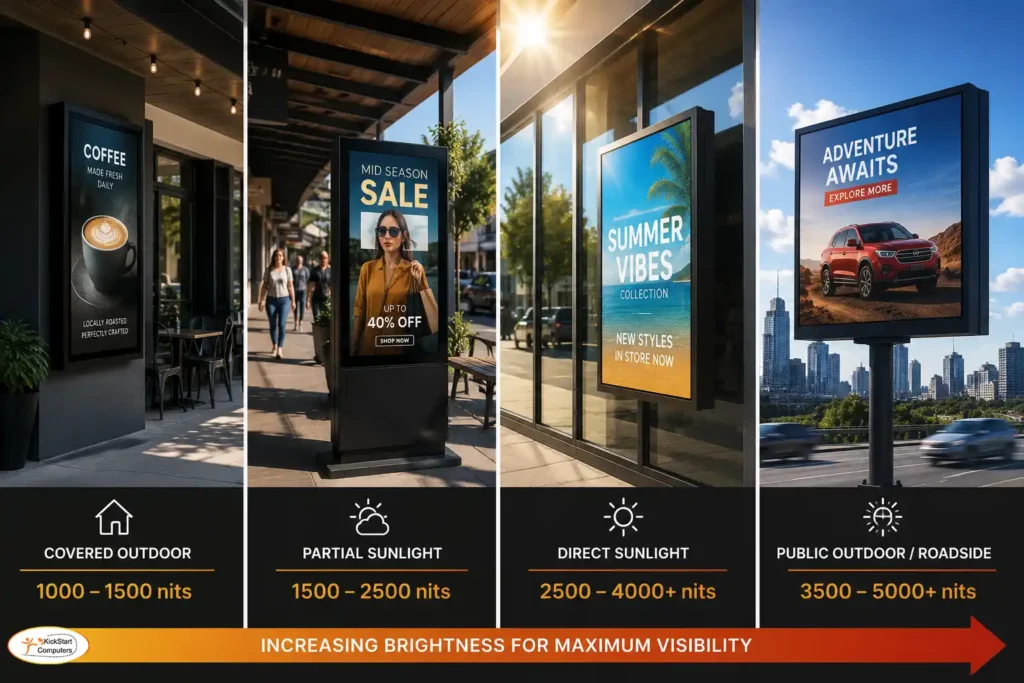
Brightness Engineering & Outdoor Display Visibility
Outdoor digital signage visibility depends on substantially more than simply increasing display brightness levels. Australian outdoor environments often introduce direct sunlight, reflective glare, ambient light washout, heat buildup, and varying daytime visibility conditions that can significantly impact display readability.
Because of this, outdoor commercial signage deployments commonly utilise specialised high-brightness commercial display technology combined with anti-reflective glass, intelligent brightness sensors, thermal management systems, and commercial-grade cooling capability designed specifically for outdoor operating environments.
| Outdoor Environment | Typical Brightness Range | Common Commercial Deployment Examples |
|---|---|---|
| Covered Outdoor Areas | 1000–1500 nits | Undercover walkways, protected hospitality areas, shaded entrances, covered public spaces |
| Partial Sunlight Environments | 1500–2500 nits | Semi-exposed retail areas, partially shaded shopfronts, outdoor hospitality environments |
| Direct Sunlight Shopfront Displays | 2500–4000+ nits | Window-facing retail signage, high ambient light commercial environments, daytime promotional displays |
| Public Outdoor & Roadside Signage | 3500–5000+ nits | Outdoor advertising, transport environments, roadside communication systems, public-facing infrastructure |
Brightness capability alone does not always guarantee effective outdoor visibility. Factors such as anti-glare coatings, optical bonding technology, viewing angle performance, panel contrast capability, and enclosure design can also significantly influence readability within direct sunlight environments.
Many modern outdoor commercial displays now incorporate automatic brightness adjustment systems capable of dynamically adapting brightness levels throughout the day depending on surrounding ambient lighting conditions.
Intelligent brightness control systems can help:
- maintain visibility during peak daylight conditions
- reduce excessive night-time brightness
- improve long-term energy efficiency
- reduce unnecessary thermal load
- assist with local visibility and compliance requirements
Within many Australian outdoor environments, thermal management becomes equally as important as brightness capability itself. Ultra-high brightness commercial displays commonly generate significantly more heat than standard indoor signage displays, requiring reinforced cooling systems and advanced airflow management to support long-term commercial reliability.
Outdoor digital signage deployments designed specifically for Australian conditions commonly balance brightness performance, environmental protection, cooling capability, and long-term operational stability rather than relying purely on maximum brightness specifications alone.
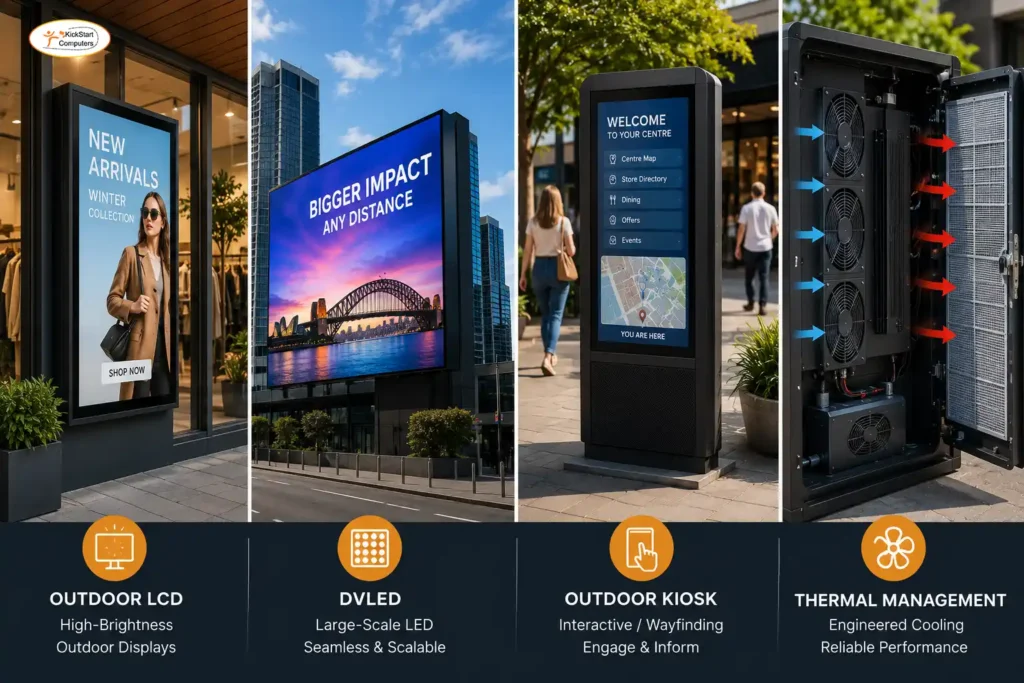
Outdoor Display Technologies & Commercial Deployment Solutions
Outdoor digital signage deployments can vary significantly depending on visibility requirements, viewing distance, environmental exposure, installation location, content strategy, and long-term commercial operating requirements.
Different outdoor display technologies are commonly designed to prioritise different strengths including ultra-high brightness visibility, large-format scalability, weather resistance, modular deployment flexibility, or integrated commercial enclosure protection.
| Outdoor Display Solution | Common Commercial Advantages | Typical Deployment Environments | Commercial Considerations |
|---|---|---|---|
| High-Brightness Outdoor LCD | Excellent image clarity, high brightness capability, strong readability within direct sunlight conditions | Shopfront windows, retail signage, hospitality environments, outdoor menu boards | Cooling systems and thermal management become increasingly important at higher brightness levels |
| Direct View LED (DVLED) | Exceptional large-format scalability, seamless panel design, ultra-high outdoor visibility | Stadiums, public advertising, transport hubs, large-scale outdoor communication environments | Typically higher project complexity and installation requirements compared to standalone LCD systems |
| Outdoor Digital Kiosks | Integrated enclosure protection, standalone deployment capability, customer engagement functionality | Shopping centres, public spaces, wayfinding systems, hospitality environments | Environmental protection ratings and vandal resistance may vary between deployment environments |
| Outdoor Menu Board Systems | Dynamic scheduling capability, daypart content management, improved operational flexibility | Drive-through environments, hospitality venues, quick-service restaurants | Brightness capability and readability remain critical during peak daylight operating hours |
| Weatherproof Display Enclosures | Allows selected commercial displays to operate within protected outdoor environments | Semi-protected outdoor areas, industrial environments, retrofit commercial deployments | Cooling capability, airflow management, and sunlight exposure remain important considerations |
Thermal Management & Outdoor Display Enclosure Considerations
Ultra-high brightness commercial displays commonly generate substantially more heat compared to standard indoor signage displays, particularly once brightness capability exceeds 1000–1500 nits within direct sunlight operating environments.
Because of this, outdoor display enclosures often require carefully planned thermal management systems capable of maintaining stable internal operating temperatures throughout prolonged Australian summer conditions.
Outdoor enclosure cooling design may commonly include:
- active cooling fan systems
- filtered airflow management
- heat extraction systems
- temperature-controlled ventilation
- air-conditioned enclosure systems
- humidity and condensation management
Within many outdoor deployments, insufficient airflow or poorly designed enclosure cooling systems can contribute to overheating, thermal shutdowns, reduced panel lifespan, image performance issues, accelerated component wear, or long-term commercial reliability concerns.
As outdoor commercial display brightness capability increases toward 2500–5000+ nit environments, thermal engineering often becomes equally as important as brightness performance itself when designing long-term outdoor signage deployments for Australian conditions.
Within many Australian outdoor deployments, selecting the correct outdoor display technology often depends on balancing visibility performance, deployment complexity, environmental protection, long-term reliability, and overall commercial operating suitability rather than simply comparing display specifications alone.
Larger outdoor environments with extended viewing distances may commonly favour Direct View LED deployment strategies, while retail-facing shopfront environments and customer engagement applications may often prioritise ultra-high brightness LCD commercial displays with advanced anti-reflective technology and integrated brightness management capability.
Outdoor digital signage deployments may also vary considerably depending on:
- viewing distance and audience size
- operating schedules and 24/7 requirements
- daytime versus night-time visibility
- environmental exposure conditions
- remote management capability
- future scalability requirements
- content management ecosystems
- long-term maintenance accessibility
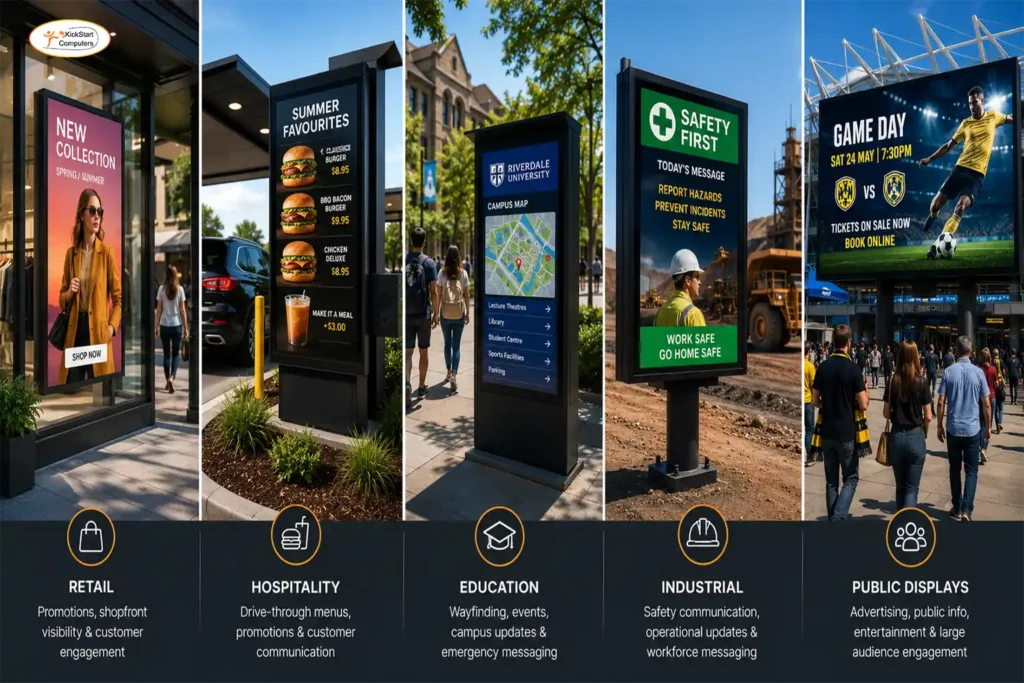
Outdoor Digital Signage Applications & Commercial Deployment Environments
Outdoor digital signage solutions are commonly deployed across a wide range of Australian commercial environments depending on visibility requirements, audience size, operating schedules, environmental exposure, and long-term communication objectives.
Different outdoor deployment environments often prioritise different commercial requirements including ultra-high brightness visibility, weather protection, remote content management, large-format scalability, interactive capability, or long-term 24/7 operational reliability.
| Commercial Environment | Common Outdoor Signage Applications | Typical Commercial Priorities | Common Display Solutions |
|---|---|---|---|
| Retail & Shopping Centres | Promotional advertising, shopfront visibility, customer engagement, window-facing campaigns | High brightness visibility, dynamic scheduling, retail marketing flexibility | High-brightness outdoor LCD displays, window-facing commercial signage systems |
| Hospitality & Drive-Through Environments | Outdoor menu boards, ordering systems, promotional campaigns, customer communication | Daylight readability, weather protection, remote content scheduling | Outdoor menu board systems, commercial kiosk displays |
| Transport & Public Infrastructure | Passenger information, public announcements, wayfinding, public communication systems | 24/7 reliability, large audience visibility, centralised management capability | Direct View LED systems, public-facing outdoor LCD deployments |
| Education & University Campuses | Campus communication, event promotion, navigation systems, emergency messaging | Flexible scheduling, remote updates, multi-location content management | Outdoor kiosks, high-brightness LCD displays |
| Mining & Industrial Environments | Safety communication, operational updates, workforce messaging, site-wide announcements | Environmental durability, thermal management, dust protection, long-term reliability | Ruggedised outdoor signage systems, weather-protected commercial displays |
| Sports, Events & Entertainment | Advertising, sponsorship visibility, live information, audience engagement | Large-format scalability, high brightness visibility, crowd readability | Direct View LED displays, large-format outdoor signage systems |
Many modern outdoor digital signage deployments now utilise cloud-based signage ecosystems capable of remotely managing content, scheduling campaigns, monitoring display status, and synchronising messaging across multiple locations from a centralised management platform.
For larger multi-site organisations, remote signage management capability can significantly simplify content deployment workflows while improving operational consistency across multiple business locations.
Outdoor signage deployments may also evolve considerably over time as businesses expand into:
- multi-location signage networks
- centralised cloud management platforms
- interactive customer engagement systems
- real-time information displays
- integrated advertising campaigns
- large-format public communication environments
Remote Management, Monitoring & Long-Term Outdoor Signage Reliability
Modern outdoor digital signage deployments often involve substantially more than simply installing a high-brightness display within an outdoor environment. Many commercial signage deployments now operate as part of larger connected signage ecosystems designed to support remote management, content scheduling, operational monitoring, and long-term multi-site deployment scalability.
For many Australian businesses, councils, education providers, retail groups, hospitality venues, and public-facing organisations, the ability to remotely manage outdoor signage networks can significantly simplify long-term deployment administration and operational consistency.
| Management Capability | Commercial Operational Benefit | Common Outdoor Signage Applications |
|---|---|---|
| Remote Content Management | Allows signage content to be updated centrally across multiple locations | Retail promotions, public messaging, hospitality menu updates, scheduled campaigns |
| Cloud-Based Scheduling | Automates daypart scheduling, timed campaigns, and operational messaging updates | Drive-through menu boards, event venues, public communication environments |
| Remote Monitoring Systems | Assists with identifying offline displays, thermal warnings, or operational faults | Multi-site commercial signage networks, public-facing outdoor deployments |
| Multi-Display Synchronisation | Supports coordinated messaging and large-scale content deployment consistency | Stadiums, transport hubs, shopping centres, public advertising environments |
| Integrated SoC Platforms | Reduces external hardware requirements while simplifying deployment management | Samsung Tizen, LG webOS, cloud signage ecosystems, standalone commercial deployments |
Many modern commercial outdoor displays now support integrated System on Chip (SoC) platforms capable of running signage applications directly from the display without requiring separate external media players.
Integrated commercial signage ecosystems such as Samsung Tizen and LG webOS platforms can support:
- centralised content management
- remote display monitoring
- cloud-based scheduling
- multi-site deployment control
- real-time content updates
- display health monitoring
- enterprise signage scalability
Within outdoor commercial environments, long-term reliability often depends on balancing hardware engineering, environmental protection, cooling capability, network stability, and signage ecosystem management rather than focusing solely on display brightness specifications alone.
Larger organisations operating multiple outdoor signage deployments may also prioritise:
- centralised network management
- remote troubleshooting capability
- software update management
- scheduled maintenance workflows
- content approval systems
- future signage scalability
Outdoor deployments are almost always 24/7 environments — and often multi-site. The CMS platform decision is as consequential as the display specification, and it should happen before hardware is ordered.
Our dedicated CMS decision framework covers what each platform does, when a manufacturer CMS suits your outdoor network versus a third-party platform, the four questions to answer before evaluating any option, and a plain-language comparison of Samsung MagicINFO, VXT, Philips PPDS Wave, LG SuperSign, Fusion Signage, and BrightSign — including which works best across multi-site outdoor networks.
How to Choose a Signage CMS Before You Buy Hardware →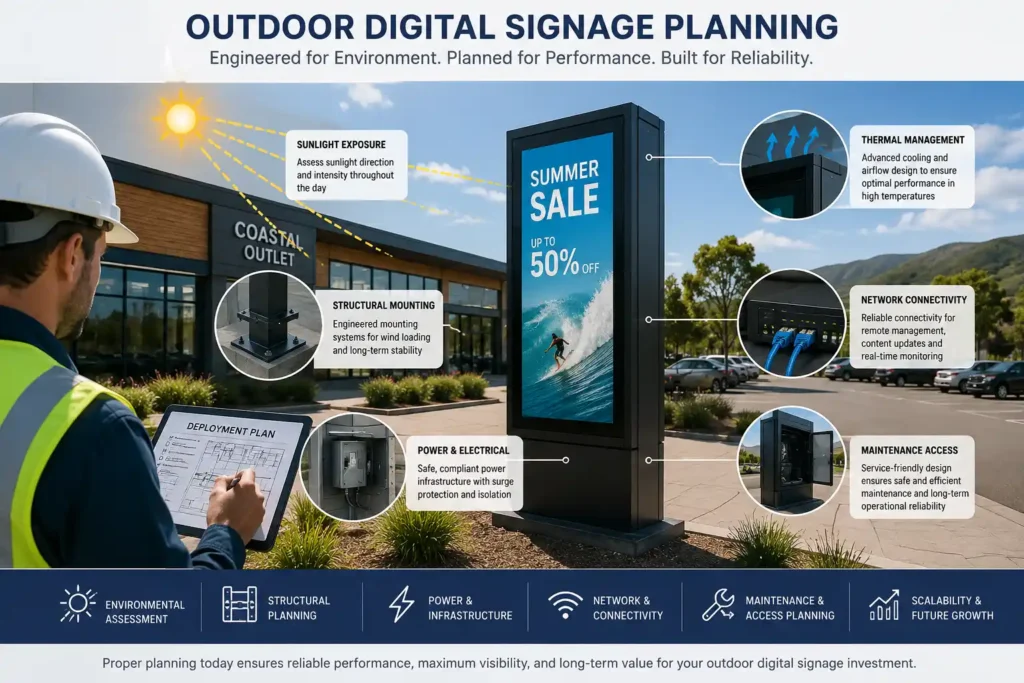
Outdoor Digital Signage Planning & Deployment Considerations
Successful outdoor digital signage deployments often depend on considerably more than selecting a high-brightness commercial display. Long-term deployment suitability can also be heavily influenced by installation location, environmental exposure, airflow management, network infrastructure, maintenance accessibility, and future operational scalability.
Planning outdoor commercial signage deployments correctly from the beginning can help reduce long-term operational issues while improving reliability, visibility performance, and overall commercial deployment stability.
| Deployment Consideration | Why It Matters | Common Commercial Impact |
|---|---|---|
| Sunlight Direction & Exposure | Direct sunlight intensity can dramatically influence brightness requirements and heat generation | May require higher nit displays, anti-reflective technology, and advanced cooling systems |
| Thermal Management & Airflow | Outdoor commercial displays generate significant heat, particularly at ultra-high brightness levels | Poor airflow may contribute to overheating, thermal shutdowns, or reduced component lifespan |
| Power & Electrical Infrastructure | Outdoor signage systems often require dedicated power planning and environmental electrical protection | Electrical compliance, surge protection, and power stability become increasingly important |
| Network Connectivity | Remote management and cloud signage systems require stable network communication | Supports remote content updates, monitoring systems, and centralised management platforms |
| Maintenance Accessibility | Outdoor signage systems may require servicing, cleaning, or future component replacement | Safe service access can significantly simplify long-term maintenance workflows |
| Wind Loading & Structural Considerations | Larger outdoor displays and DVLED systems may experience significant environmental loading forces | Structural engineering and mounting systems may vary substantially depending on installation environment |
Outdoor signage deployments may also require consideration for:
- local council signage regulations
- public visibility compliance requirements
- future display expansion capability
- multi-site signage management
- remote troubleshooting accessibility
- daytime and night-time brightness balancing
- long-term environmental exposure conditions
Within many Australian outdoor deployments, businesses often benefit from evaluating long-term operational suitability, environmental exposure, maintenance accessibility, and signage scalability during the initial planning stage rather than focusing solely on upfront display pricing comparisons.
Larger outdoor signage deployments may also evolve considerably over time as organisations expand into:
- additional business locations
- centralised cloud signage ecosystems
- network-wide content scheduling
- interactive public communication systems
- large-format outdoor advertising networks
Choosing The Right Outdoor Digital Signage Solution
Selecting the most suitable outdoor digital signage solution often depends on balancing brightness capability, environmental exposure, deployment scale, visibility requirements, operational management, and long-term commercial reliability rather than simply comparing display specifications alone.
Different outdoor commercial environments commonly prioritise different signage requirements depending on audience size, viewing distance, operating schedules, environmental conditions, and overall communication objectives.
| Deployment Requirement | Common Commercial Priority | Often Best Suited To | Typical Commercial Considerations |
|---|---|---|---|
| Retail Shopfront Visibility | Daylight readability, promotional flexibility, customer engagement | Ultra-high brightness outdoor LCD displays | Anti-reflective technology, thermal management, direct sunlight exposure |
| Large Public Viewing Environments | Long-distance visibility, large audience communication, scalability | Direct View LED (DVLED) systems | Structural engineering, viewing distance, installation complexity |
| Interactive Customer Engagement | Wayfinding, touch interaction, self-service communication | Outdoor digital kiosks and interactive signage systems | Vandal resistance, enclosure protection, maintenance accessibility |
| Hospitality & Menu Board Deployments | Daypart scheduling, operational flexibility, content updates | Outdoor menu board systems | Brightness balancing, readability, weather protection |
| Industrial & Mining Environments | Reliability, environmental durability, operational communication | Ruggedised commercial outdoor signage systems | Dust protection, thermal stability, long-term operational reliability |
Within many Australian outdoor environments, brightness capability alone may not always determine the most suitable commercial signage solution. Factors such as airflow management, thermal engineering, maintenance accessibility, remote management capability, environmental protection ratings, and long-term operational scalability can all significantly influence deployment suitability.
Businesses planning future expansion or multi-site outdoor signage deployments may also benefit from evaluating:
- cloud signage ecosystem compatibility
- remote management capability
- multi-location content scheduling
- future scalability requirements
- maintenance accessibility
- network infrastructure requirements
- long-term signage management workflows
Since 2007, Kickstart Computers has supplied commercial display and signage solutions across Australia, helping businesses evaluate outdoor signage deployments based on visibility requirements, operating environments, deployment complexity, and long-term commercial suitability.
Frequently Asked Questions With Answers On Outdoor Digital Signage Solutions
What brightness is recommended for outdoor digital signage?
Outdoor digital signage brightness requirements depend heavily on ambient light and direct sunlight exposure. Many covered outdoor environments may operate effectively around 1000–1500 nits, while direct sunlight retail windows and roadside signage deployments commonly require 2500–5000+ nit commercial displays to maintain daytime visibility.
• Covered outdoor environments: 1000–1500 nits
• Partial sunlight environments: 1500–2500 nits
• Direct sunlight shopfronts: 2500–4000+ nits
• Roadside & public outdoor signage: 3500–5000+ nits
Can outdoor digital signage displays operate in direct sunlight?
Yes. Commercial outdoor digital signage displays are specifically engineered for high ambient light and direct sunlight operating environments using ultra-high brightness commercial panels, anti-reflective technology, thermal management systems, and weather-resistant enclosure protection.
Commercial outdoor visibility systems commonly include:
• Ultra-high brightness commercial displays
• Anti-reflective glass technology
• Intelligent brightness sensors
• Thermal cooling systems
• Weather-resistant enclosures
• Commercial 24/7 operating capability
What IP rating is recommended for outdoor digital signage?
Outdoor commercial signage deployments commonly utilise IP65, IP66, or IP67-rated protection systems depending on environmental exposure conditions. These protection ratings help reduce dust ingress, rainfall exposure, humidity intrusion, and environmental contamination risks.
Common outdoor protection ratings include:
• IP65 — protected against rain and dust ingress
• IP66 — improved resistance against heavy rain and water jets
• IP67 — additional protection for harsher outdoor environments
Do outdoor digital signage displays require cooling systems?
Yes. Ultra-high brightness outdoor commercial displays commonly generate substantial heat, particularly once brightness capability exceeds 1500–2500 nits within direct sunlight environments.
Outdoor thermal management systems may commonly include:
• Active cooling fan systems
• Filtered airflow management
• Temperature-controlled ventilation
• Heat extraction systems
• Air-conditioned enclosure systems
• Thermal monitoring capability
Proper airflow management can significantly improve long-term operational reliability and reduce overheating risks.
Can outdoor digital signage displays overheat?
Yes. Poorly ventilated outdoor signage systems or incorrectly designed enclosures may experience overheating, thermal shutdowns, reduced panel lifespan, or image performance issues during prolonged sunlight exposure and high ambient temperature conditions.
Factors commonly influencing thermal performance include:
• Direct sunlight exposure
• Display brightness capability
• Enclosure airflow design
• Cooling system effectiveness
• Australian summer operating conditions
• Internal enclosure heat buildup
What is the difference between outdoor LCD and Direct View LED (DVLED) displays?
Outdoor LCD commercial displays are commonly deployed for retail shopfronts, menu boards, kiosks, and customer-facing communication environments requiring strong image clarity and high brightness visibility. Direct View LED (DVLED) systems are more commonly used for large-scale outdoor advertising and long-distance public viewing environments.
Outdoor LCD displays commonly prioritise:
• High image clarity
• Retail visibility
• Menu board deployments
• Interactive kiosk applications
• Customer engagement environments
Direct View LED (DVLED) systems commonly prioritise:
• Large-format scalability
• Long-distance visibility
• Public advertising environments
• Stadium and transport deployments
• Seamless large-scale displays
As a general commercial guideline, high-brightness LCD displays are commonly preferred for closer viewing environments such as retail shopfronts, kiosks, and menu boards where audiences may stand within a few metres of the screen. Direct View LED (DVLED) systems often become more suitable for larger public environments and longer viewing distances where large-format scalability and long-distance visibility become increasingly important.
Can outdoor digital signage displays operate 24/7?
Yes. Many commercial outdoor signage systems are specifically engineered for extended 16/7 and 24/7 commercial operation using commercial-grade components, reinforced power systems, advanced cooling capability, and enterprise signage platforms.
Commercial 24/7 outdoor deployments commonly include:
• Commercial operating panels
• Advanced thermal management
• Enterprise signage platforms
• Remote monitoring capability
• Weather-resistant enclosure protection
• Centralised content management systems
How long do outdoor digital signage displays typically last?
Commercial outdoor digital signage lifespan can vary considerably depending on brightness levels, operating schedules, environmental exposure, airflow management quality, and overall deployment conditions. Properly engineered commercial signage systems commonly provide substantially longer operational reliability compared to standard consumer televisions operating outdoors.
Long-term outdoor reliability may commonly depend on:
• Brightness operating levels
• Environmental exposure conditions
• Thermal management quality
• Airflow and cooling design
• Commercial operating schedules
• Preventative maintenance workflows
• Signage platform management capability