
Promethean and SMART Board are Australia's two most established classroom interactive whiteboard ecosystems — and unlike most display comparisons, this one isn't about which is technically superior. Both are strong education-first platforms. The real decision involves teacher familiarity, switching costs, hardware tier flexibility, software ecosystem fit, and the pricing dynamics that emerge when both suppliers compete for the same deployment.
This guide is written for Australian school ICT managers, principals, and procurement teams who need an honest assessment of both platforms — including the commercial dynamics most resellers won't discuss.
Jump Ahead Too
ToggleWhy Promethean vs SMART Board Is Not a Simple “Which Is Better?” Question
Most interactive display comparisons involve products that are clearly differentiated — different primary use cases, different engineering philosophies, different target environments. The Promethean vs SMART Board comparison is not that kind of comparison.
Both Promethean and SMART Board are genuinely strong, education-first interactive display platforms with long established histories in Australian classrooms. Both have built real brand loyalty. Both have software ecosystems that teachers learn, rely on, and build lesson resources around. And both regularly appear in the same school tender, competing for the same classroom budget, evaluated by the same ICT managers and procurement teams.
This means the comparison is less about which product is objectively better — because neither is — and more about understanding the real commercial dynamics at play, what genuine technology differences exist at any given point in time, and how to get the best possible outcome for your school or organisation when evaluating both.
At Kickstart Computers, our approach to this comparison is straightforward: we will tell you what we know, tell you what genuinely matters, and help you navigate the commercial dynamics honestly — including the parts that most resellers would prefer to leave unsaid.
The most important thing to understand about the Promethean vs SMART Board comparison is this: at any given moment, one platform may have a feature or capability the other does not yet offer. But that gap is almost always measured in months, not years. Buying on a momentary feature difference alone is rarely the strongest long-term procurement decision.
What Makes Promethean the Default Choice in So Many Australian Schools?
Promethean has built one of the strongest brand positions in the Australian education interactive display market. In many schools, Promethean is not just a product name — it is the category name. Teachers who have spent years building lesson resources on Promethean software, learning its firmware, and integrating it into their daily classroom workflows carry a genuine familiarity with the platform that has real operational value.
That familiarity is not trivial. When a school deploys Promethean across multiple classrooms, the investment is not just in the hardware — it is in the institutional knowledge teachers build around it. Lesson resources, annotation workflows, student engagement tools, and software habits all become embedded in how a school teaches. Switching platforms carries a switching cost that goes well beyond the price of replacement hardware.
Promethean also occupies a strong position within the reseller channel. As a dominant education brand, Promethean manages its pricing through reseller tier structures that protect margins more actively than some competing platforms. For schools evaluating Promethean through a reseller like Kickstart Computers, it is worth understanding that pricing competitiveness on Promethean — particularly for smaller deployments — may be more constrained than on comparable SMART Board configurations. Larger volume deployments and competitive tender situations change that dynamic considerably.
What Promethean Is Known For
- One of the strongest brand recognition positions in Australian education interactive displays
- Deep teacher familiarity — many educators have built years of lesson resources on Promethean platforms
- Education-first software ecosystem designed exclusively around classroom engagement
- Strong multi-user interaction capability for collaborative classroom environments
- Widely deployed across schools, TAFEs, and education departments Australia-wide
- Long-term institutional loyalty built through consistent classroom performance
The Real Switching Cost
One of the most commercially important — and least discussed — aspects of the Promethean vs SMART comparison is the switching cost embedded in teacher familiarity. A school moving from Promethean to SMART Board is not just replacing hardware. It is asking teachers to rebuild workflows, relearn software, and adapt lesson resources to a new platform. That friction is real, and it is one of the reasons Promethean retains school loyalty even in competitive tender situations where SMART Board may offer comparable or superior hardware at a better price point.
Understanding this dynamic helps schools make more honest procurement decisions — and helps Kickstart Computers give more useful advice. If teacher familiarity and lesson resource continuity are genuine operational priorities, that should be weighted explicitly in any evaluation. If the school is open to a platform transition and the pricing difference is meaningful, that conversation deserves to happen too.
Teacher Adoption Risk — The Factor Most Specifications Miss
Even technically superior platforms can underperform operationally if teacher adoption confidence is low during transition. This is one of the most important and least discussed risks in any interactive display platform switch — and it applies equally whether a school is moving from Promethean to SMART Board or in the opposite direction.
Teachers who have invested time building lesson resources, annotation workflows, and classroom engagement routines around a specific platform carry that investment as institutional knowledge. When a new platform is introduced — even one that is objectively more capable in certain areas — the initial period of unfamiliarity creates friction that can reduce classroom effectiveness during transition. Training fatigue, workflow disruption, and reduced confidence with new software all represent real short-term operational costs that rarely appear in a hardware specification comparison.
Understanding adoption risk does not mean avoiding platform transitions. It means planning for them honestly — budgeting for training, allowing adequate transition time, and ensuring teachers have the support they need to build confidence with a new system before the full deployment is complete.
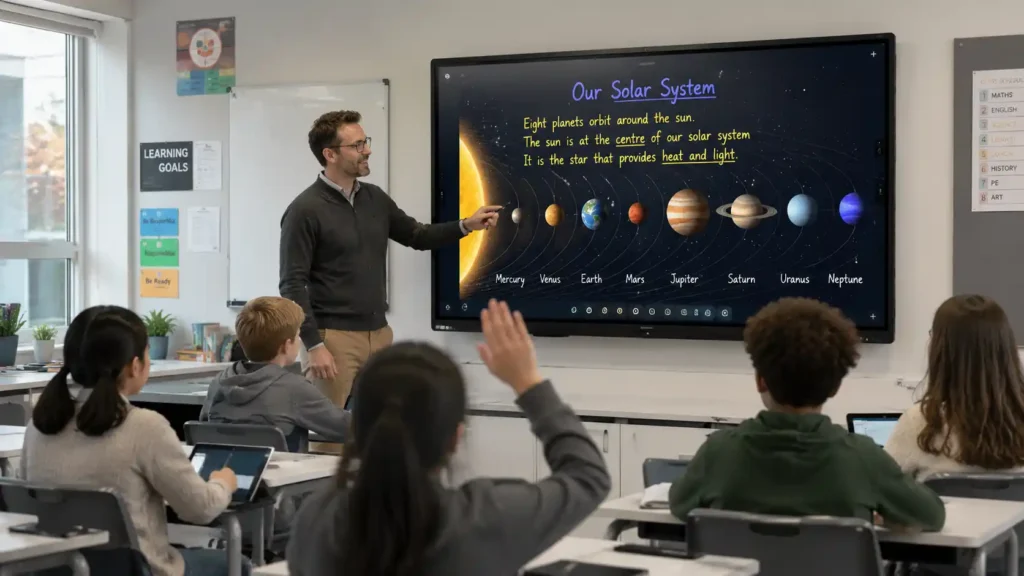
The operational reality of teacher familiarity and classroom engagement becomes much easier to understand when viewed in a real teaching environment rather than a specification comparison.
What Does SMART Board Offer That Promethean Doesn’t — and Vice Versa?
SMART Board has built its Australian education market position on a combination of hardware tier flexibility, a strong software platform, and an ecosystem that extends meaningfully beyond the classroom into corporate and enterprise environments.
The SMART Board range — spanning the GX (V3), MX (V5), and RX series — gives schools genuine flexibility to deploy at different capability and budget levels within the same platform ecosystem. A school can deploy GX units in standard classrooms, MX units in technology-forward learning spaces, and RX units in premium environments — all running the same SMART software platform with consistent teacher experience across the range.
SMART's software ecosystem — including SMART Notebook classroom software and broader collaboration tools — has also evolved significantly in recent years. HyPr Touch technology on the MX and RX series delivers improved touch precision. The RX series adds environmental sensors that monitor classroom air quality — a genuinely differentiated capability with real student wellbeing implications. And SMART's classroom engagement tools — two-way annotation, student device connectivity for 40+ devices, polling and voting — represent a strong and mature teaching toolkit.
What SMART Board Is Known For
- Hardware tier flexibility — GX, MX, and RX series spanning entry to premium classroom deployments
- HyPr Touch technology delivering improved touch precision on mid and upper series
- Strong classroom software ecosystem with two-way annotation and student device connectivity
- RX Series environmental sensors — classroom air quality, CO2, temperature, and humidity monitoring
- Ecosystem that extends into corporate and enterprise environments beyond education
- Competitive pricing in direct tender situations — particularly at volume
Elevated CO2 levels in enclosed classrooms are directly associated with reduced student concentration and cognitive performance — a relationship increasingly recognised in Australian school wellbeing initiatives and ventilation guidelines. For schools where student health outcomes and learning environment quality are explicit procurement priorities, the RX environmental sensors are more than a hardware feature: they are an operational argument for the RX series specifically.
The SMART Pricing Dynamic
In competitive tender situations where both Promethean and SMART Board are being evaluated simultaneously, SMART Board pricing can move meaningfully. This is one of the most important practical insights for schools evaluating both platforms — and it is the foundation of the Kickstart Computers approach to this comparison.
When a manufacturer knows it is competing directly against an established rival for a specific deployment, the commercial motivation to be competitive increases significantly. Schools and procurement teams who understand this dynamic and use it explicitly in their evaluation process are far more likely to achieve the best possible outcome — both in terms of price and in terms of genuine commitment from the supplier.
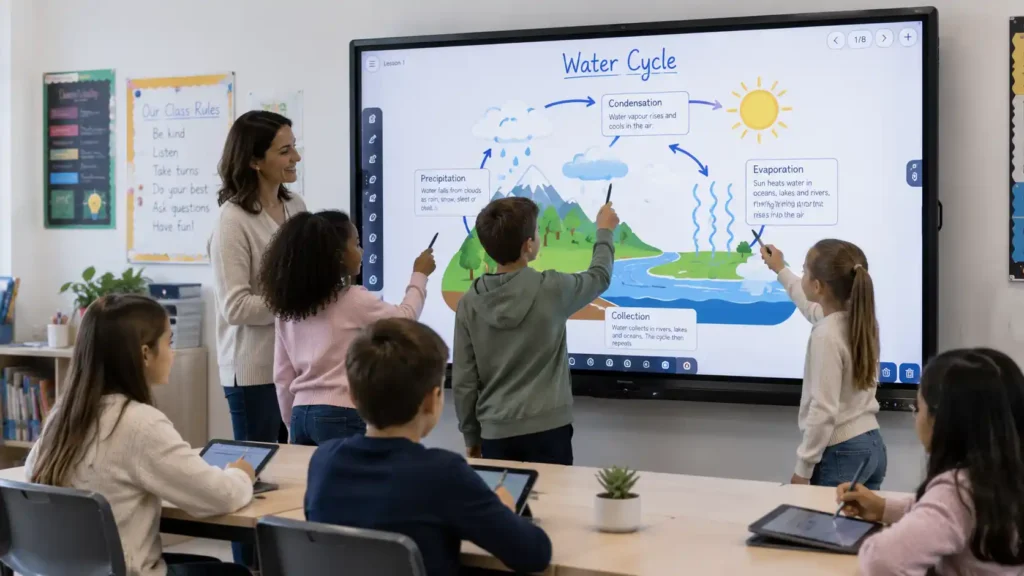
The practical difference between platform ecosystems is often most visible in how teachers and students interact with the display during collaborative classroom sessions.

How Kickstart Computers Navigates the Promethean vs SMART Board Evaluation
At Kickstart Computers, our philosophy is simple: when a school is evaluating both Promethean and SMART Board, we tell both parties they are competing against one another and let the market find its level. This creates the conditions under which both manufacturers are genuinely motivated to put forward their best commercial proposition — and in most cases, the pricing that emerges is meaningfully more competitive than standard reseller rates would suggest.
Our advice to any school in this evaluation: tell both suppliers explicitly that you are running a competitive process. The moment both parties know they are competing for the same deployment, the commercial dynamic changes — and the outcome for your school almost always improves.
What Kickstart Evaluates on Your Behalf
- Current hardware specifications and genuine capability differences at each price point
- Software ecosystem depth and classroom workflow compatibility for your specific teaching environment
- Warranty terms, local service capability, and long-term support commitments
- Teacher training requirements and transition costs for platform switches
- Volume pricing potential and tender-specific commercial flexibility
- Long-term roadmap and platform evolution trajectory for both ecosystems
Why Buying on Today’s Feature Difference Is Often the Wrong Strategy
One of the most misunderstood aspects of the Promethean vs SMART Board comparison — and of competitive education technology evaluations generally — is the significance of momentary technology differences between platforms.
At any given point in time, one manufacturer may have released a feature, capability, or hardware refinement that the other has not yet matched. This is a normal and expected aspect of competitive product development. The question that matters commercially is not whether a difference exists today — it is whether that difference represents a genuine and durable operational advantage, or simply a development timeline gap that will close within a matter of months.
In the Promethean vs SMART Board market, technology gaps between comparable products are typically measured in months rather than years. A feature that gives one platform a temporary advantage in a procurement evaluation today is often matched or surpassed by the competing platform within a development cycle. Procurement decisions made purely on the basis of a momentary feature difference — without considering software ecosystem fit, teacher familiarity, pricing, and long-term support — frequently lead to outcomes that disappoint in practice.
Build as an Elementor visual widget — do not publish this block as body text. Concept: a horizontal timeline showing how feature leadership alternates between Promethean and SMART Board over time. Two parallel tracks with alternating "leads here" / "catches up here" markers. No winner implied. Suggested label: "How Feature Leadership Shifts Between Platforms Over Time." Implementation: Elementor timeline or custom SVG, full content column width.
At Kickstart Computers we always ask: is this technology difference a genuine long-term operational advantage, or a development timeline gap that will close within months? That question often changes the conversation significantly.
Features Worth Evaluating Carefully Right Now
- SMART RX Series environmental sensors — classroom air quality and CO2 monitoring is a genuinely differentiated capability. Elevated CO2 levels in enclosed classrooms are directly associated with reduced student concentration and cognitive performance. For schools where student health outcomes are explicit procurement priorities, this is an operational argument for the RX series specifically.
- HyPr Touch on SMART MX and RX — improved touch precision over standard IR; evaluate whether this difference is perceptible in your specific classroom context
- Promethean software ecosystem depth — ActivInspire and classroom engagement tools have a maturity and depth that teachers with existing Promethean experience will feel immediately
- Student device connectivity — both platforms now support broad student device connectivity; evaluate the specific implementation against your school's device ecosystem
How Do Promethean and SMART Board Compare for Daily Classroom Annotation?
While software ecosystem and commercial dynamics are the primary decision drivers in most Promethean vs SMART Board evaluations, the day-to-day touch and annotation experience is worth addressing directly — because teachers interact with the display surface every single day.
Both Promethean and SMART Board use infrared touch technology across their education ranges. For standard classroom annotation, content delivery, and multi-user interaction, both platforms deliver entirely adequate touchscreen responsiveness for daily teaching workflows. Neither platform targets the premium bonded-glass writing experience of the Samsung Flip Pro — which is engineered specifically around annotation-heavy daily use. For most classroom environments, the annotation feel of both Promethean and SMART Board is comparable and operationally sufficient.
The most meaningful touch experience difference within the SMART range is between the standard infrared GX series and the HyPr Touch-equipped MX and RX series — where improved touch precision and smoother annotation responsiveness are genuinely noticeable in daily use. Schools for whom annotation quality is a primary teaching priority should evaluate the SMART MX or RX series specifically, rather than drawing a broad conclusion about SMART Board touch performance based on the entry-level GX.
Promethean vs SMART Board: Full Comparison for Australian School Procurement
| Consideration | Promethean | SMART Board |
|---|---|---|
| Market Position | Dominant education brand — strong institutional loyalty | Strong education brand — broader ecosystem reach |
| Teacher Familiarity | Very high — deeply embedded in Australian classroom workflows | Strong — well established across education sector |
| Hardware Range | Education-focused range across multiple sizes | GX, MX, RX series — tiered capability and budget flexibility |
| Touch Technology | Commercial infrared touch — multi-user capability | Standard IR (GX) / HyPr Touch Advanced IR (MX, RX) |
| Software Ecosystem | Education-first — ActivInspire, deep classroom engagement tools | Strong education platform — SMART Notebook, two-way annotation, student device connectivity |
| Student Device Connectivity | Yes — multi-device classroom interaction | Yes — 40+ devices (MX and RX series) |
| Environmental Sensors | Not currently integrated at display level | Yes — RX Series: CO2, VOC, PM2.5, temp, humidity |
| Ecosystem Beyond Education | Primarily education-focused | Extends into corporate and enterprise environments |
| Reseller Pricing Dynamics | Protected margins — pricing more constrained at smaller volumes | Competitive flexibility — particularly in direct tender situations |
| Australian Warranty Support | Yes — commercial warranty with local service | Yes — commercial warranty with local service |
| Technology Gap Reality | Strong platform — gaps with SMART typically close within months | Strong platform — gaps with Promethean typically close within months |
| Best Suited To | Schools with existing Promethean investment, strong teacher familiarity, education-first deployments | Schools wanting hardware tier flexibility, competitive pricing in tenders, broader ecosystem reach |
| Primary Long-Term Strength | Teacher familiarity, lesson resource continuity, and education-first software depth | Hardware tier scalability, environmental sensing capability, and ecosystem breadth beyond education |
How to Choose: Promethean vs SMART Board Decision Guide for Schools
The most useful question to ask in any Promethean vs SMART Board evaluation is not which platform is technically superior today. It is: what does our school genuinely need from this deployment over the next seven to ten years — and which platform best serves that requirement honestly?
Stay with Promethean if:
- Your teachers have significant existing investment in Promethean software, lesson resources, and platform familiarity
- The switching cost of platform transition — retraining, resource rebuilding, workflow disruption — is a genuine operational concern
- Your deployment volume is sufficient to access competitive Promethean pricing through a reseller
- Education-first software depth and ActivInspire ecosystem capability are your primary daily operational priorities
- Institutional continuity across your existing Promethean classrooms is important for teacher experience consistency
Consider SMART Board if:
- Your school is deploying interactive displays for the first time without existing platform loyalty
- Hardware tier flexibility across GX, MX, and RX configurations suits your mixed budget environment
- Classroom air quality monitoring and environmental sensors are genuine student wellbeing priorities
- You are running a competitive tender and want to leverage SMART's pricing flexibility in that context
- Your organisation needs an interactive display platform that extends into corporate or enterprise environments as well as classrooms
In either case — run a competitive evaluation:
- Engage both Promethean and SMART Board simultaneously and make the competition explicit
- Ask both parties for their best price on comparable configurations for your specific deployment
- Evaluate software ecosystem fit with your teachers directly — not just on specification sheets
- Consider the total cost of ownership including training, transition, and long-term support
- Contact Kickstart Computers to help structure and facilitate the evaluation process on your behalf

Get Honest Advice from an Australian Education Display Specialist
For most schools, the strongest procurement outcome comes from evaluating both platforms honestly against the real operational needs of teachers, students, and ICT teams — not just comparing specification sheets in isolation.
Kickstart Computers sources both Promethean and SMART Board interactive displays for Australian education, corporate, and government environments. We can help structure a genuine competitive evaluation, facilitate pricing from both manufacturers, assess the real technology differences at the time of your deployment, and recommend the platform that best serves your school's operational requirements — without bias toward either brand.
Our goal is the same in every evaluation: the best possible outcome for your organisation, at the best possible price, with the right platform for your environment. If that means Promethean, we will tell you. If that means SMART Board, we will tell you that too. And if the right answer is to run both suppliers against each other and see who wants the deal, we will help you do exactly that.
Planning a Classroom Display Rollout?
Comparing specific platforms is one part of the classroom display decision.
Platform choice, ecosystem selection, writing feel, multi-classroom rollout planning, total cost of ownership, and teacher onboarding all deserve equal attention before committing to a purchase. Our dedicated classroom interactive display page covers every aspect of the decision for Australian schools.
Interactive whiteboard for classroom — full platform decision overview →Frequently Asked Questions — Promethean vs SMART Board
Not necessarily — both are strong education-focused interactive whiteboard platforms with long histories in Australian classrooms. The better choice usually depends on teacher familiarity, existing lesson resources, software ecosystem preference, deployment scale, and whether the school values continuity or is open to platform transition.
It can be. The hidden cost of switching is rarely the hardware itself — it is the operational disruption caused by retraining, rebuilding lesson workflows, and adapting years of existing classroom resources. Schools planning a platform transition should budget realistically for teacher adoption time, software familiarisation, and classroom support during deployment.
Yes — and SMART Notebook can also run on Promethean hardware to a degree. However, schools often lose some of the native optimisation, workflow familiarity, and platform-specific interaction features that teachers rely on daily. While cross-platform software compatibility exists, most schools find the long-term experience works best when hardware and software ecosystems remain aligned.
In the education interactive display market, technology leadership shifts constantly. One platform may lead temporarily in hardware refinement, software capability, or classroom features, but those gaps are often measured in months rather than years. Schools usually achieve better long-term outcomes by prioritising operational fit, teacher familiarity, and ecosystem compatibility rather than chasing short-term specification advantages.
The GX Series is SMART Board’s value-focused classroom platform. It delivers the core interactive whiteboard experience very effectively but does not include some of the more advanced capabilities found in the MX and RX series, such as HyPr Touch precision improvements, environmental sensors, and higher-tier collaboration refinements. For many standard classrooms, the GX is entirely sufficient — while higher-use collaborative environments may benefit from the MX or RX ranges.
Not necessarily. Both platforms now include integrated Android-based systems capable of web browsing, whiteboarding, cloud file access, and classroom collaboration without a dedicated PC. However, some schools still deploy OPS modules or connected Windows devices where specific desktop applications, Windows workflows, or advanced classroom software compatibility are required.
The most common mistake is evaluating only current hardware specifications while ignoring teacher familiarity, software ecosystem fit, training requirements, switching costs, and long-term operational support. In practice, the strongest procurement decision is usually the platform that integrates most naturally into the school’s daily teaching environment — not simply the platform with the newest feature today.