retail-digital-signage
Retail Digital Signage Displays — Shop Online Australia
Commercial displays for retail environments — from single-screen promotional displays and digital menu boards through to multi-screen in-store signage networks and high-brightness window-facing installations. Samsung, LG and Sharp retail digital signage displays available with Australia-wide delivery.
Retail digital signage covers every commercial display deployed in a retail environment to communicate with customers — promotional screens at store entry, price and product displays at point of sale, digital menu boards above service counters, window-facing displays visible from the street, and in-store screens that update centrally across a network of locations. What connects them is the commercial environment they operate in: bright ambient lighting, extended trading hours, high foot traffic and the expectation that content can be changed quickly without touching the hardware.
The displays in this range are commercial-grade panels from Samsung, LG and Sharp — rated for the duty cycles that retail trading hours demand. Most retail environments require displays running 12 to 16 hours per day, seven days a week. Commercial panels carry duty cycle ratings that reflect this — typically 16/7 for standard retail and 24/7 for environments that operate around the clock, including convenience stores, transport retail and food service venues within larger retail precincts.
Promotional Displays
Single or multi-screen displays positioned at store entry, end-of-aisle or high-traffic zones. Content-driven installations where the ability to update promotions centrally — without printing or manually swapping panels — delivers the operational advantage.
Menu & Price Boards
High-brightness displays above service counters in food service, specialty retail and pharmacy environments. Rated for continuous operation and bright enough to remain readable under commercial kitchen or retail floor lighting without washing out.
Window & Shopfront
Ultra-high-brightness displays positioned in or near shopfront windows to attract passing foot traffic. Requires 2,500cd/m² or above to compete with direct natural light — a fundamentally different specification from standard retail floor displays.
Content management is as important as the display hardware in any retail digital signage installation. A commercial display with a built-in media player — such as the Samsung Tizen-powered QB, QM and QH series — can receive content updates over a network without requiring a separate media player at each screen. For single-screen or small installations, this simplifies deployment considerably. For retailers managing content across multiple stores or dozens of screens within a single location, a centralised content management system connected to networked commercial displays is the standard approach.
Screen orientation is a specification decision that retail buyers often confirm too late. Most commercial retail signage runs in landscape orientation — the natural format for promotional imagery, price lists and video content. Portrait orientation suits narrow display positions alongside queue lines, at checkout points or in window installations where the vertical format better matches the available space and the content being displayed. The Samsung commercial displays in this range support both landscape and portrait mounting natively — portrait rotation does not degrade performance or duty cycle rating.
For retailers with outdoor or window-adjacent installations, brightness specification is the critical dividing line. Standard high-brightness retail displays — rated at 700 to 1,000cd/m² — perform well on bright retail floors and in positions adjacent to windows. Displays positioned directly in a shopfront window, facing outward toward the street, require a dedicated window-facing display rated at 2,500cd/m² or above. The ambient light load through glass on a north-facing Australian shopfront overwhelms a standard high-brightness panel entirely by mid-morning on a clear day.
- Fashion & apparel stores
- Supermarkets & grocery
- Pharmacy & health retail
- Specialty food retail
- Electronics & tech stores
- Shopping centre common areas
- Car dealership showrooms
- Convenience & petrol retail
- Liquor & bottle shops
- Sports & outdoor retail
Retailers deploying digital signage for the first time frequently underestimate the value of selecting a display platform with a clear upgrade path. A commercial display ecosystem — such as the Samsung Tizen platform — allows content management software, network management tools and hardware to evolve without requiring a full hardware replacement each time operational requirements change. Choosing a commercial-grade platform from the outset is consistently more cost-effective over a three to five year deployment lifecycle than starting with a consumer or entry-level display and replacing it when it fails to meet commercial operating demands.
Retail digital signage is also widely used by real estate agencies, where property listings, auction campaigns and office branding content can be updated centrally across one or multiple branch locations — making it a natural fit for the window-facing and high-brightness display categories within this range.
Understanding Retail Digital SignageDigital menu boards are a core subset of retail digital signage — displays deployed above service counters in food service and food retail environments where pricing, promotions and product ranges change regularly. Browse the menu board range for displays rated for food service duty cycles.
Browse Digital Menu BoardsRetail floors and food service environments consistently demand higher brightness than standard commercial displays provide. Our high brightness display range covers panels rated at 700cd/m² and above — the right specification for bright retail environments where standard displays wash out.
Browse High Brightness DisplaysHotels, restaurants, bars and hospitality venues share many of the same display requirements as retail — high ambient light, extended operating hours and the need to update content centrally. Browse our hospitality digital signage range for displays suited to those environments.
Browse Hospitality Digital SignageSetting up digital signage for your retail store?
Call Andrew on 0416 353 501 or send us a message — we work with Australian retailers every day on display selection, brightness specification and content management setup, and can point you to the right solution without the runaround.
Showing 1–16 of 464 results
- Found it cheaper elsewhere? Talk to us first.

BenQ RE6504FV 65″, 16:9 IFP 4K 3840 x 2160, Essential Series with Google GMS w/built-in cam/NFC reader
Original price was: $5,299.00.$3,399.00Current price is: $3,399.00. - Found it cheaper elsewhere? Talk to us first.
BenQ RE7504FV 75″, 16:9 IFP 4K 3840 x 2160, Essential Series with Google GMS w/built-in cam/NFC reader
Original price was: $7,299.00.$4,999.00Current price is: $4,999.00. - Found it cheaper elsewhere? Talk to us first.
BenQ ST6502S Pro Smart Signage 65″ UHD/ 400nits/ 18/7 Operation/ Android 8/ X-Sign included/ DMS included/ OPS Slot/ Landscape/ 3 Yr On-Site
Original price was: $2,999.00.$1,878.50Current price is: $1,878.50. - Found it cheaper elsewhere? Talk to us first.
BenQ ST7502S Pro Smart Signage 75″ UHD/ 400nits/ 18/7 Operation/ Android 8/ X-Sign included/ DMS included/ OPS Slot/ Landscape/ 3 Yr On-Site
Original price was: $4,499.00.$2,774.60Current price is: $2,774.60. - Found it cheaper elsewhere? Talk to us first.
BenQ ST8602S Pro Smart Signage 86″ UHD/ 400nits/ 18/7 Operation/ Android 8/ X-Sign included/ DMS included/ OPS Slot/ Landscape/ 3 Yr On-Site
Original price was: $7,499.00.$3,837.20Current price is: $3,837.20. - Call for Price
- $5,645.00
- Found it cheaper elsewhere? Talk to us first.
Hisense 100DM66GE 100″ 4K Commercial Digital Signage Display | 24/7 Networked Signage
Original price was: $6,263.00.$5,968.00Current price is: $5,968.00. - $666.00
- Call for Price
- Found it cheaper elsewhere? Talk to us first.
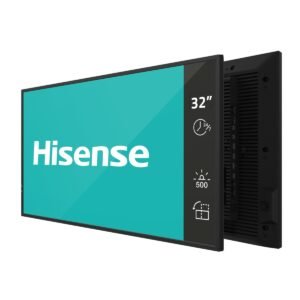
Hisense 32DM66D 32″ Commercial Digital Signage Display | Retail and Hospitality Venues
Original price was: $736.00.$640.00Current price is: $640.00. - Found it cheaper elsewhere? Talk to us first.
Hisense 32DM66GE 32″ FHD Commercial Digital Signage Display | 24/7 Networked Signage
Original price was: $951.00.$671.00Current price is: $671.00. - Out of stock
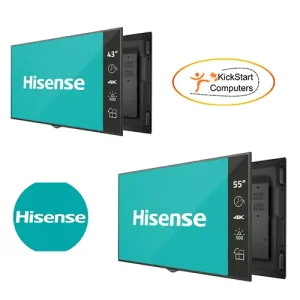
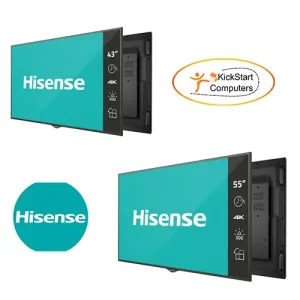
Hisense 43B4E31T 43″ UHD Digital Signage 500nit, 3 year warranty 18 x 7 – FREE Freight**
Call for Price - Call for Price
- Found it cheaper elsewhere? Talk to us first.
Hisense 43DM66D 43″ 4K Digital Signage Display | Retail and Hospitality Environments
Original price was: $1,057.00.$917.00Current price is: $917.00. - Found it cheaper elsewhere? Talk to us first.
Hisense 43DM66GE 43″ 4K Commercial Digital Signage Display | 24/7 Networked Signage
Original price was: $1,171.00.$881.00Current price is: $881.00.